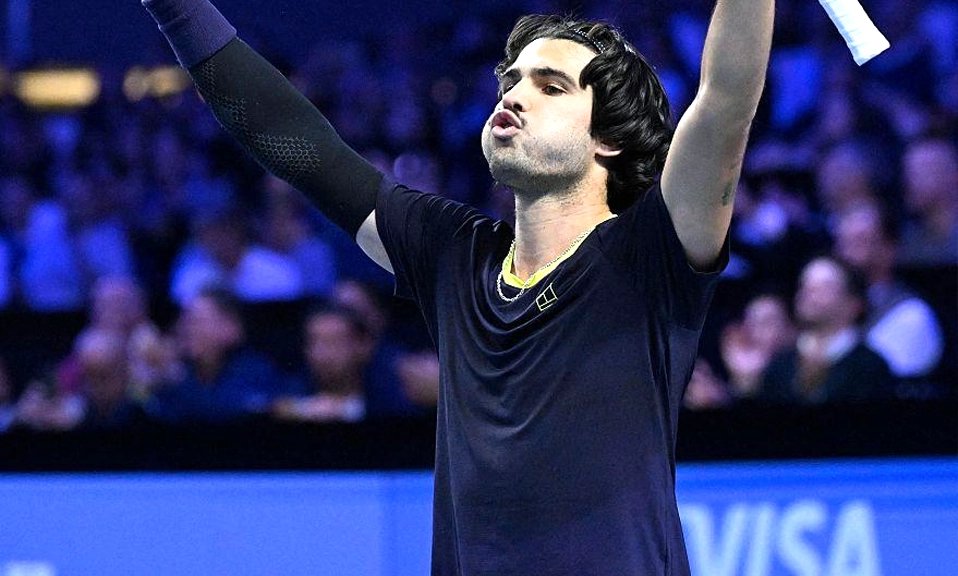
Carlos Alcaraz doesn’t just win tennis matches. He bends them to his will, turns them into theatre, and leaves audiences wondering if they’ve just witnessed something that belongs in a different category of sport entirely. In 2026, the 23-year-old Spaniard has crossed a threshold that few players ever reach: the point where excellence stops being surprising and starts being expected. The question is no longer whether Alcaraz is great. It is whether tennis has found the defining champion of its next era—and whether anyone can stop him.
The evidence is overwhelming. Alcaraz began 2026 by winning the Australian Open, defeating Novak Djokovic in the final to claim his seventh Grand Slam title and complete the career Grand Slam. In doing so, he became the youngest man in the Open Era to achieve the feat, at just 22 years and 272 days old. It was his 15th “Big Title”—a combination of Grand Slams, ATP Finals, Masters 1000s, and Olympic gold—and it extended his lead over Jannik Sinner in their personal arms race.
The Numbers That Defy Belief
Alcaraz’s Grand Slam record is not just good. It is historically exceptional. His win percentage at the majors stands at 95-14 (0.872) , the fourth-best in the Open Era behind only Bjorn Borg, Rafael Nadal, and Novak Djokovic. During his run at the 2026 US Open, he briefly moved ahead of both Nadal and Djokovic on that list before a quarter-final defeat to Ben Shelton. That defeat, it should be noted, came after a four-month absence with a wrist injury—and it was a five-set epic that he narrowly lost, not a collapse.
He closed the 2026 major season with an 11-1 record at Grand Slams, despite missing both Roland Garros and Wimbledon through injury. The fact that a season interrupted by surgery and rehabilitation still produced a career-defining milestone speaks to the level he operates at. Most players would call a year with one major and a quarter-final a success. For Alcaraz, it is a year that leaves room for what-ifs.
The Rivalry That Defines the Era
No conversation about Alcaraz’s greatness is complete without Jannik Sinner. The two have built the most compelling rivalry in men’s tennis since Federer and Nadal, and possibly the most statistically symmetrical one the sport has ever seen. They have played 17 times, with Alcaraz leading 10-7 in the head-to-head. Both have won 26 tour-level titles. Both have spent 66 weeks as world No. 1. And remarkably, both have won exactly 1,651 tour-level points against each other.
That symmetry is not a coincidence. It is the product of two players who have separated themselves so thoroughly from the rest of the field that their rivalry has become the sport’s centre of gravity. Together, they have claimed the past nine major trophies, dating back to the 2024 Australian Open. They are not just the best players of their generation. They are the generation.
But Alcaraz holds the edge where it matters most. His 10-7 lead includes a 3-1 advantage on clay, and he has won four of their seven meetings since the start of 2025. More significantly, he has won seven Grand Slams to Sinner’s four. In the currency that defines tennis greatness, Alcaraz is ahead—and he is a year younger.
The Experts Have Run Out of Superlatives
The tennis world has stopped trying to find new ways to describe Alcaraz. It has started simply pointing at him and saying: that.
Martina Navratilova, speaking after his US Open run, called him “an alien” and said: “It is really crazy that he got this good this fast with his game. Usually when people have that many options, it takes them a while to find out how to play the game because there are too many options. Not Carlos. He is just in another stratosphere”.
Rick Macci, the coach who developed Venus and Serena Williams, has gone further. “Alcaraz is a generational talent,” he said. “I predicted it when he was 17. If he stays injury-free, I believe he can become a historical phenomenon. The Spanish magician is heading for the very top. It is something this sport has never seen”. Macci has since called him “the most complete player who has ever picked up a racket” and said he “plays his own league”.
Jim Courier, a former world No. 1, has said Alcaraz “is like no one else—he has taken the best from each” of the great champions who came before him. Boris Becker has identified him as the leader of tennis’s new era. And the projections have already begun: multiple experts, including Macci and Tim Henman, believe Alcaraz could win 20 or more Grand Slam titles if his body holds up.
The Injury Question
The one caveat that follows Alcaraz everywhere is injury. His 2026 season was interrupted by a wrist problem that kept him out for more than four months, forcing him to miss Roland Garros and Wimbledon—the two tournaments where he is arguably most dangerous. He returned at the US Open and immediately looked as if he had never been away, reaching the quarter-finals and pushing Shelton to five sets.
Navratilova noted that “the arm is 100%” and that he is “playing as if he never left”. But the wrist injury was a reminder that Alcaraz’s all-action style—the explosive movement, the improvisational shot-making, the sheer physicality of his game—carries risk. Every expert who projects greatness for him attaches the same condition: if he stays fit. The talent is not in question. The durability is.
Has Tennis Found Its Next Era?
The answer is yes—but with a nuance that makes it more interesting than a simple coronation.
Alcaraz is not the sole occupant of tennis’s throne. Sinner is not a supporting actor. The two of them have built a rivalry that is genuinely competitive, statistically balanced, and stylistically contrasting. Alcaraz is chaos and creativity, instinct and improvisation. Sinner is precision and power, control and repetition. Their matches are not just contests; they are arguments about how tennis should be played.
That is what makes this era compelling. The Big Three era was defined by three champions who pushed each other to unprecedented heights. The Alcaraz-Sinner era is defined by two champions who have separated themselves so completely that their rivalry has become the sport’s defining narrative. And Alcaraz, with his seven majors and his career Grand Slam and his absurd highlight reel, is the one setting the pace.
He is not unstoppable in the literal sense. Shelton beat him at the US Open. Sinner has beaten him on the biggest stages. Injuries have interrupted his momentum. But he is unstoppable in the sense that matters: he cannot be ignored, he cannot be written off, and he cannot be contained by the normal expectations of his age. At 23, he has already done things that most players never do. The question is no longer what he will achieve. It is how far beyond the current record books he will go.
Carlos Alcaraz has not
just arrived at the top of men’s tennis. He has redefined what the top looks like. A career Grand Slam before his 23rd birthday. A winning record against his greatest rival. A Grand Slam win rate bettered by only three players in the history of the Open Era. And a growing chorus of experts—coaches, champions, analysts—who have stopped comparing him to the greats and started suggesting he might surpass them.
Tennis has found its next era of greatness. It has found it in a player who smiles while he dismantles opponents, who dances between points, who plays with the joy of someone who cannot quite believe this is his job. The era is not just about winning. It is about the way Alcaraz wins—with flair, with risk, with a sense of possibility that makes every match feel like it could become a classic.
Sinner will have something to say about how this era unfolds. So will the next generation of challengers. But for now, in 2026, the story of men’s tennis is the story of Carlos Alcaraz. And it is only just beginning.