Agility Robotics began trading on the Nasdaq on November 5, 2026, under the ticker AGLT. It is the first U.S. company whose entire business is humanoid robots to go public. The listing is being framed as a milestone for “physical AI”—the idea that artificial intelligence is moving out of software and into machines that walk, lift, and work in the physical world.
But the financial disclosures that accompanied the listing tell a different story. In 2025, Agility generated $1.8 million in revenue and lost $138.1 million. In the first six months of 2026, revenue was $174,000, and losses reached $362 million. The company’s $2.5 billion pre-money valuation is a bet on a future that has not yet arrived—and the public markets are now being asked to underwrite it.
The Milestone: First Pure-Play Humanoid on Wall Street
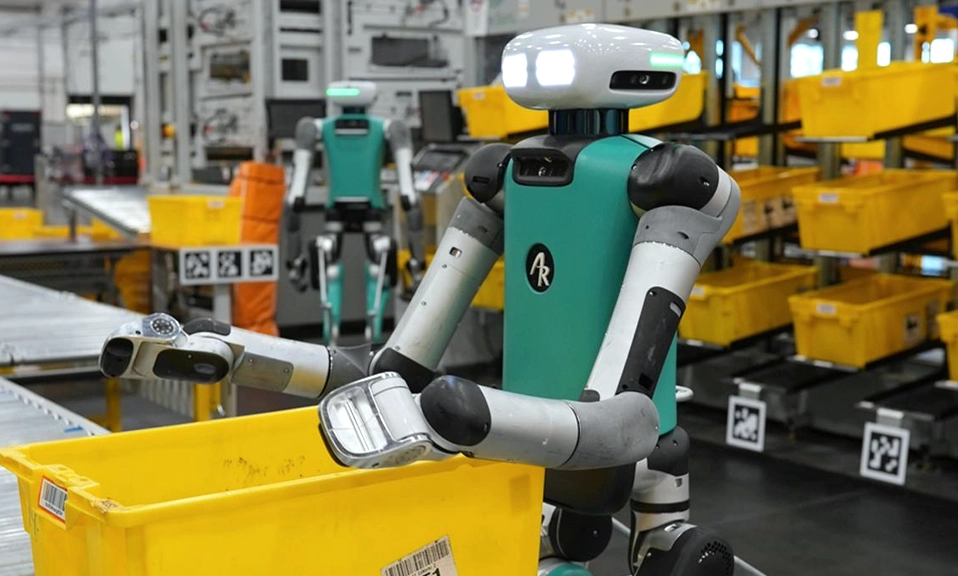
Agility Robotics is not a newcomer. It was spun out of Oregon State University in 2015 by researchers who solved one of robotics’ hardest problems: getting a machine to walk safely on two legs. Its flagship product, Digit, is a bipedal robot designed to move totes, load pallets, and perform repetitive material-handling tasks in warehouses and factories. It is not designed to dance, do backflips, or impress on social media. It is designed to work.
That pragmatism is Agility’s defining characteristic. “You don’t see a lot of dancing robots or backflipping robots from Agility,” CEO Peggy Johnson told TechCrunch. “We stuck to our strategy, which [are] these manual, very repetitive jobs, that it’s hard to find humans to do.”
Digit robots are already deployed at nine customer facilities, including Amazon, Toyota Motor Manufacturing Canada, GXO Logistics, and Schaeffler. At a GXO facility in Georgia, Digit robots have moved more than 100,000 totes. The company says its robots have accumulated over 65,000 hours of real-world operation—the longest tenure of any humanoid actively working in industrial settings.
The listing was completed through a merger with Churchill Capital Corp XI, a SPAC led by former Citigroup executive Michael Klein. The transaction valued Agility’s existing equity at approximately $2.5 billion** and raised about **$465 million in gross capital before expenses. That total includes $201 million** from a PIPE led by **Foxconn**, **$164 million from the SPAC trust, and $100 million Agility had already raised after announcing the deal. Investors include Nvidia, Amazon, SoftBank Vision Fund 2, and DCVC.
The Reality: A $1.8 Million Business Valued at $2.5 Billion
The gap between Agility’s valuation and its financial performance is the central tension of the listing.
In 2025, more than half of Agility’s $1.8 million in revenue came from five robots purchased by one of its investors**—Amazon bought five Digit robots for **$1.05 million, according to the company’s SEC filings. The company used $99.8 million in cash** to run the business that year, and it lost **$2.7 million on its sales even before research and other expenses. “We expect to incur additional losses and higher operating expenses for the foreseeable future,” Agility said in its filings.
The first half of 2026 was worse. Revenue was $174,000**, and losses reached **$362 million. Agility’s public listing gives it capital to keep going, but the clock is ticking. The company’s pitch is that a Digit robot can save a customer $100,000 a year under a robot-as-a-service model, and more if the customer buys outright. Whether those unit economics work depends entirely on whether Digit 5 delivers on its promises.
The Bet: Digit 5 and the $300 Million Order That Isn’t Quite What It Seems
Agility is betting its future on Digit 5, unveiled in September 2026. The new model is a genuine step change.
It is the first “cooperatively safe” humanoid—designed to work in close proximity to people without physical safety barriers. It combines proprietary human-detection software, multiple sensors, and an independent safety controller that can trigger the robot to avoid a person, stop, or sit down. It can repeatedly lift 50 pounds, reach 7.2 feet off the ground, and run for 90 minutes on a battery that recharges in nine minutes. Agility says that enables more than 20 productive hours in a 24-hour period. The grippers are swappable, allowing one robot to do the work of several specialized machines.
Agility says it has more than $300 million in committed multi-year orders for Digit 5. But the filings reveal a more complicated picture. Those orders are linked to a three-year agreement for 1,000 robots with a single customer, and the SEC prospectus identifies that customer as a related party. The commitments are conditional on Agility meeting milestones for throughput, uptime, and placement accuracy. They are not guaranteed revenue. The company has not named the customer publicly, and it has not yet shown off prototypes of Digit 5; those are expected at CES 2027, with general availability at the end of 2027.
The concentration risk is significant. One customer, with related-party ties, accounts for the entire $300 million order book. If that customer walks away or the milestones are missed, the commercial case for Digit 5 collapses.
The Capability Gap: What Digit Still Can’t Do
Digit can lift heavy loads and place them with 98% accuracy. It cannot, like most humanoid robots today, perform complex manipulation tasks. It cannot pick up a wide variety of irregular objects, handle delicate items, or adapt to unstructured environments with the dexterity of a human hand.
The industry is betting that generative AI will eventually solve this problem—that training systems based on video and teleoperation data will unlock reliable general autonomy. That has not happened yet. Agility’s advantage, Johnson argues, is its 65,000 hours of real operational data from real customers in real facilities, which it is using to train Digit. “There’s no internet of physical data of robot movements,” she said. “We have 65,000 hours of real operational data from real customers in real facilities… that helps us accelerate the training of Digit.”
That data advantage is real. But it does not yet translate into a robot that can do everything a warehouse worker can do. Agility’s strategy is to start with the simplest, most repetitive tasks—moving bins and totes—and expand from there. Co-founder Jonathan Hurst described the roadmap: “Let’s start with the bins and the totes, and then let’s do the picking and the kitting. And then let’s like start working on cardboard, which is really hard, and loading and unloading tractor trailers… Okay, now we’re at 100 million robots, you know? A trillion-dollar company.”
That is the vision. The question is how long it takes to get there—and whether Agility can survive the journey.
The Valuation Puzzle: Why Is a Robot Company With Almost No Revenue Worth $2.5 Billion?
The answer lies in a striking divide in how investors value humanoid robotics companies.
Agility’s $2.5 billion** valuation is well below those of some privately held rivals. **Figure AI** is valued at about **$39 billion. Apptronik is at roughly $5.5 billion**. **Neura Robotics** is at around **$7 billion. Tesla’s Optimus project has no standalone valuation, but Tesla itself is one of the most valuable companies in the world.
“This is a trend we’re seeing,” said George Chowdhury, a principal analyst at ABI Research, “where companies with deployments who are actually shipping hardware today are valued by the market a lot lower than companies that are betting on this future.”
The logic is uncomfortable. Agility is the company that has actually deployed robots in customer facilities. It has the longest track record, the most real-world data, and the clearest path to commercial viability. Yet it is valued at a fraction of companies that have shipped far less. Public markets, it seems, are more skeptical than private venture capital—or more realistic.
The listing will provide a reference point. If Agility trades well, it could validate the sector and open the door for other humanoid companies to go public. If it struggles, it could cast a shadow over the entire category—and make it harder for the privately held leaders to justify their valuations.
The Geopolitical Context: America’s Humanoid Ambitions
Agility’s listing is also a geopolitical statement.
The humanoid market is currently dominated by Chinese companies. Unitree went public on the Shanghai Stock Exchange in August 2026 and has a market value of around $40 billion. Chinese robotics firms accounted for about 90% of humanoid robot shipments last year, according to Omdia.
The U.S. is trying to catch up. In July 2026, the Federal Communications Commission banned new foreign-made “advanced robotic devices,” including humanoids, quadrupeds, and some robot vacuums. Agility manufactures Digit at its Oregon factory, giving it a domestic manufacturing advantage that few competitors can match.
“It’s good for the US to show strength in this area,” Johnson said.
Agility is not just a company. It is a test case for whether American hardware manufacturing can compete in a category that China currently dominates. The public listing gives it capital to scale. Whether it can use that capital to close the gap is another question.
A Milestone, Not a Coronation
Agility Robotics made history on November 5, 2026. It became the first pure-play humanoid robotics company to trade on a U.S. exchange, raising $465 million and giving public investors their first direct exposure to a sector that has been hyped for years.
But the listing is not a coronation. It is a reality check. Agility generated $1.8 million in revenue last year and lost $138 million. Its $300 million order book comes from a single related-party customer and is contingent on milestones it has not yet met. Its flagship robot cannot do complex manipulation. Its valuation is a fraction of its private rivals, and its path to profitability is measured in years, not quarters.
“There’s something to be said for being first,” Johnson said. “We will be able to set many of the metrics, if you will, on what customers need in a humanoid.”
She is right. Being first matters. But being first is not the same as being profitable. The public markets will now judge Agility on the same terms as every other company: revenue, margins, and growth. The humanoid robot era has arrived on Wall Street. Whether it thrives there is a question the next few quarters will answer.