On December 5, 1945, five U.S. Navy bombers took off from Fort Lauderdale on a routine training mission. They never returned. The legend of the Bermuda Triangle was born that day—not from the sea itself, but from a magazine article published nearly two decades later. And that, more than any rogue wave or methane bubble, is the key to understanding why we are still fascinated by it.
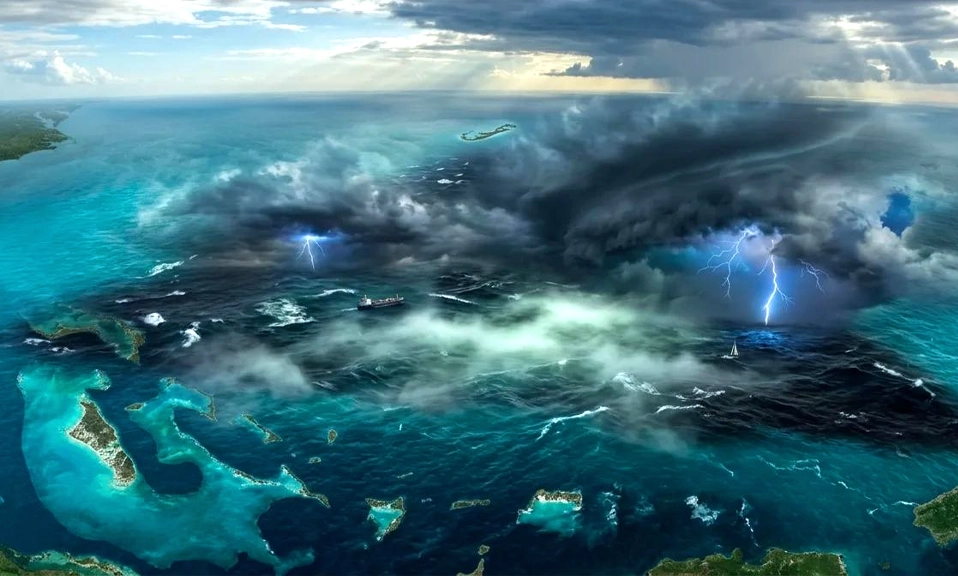
The Bermuda Triangle is an imaginary region roughly bounded by Miami, Bermuda, and Puerto Rico. It is not an official geographic designation. No nautical map marks its borders. The U.S. Coast Guard does not identify it as a hazardous area. And yet, for more than half a century, it has functioned as a kind of blank space on the mental map of the ocean—a place where the normal rules of cause and effect are suspended, and where the unexplained is not just possible but expected.
Here is what actually happened, what the science says, and why the myth refuses to die.
The Incidents That Built the Legend
The Bermuda Triangle did not become a cultural phenomenon because of a single disappearance. It became one because a series of incidents were stitched together into a narrative.
Flight 19 (1945) is the foundational story. Five TBM Avenger torpedo bombers carrying 14 men took off on a navigational training mission led by Lieutenant Charles Taylor. Taylor got lost. Transcripts suggest his compasses were malfunctioning and he wasn’t wearing a watch. The planes flew in one direction, then another, as daylight turned to stormy darkness. A search plane sent to find them also disappeared. No wreckage from Flight 19 has ever been found.
The USS Cyclops (1918) is the other pillar. The naval collier disappeared without a trace while returning from Brazil with 309 people on board. Two of her sister ships vanished along the same route in 1941. No wreckage was ever located.
The Star Tiger and the Witchcraft—a Avro Tudor passenger plane and a cabin cruiser, respectively—are also frequently cited. The Witchcraft vanished in 1967 after its owner radioed the Coast Guard to say his boat was stuck on a shoal. When the Coast Guard arrived minutes later, the boat was gone. The owner, his guest, and the vessel were never found.
These are the stories that built the legend. But as journalist Larry Kusche demonstrated in his 1975 book, many of the incidents were inaccurate, exaggerated, or unverified. Some disappearances were not disappearances at all. Others occurred far outside the triangle’s boundaries. The narrative had been curated for maximum mystery, not maximum accuracy.
What Science Actually Says
The scientific consensus is clear: there is no mystery.
The Bermuda Triangle is one of the most heavily trafficked stretches of ocean in the world. It sits at the crossroads of major shipping lanes and commercial air routes. It is also a region prone to hurricanes and sudden, violent storms. When you combine high traffic volume with unpredictable weather, human error, and the simple fact that the ocean is very, very large, disappearances are statistically inevitable.
“The region is highly traveled and has been a busy crossroads since the early days of European exploration,” said John Reilly of the U.S. Naval Historical Foundation. “To say quite a few ships and airplanes have gone down there is like saying there are an awful lot of car accidents on the New Jersey Turnpike—surprise, surprise”.
The U.S. Coast Guard’s official position is equally blunt: “It has been our experience that the combined forces of nature and the unpredictability of mankind outdo science-fiction stories many times each year”.
Several specific hypotheses have been proposed to explain the disappearances. Methane hydrate eruptions—the idea that bubbles of methane gas from the seafloor could reduce water density and sink ships—is one of the most popular. But the U.S. Geological Survey has recorded no significant methane releases in the region in the past 15,000 years. Rogue waves up to 30 meters high have been simulated in laboratories, and converging storms could theoretically generate them, but there is no evidence they actually occur in the Bermuda Triangle. Compass anomalies are sometimes cited, but while magnetic north and true north aligned in the region in the early 20th century—which could have caused navigational errors—no actual magnetic anomalies have been identified.
A 2026 OSINT analysis examined the absence of physical wreckage across major events like Flight 19 and the Cyclops and concluded that conventional explanations—ocean currents, weather, human error—remain the most parsimonious, even as it noted that classified military infrastructure in the region, including AUTEC and SOSUS, has documented capability to monitor activity at depths exceeding 8,000 meters.
The scientific conclusion is not ambiguous. As BBC Science Focus put it: the Bermuda Triangle “hasn’t experienced a statistically unusual number of crashes and wrecks”.
Why the Myth Refuses to Die
So if the science is settled, why are we still talking about it?
The answer is not about the ocean. It is about us.
The myth was manufactured. The term “Bermuda Triangle” was coined by Vincent Gaddis in a 1964 Argosy magazine article about Flight 19. The article “stimulated a virtual cottage industry in myth-making”. Subsequent writers—most notably Charles Berlitz, whose 1974 bestseller sold millions of copies—built on Gaddis’s foundation, adding new incidents, ignoring contradictory evidence, and creating a narrative that was far more compelling than the mundane truth.
The human brain is pattern-seeking. We are wired to find meaning in coincidence, to connect dots that may not be connected. A cluster of disappearances in a heavily trafficked area becomes a mystery. A malfunctioning compass becomes a supernatural anomaly. A missing plane becomes a portal to another dimension. The Bermuda Triangle is a case study in apophenia—the tendency to perceive meaningful patterns in random data.
The mystery is more satisfying than the explanation. “Human error, bad weather, and bad luck” is a deeply unsatisfying answer to the question of why 300 people vanished without a trace. It offers no closure, no villain, no cosmic significance. The supernatural explanations—alien abduction, sea monsters, a space-time warp, the lost city of Atlantis—offer something that the scientific explanation does not: a story. And stories are what we remember.
The myth has been reinforced by popular culture. The Bermuda Triangle has appeared in countless books, documentaries, films, and television shows. It has become a trope—a shorthand for the inexplicable, the uncanny, the place where things go wrong in ways that defy understanding. It has replaced the Sargasso Sea as the default locus of maritime weirdness in the popular imagination.
And perhaps most importantly: the legend is self-sustaining. Once the myth was established, reporters were “quick to attribute more wrecks to the Bermuda Triangle’s mysterious forces”. Every new disappearance, no matter how mundane, became evidence for the mystery. The mystery became a lens through which the region was viewed, and that lens has never been fully removed.
The 2026 Context: Why It Still Matters
The Bermuda Triangle remains culturally relevant because it taps into something deeper than geography. It is a story about the limits of human knowledge—about the fear that there are places in the world where our maps, our instruments, and our science cannot help us.
In an age of satellite tracking and GPS, the idea of a place where planes vanish without a trace feels almost nostalgic. It is a reminder of a time when the ocean was still vast and unknowable, when a compass could fail and a ship could disappear and no one could tell you why. The Bermuda Triangle is a myth for a disenchanted world—a small, contained pocket of mystery in a planet that has been mapped, measured, and illuminated.
And the myth persists because it serves a purpose. It gives us a place to put our fear of the unknown. It gives us a story to tell about the sea. It gives us a reason to look at a map of the Atlantic and feel, just for a moment, that the world is still bigger than we think.
The Bermuda Triangle
is not a mystery. It is a legend—carefully constructed, commercially sustained, and culturally resilient. The disappearances it is famous for can be explained by weather, human error, and the ordinary dangers of a heavily trafficked ocean. The U.S. Coast Guard does not consider it hazardous. The scientific literature does not support the supernatural theories. The wreckage, when it exists, tells a mundane story.
But that is not why we keep talking about it. We keep talking about it because the legend is more interesting than the truth. We keep talking about it because the ocean is still scary, and we need stories to contain that fear. We keep talking about it because, in a world where everything has been explained, a little mystery is a precious thing.
The Bermuda Triangle is not a place on a map. It is a place in the imagination. And that is why it will never disappear.
What do you think—is the Bermuda Triangle a genuine mystery, or a manufactured myth that we keep alive because we want it to be true?