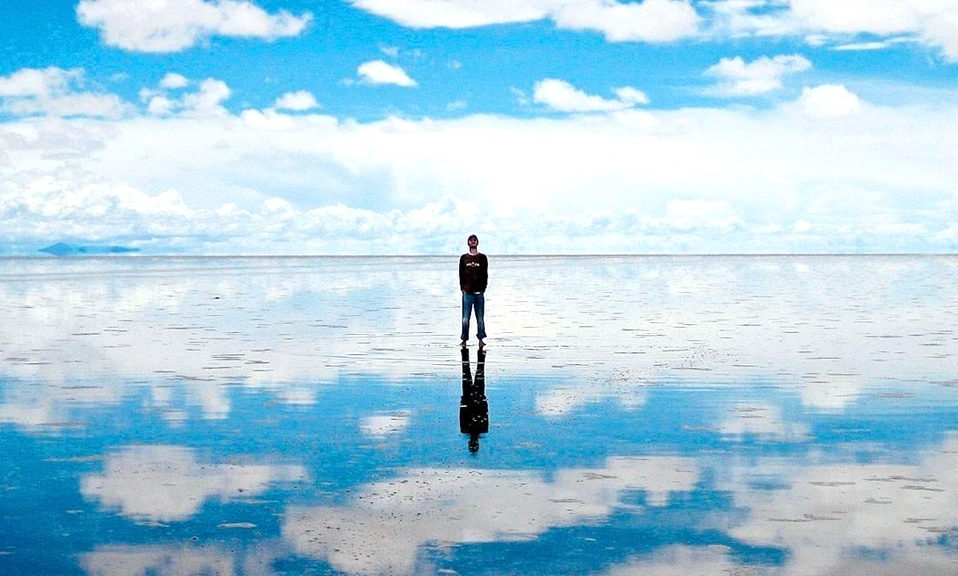
The world’s largest mirror has returned. Every year, between December and March, a thin layer of rainwater transforms Bolivia’s Salar de Uyuni—the planet’s largest salt flat—into a flawless, sky-reflecting expanse that seems to erase the horizon entirely. For a few precious months, the boundary between earth and heaven dissolves, and walking across it feels less like a journey and more like a lucid dream.
This is not a permanent phenomenon. For most of the year, the Salar is a stark, white, cracked desert of hexagonal salt tiles, stretching over 10,582 square kilometres across the high-altitude Altiplano. But when the rains come, the flat becomes a mirror so perfect that the sky, the clouds, and the distant volcanoes are reflected with near-symmetrical precision. It is a spectacle that draws travellers from around the world, and it is happening right now.
The Mirror Effect: What It Is and Why It Happens
The Salar de Uyuni is the remnant of a series of ancient lakes—Lake Minchin, Lake Tauca—that dried up thousands of years ago, leaving behind the world’s largest salt crust. The flat is exceptionally level, with variations in elevation of less than a metre across its entire expanse. When it rains, the water has nowhere to drain, and it spreads evenly across the surface, creating a shallow, perfectly still lake.
The result is the “Sky Mirror” effect: the water reflects the sky so completely that the horizon disappears. People appear to float in the clouds. Sunsets are doubled, with the sky above and below burning in the same colours. At night, the Milky Way is reflected in the water, and the salt flat becomes a portal to the cosmos.
It is, as one traveller put it, “one of the few places on Earth where you can literally walk through the clouds”.
When to Go: The Rainy Season Is the Key
The mirror effect is most reliable from January to March, when rainfall is at its highest and the layer of water on the salt flat is at its most consistent. December and March are shoulder months—you may catch the mirror, or you may not, depending on the year’s rainfall.
The trade-off is that the rainy season brings challenges. The water can make some areas inaccessible, and Incahuasi Island—the famous “oasis” in the middle of the salt flat, home to giant cacti—is often closed to visitors from January to March. Heavy rains can also flood deeper sections of the flat, limiting where tours can go.
The dry season (April to November) offers a completely different experience. The salt flat is solid and drivable, the hexagonal salt patterns are vividly visible, and the skies are clear—ideal for stargazing and for the classic perspective-bending photos that the Salar is famous for. But there is no mirror.
For the mirror, you must accept the rain. And as one travel hack noted, the rainy season also brings cheaper flights—February can be 40–50% cheaper than the peak dry-season months, and you get the reflection as a bonus.
The Practicalities: What to Know Before You Go
Altitude. The Salar sits at 3,650 metres above sea level. Altitude sickness is a real risk, and it is recommended to acclimatise in La Paz or another high-altitude city for one to two days before travelling to Uyuni.
Temperature. The Altiplano is cold and dry, not tropical. Daytime temperatures in the rainy season can be mild, but nights drop below freezing, and the day-night temperature difference can reach 30°C. Warm clothing, layers, and a good jacket are essential, even in summer.
Gear. The salt is highly corrosive, so bring a camera cleaning kit. Waterproof shoe covers or rain boots are essential in the wet season—many tours include rain boots in the price. Sunscreen (SPF50+) and sunglasses are non-negotiable; the glare from the salt and water is intense.
Tours. You cannot explore the Salar independently; you must join a local tour from the town of Uyuni. Full-day tours (including sunset) cost around $35 USD**, while **starlight and sunrise tours** are around **$25 USD. Multi-day tours that include the surrounding lagoons, geysers, and deserts start at around $100–150 per person for three days.
The crowds. The rainy season is quieter than the dry season, but the mirror effect is no longer a secret. Book accommodation and tours in advance, especially if you are travelling in January or February.
Beyond the Mirror: What Else to See
The Salar de Uyuni is the centrepiece, but the surrounding region is filled with otherworldly landscapes.
The Train Cemetery just outside Uyuni town is an open-air museum of abandoned steam locomotives from the late 19th century—a haunting, photogenic graveyard of rusting metal. Incahuasi Island, when accessible, is a surreal oasis of giant cacti rising from the white salt. Further afield, the Laguna Colorada (Red Lagoon) is a pink-hued lake inhabited by flamingos, and the Sol de Mañana geysers are an active geothermal field at 5,000 metres.
And for those who want to stay in the Salar itself, the Palacio de Sal is the world’s first hotel built entirely of salt bricks—even the furniture is made of salt.
The Salar de Uyuni is not
just a destination. It is a reminder that the world is still capable of producing moments of pure, unmediated wonder. The mirror effect is fleeting—a few months of rain, a thin layer of water, and a landscape so flat and so vast that it becomes a canvas for the sky. It is a phenomenon that cannot be manufactured, and it cannot be guaranteed. But when it happens, it is one of the most extraordinary sights on Earth.
The mirror is back. And for the next few months, the largest salt flat in the world will be the largest mirror in the world. If you have ever wanted to walk through the clouds, now is the time.
Have you visited Salar de Uyuni during the mirror season—or is it on your bucket list?