Yes—but “red blood cells” is doing a lot of work in that sentence. Scientists have found the chemical fingerprints of heme, the iron-rich molecule that makes blood red, inside structures that look like red blood cells in a 115-million-year-old dinosaur bone. Whether those structures are actually fossilized blood cells, or mineral look-alikes shaped by the chaotic chemistry of decay, is a question that has divided the field for two decades. The new study is the strongest case yet. It is not a closed case.
Here is what was found, what it means, and why the debate is far from over.
The Discovery: A 115-Million-Year-Old Bone From Brazil
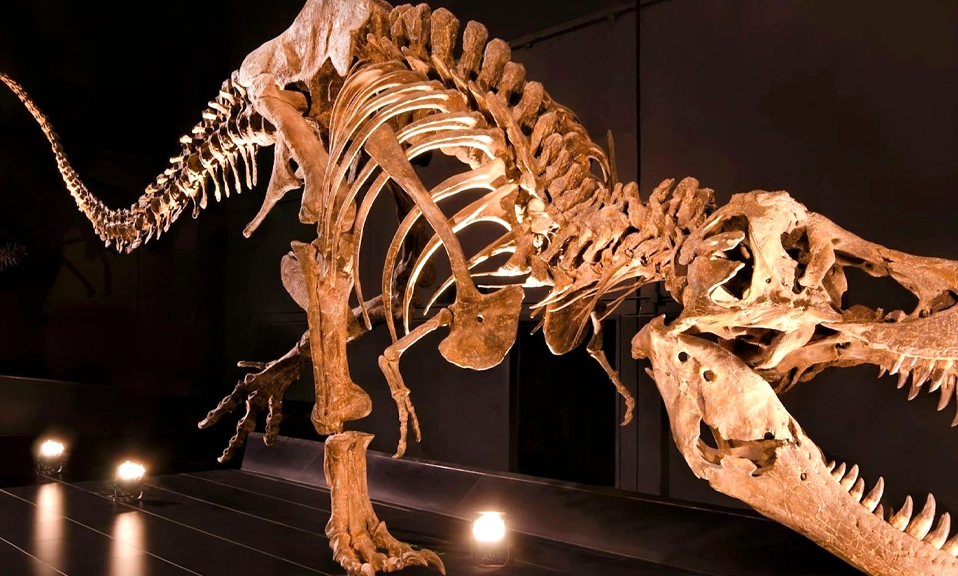
The fossil belongs to Aratasaurus museunacionali, a small, bipedal, meat-eating dinosaur that lived in the Early Cretaceous. It was about 10 feet long and weighed around 75 pounds, and it was only about four years old when it died—not yet fully grown. The specimen was discovered in a mine in northeastern Brazil in 2008 and eventually made its way to Brazil’s National Museum in Rio de Janeiro. In 2024, it was sent to a team led by Kliti Grice, a geochemist at Curtin University in Australia, for analysis.
The study, published on November 2, 2026, in the Proceedings of the National Academy of Sciences, reports the discovery of oval-shaped microstructures inside the bone’s vascular canals—the channels that carried blood vessels through the bone while the animal was alive. The structures were roughly 23 micrometers long and 20 micrometers wide, with sunken centers—a shape consistent with red blood cells.
But shape alone proves nothing. Minerals can form spheres that look exactly like cells. The team needed chemistry.
The Evidence: Four Independent Lines of Analysis
What makes this study stand out is not any single finding. It is the convergence of multiple, independent analytical techniques that all point to the same conclusion.
First, the structures were in the right place. They were located inside the vascular canals—the exact anatomical location where red blood cells would have been circulating when the dinosaur was alive.
Second, elemental mapping showed the structures were rich in iron, carbon, and nitrogen—the elemental building blocks of heme, the iron-bearing, ring-shaped molecule in hemoglobin that carries oxygen and gives blood its color.
Third, laser-based molecular analysis detected porphyrins—ringlike organic compounds that are the precursors of heme. The team then ruled out contamination from other porphyrins, such as chlorophyll from plants, by separating and identifying the molecular contents of a bone extract. That analysis also pointed to heme. They identified heme B, the form found in hemoglobin, and 3,8-diethyl heme B, a chemically altered form that hints at its ancient origins.
Fourth, they found a mineral called hausmannite—a manganese oxide—inside the structures. The team proposes that hausmannite acted as a “time capsule”, rapidly mineralizing the blood cells and protecting the heme molecules within from decay. When they ran the same analyses on the sediment surrounding the fossil, they found mostly plant and bacterial signatures, with only trace amounts of heme—evidence that the bone samples were not contaminated.
“Evidence from microscopy, mineralogy, spectroscopy and molecular geochemistry all point toward the same conclusion,” Grice wrote in The Conversation. “We are convinced these are fossilized red blood cell structures containing traces of heme molecules.”
If the interpretation is correct, these are the oldest red blood cell structures ever identified and the first to be chemically proven in a dinosaur fossil.
The Skeptics: “Extraordinary Claims Require Extraordinary Evidence”
Not everyone is convinced. The most prominent voice of caution is Mary Schweitzer, the paleontologist at North Carolina State University who made the landmark 2005 discovery of soft tissue in a T. rex bone—a finding that sparked its own fierce debate.
Schweitzer has two main concerns.
First, the heme biomarkers do not appear to be localized to the round structures alone. In a fossilized blood cell, the heme signal should be concentrated inside the cell-like shape. But in this study, the chemical analysis came from the entire bone, not from the isolated structures. “The heme biomarkers, for example, don’t appear to be localized to the round structures alone, as would be expected in fossilized blood cells, but come from analysis of the entire bone,” Schweitzer told Science News.
Second, the structures differ in size and shape from the red blood cells of living birds and crocodiles, dinosaurs’ closest living relatives. Non-mammalian red blood cells typically retain nuclei and have a distinctive bulge. The concave shapes found in the fossil do not fit that profile. “I am not convinced” that the team has definitively identified heme compounds, Schweitzer said. “I do applaud them for bringing a plethora of methods to the study. Extraordinary claims require extraordinary evidence, and that does require state-of-the-art technology.”
Other experts have echoed the caution. Maria McNamara, a paleobiologist at University College Cork, called the paper “probably the most comprehensive effort that’s been done so far” but said she would still be “very cautious about interpreting those necessarily as red blood cells.”
The history of the field counsels skepticism. At least 14 previous studies have tried to describe red blood cells in ancient fossils, and all have remained controversial. In a 1997 study, tiny spheres found inside a fossil were initially thought to be blood cells but were later determined to be pyrite—an iron mineral deposited after death. A 2026 PeerJ paper re-examined putative blood cells in a Beipiaosaurus fossil and concluded they were diagenetic structures—clay minerals that replicated the shape of cells during fossilization—not blood cells at all. The lesson is consistent: minerals can mimic biology with unsettling precision.
Why the Debate Matters
The question of whether dinosaur blood can fossilize is not just a curiosity. If red blood cells and their molecular contents can survive for over 100 million years, they offer a window into dinosaur physiology that bones alone cannot provide—metabolism, activity levels, even the chemistry of extinct soft tissues. Grice argues that the techniques used in this study could be applied to other fossils, and that museum collections worldwide may hold hidden molecular information that has never been investigated.
But the opposite is also true. If these structures are mineral artifacts, then the search for ancient blood is a search for something that does not exist—and the resources spent chasing it could be directed elsewhere.
The study’s authors are careful to note that their findings do not imply DNA survival and are “a long way from Jurassic Park.” Heme is a relatively stable molecule. DNA is not. Even if the heme is real, it tells us about blood chemistry, not about the genetic code of the dinosaur.
Strong Evidence, Not Proof
Did scientists really find red blood cells inside dinosaur fossils? They found something that looks very much like them, in the right place, with the right chemical signature, and they ruled out the most obvious sources of contamination. The evidence is stronger than any previous claim. It is not yet conclusive.
The debate will be settled the way scientific debates are always settled: by replication, by independent analysis, and by the slow accumulation of evidence that either confirms or overturns the original interpretation. Schweitzer—who has been on both sides of this argument—put it best: “Extraordinary claims require extraordinary evidence.” Grice and her team have made an extraordinary claim. Whether their evidence is extraordinary enough is a question the field has not yet answered.
The dinosaur’s blood, if it is there, has waited 115 million years. It can wait a little longer for the verdict.