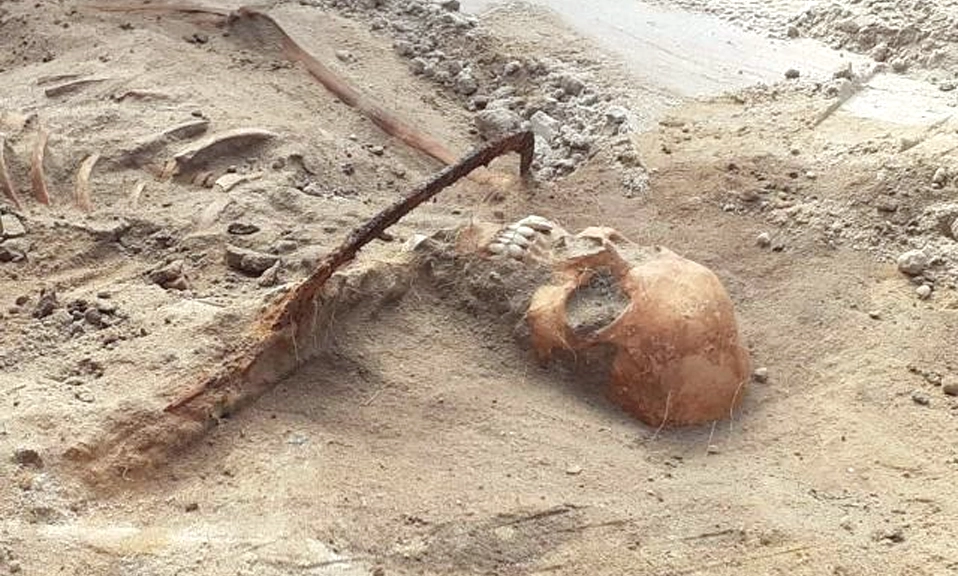
In the mid-17th century, a teenage girl was buried in an unmarked cemetery in Pień, Poland. She was laid to rest with a triangular padlock fastened to the big toe of her left foot. That should have been enough. But shortly after her burial, someone reopened the grave and placed an iron sickle across her throat, its blade positioned to decapitate her if she tried to rise.
She was not a criminal. She was not a stranger, at least not entirely. She was a young woman, between 17 and 19 years old, who suffered from a painful tumor in her chest that may have caused a visible deformity. And her community was so afraid of her that they took two separate precautions to keep her in the ground.
The burial, discovered in 2022 and analysed in a study published in the Journal of Archaeological Science: Reports, has become one of the most famous “vampire graves” in the world. But the story of Zosia—as researchers nicknamed her—is not really about vampires. It is about something far more human: the terror of the dead returning, and the extraordinary lengths people will go to in order to stop them.
The Grave That Launched a Thousand Headlines
Zosia’s grave was found in a 17th-century cemetery in Pień, in Poland’s Kuyavian-Pomeranian Voivodeship, by archaeologists from Nicolaus Copernicus University in Toruń, led by Professor Dariusz Poliński. The cemetery holds 101 burials, at least a dozen of which are “atypical”—what archaeologists call “deviant burials”.
Zosia’s was the most striking. The padlock was placed during the original burial. The sickle was added later—the bones remained in their anatomical positions, indicating the grave was reopened before the body had fully decomposed. Two precautions, two methods of keeping her in the grave. As Poliński told CNN, “the fear of the body coming back to life was greater” because of it.
Researchers also found traces of copper, manganese, and gold on her palate, suggesting that some other object—perhaps a coin or a small metal item—was placed in her mouth after death as a further safeguard.
She was buried in a coffin, wearing a silk cap trimmed with real silver and gold threads. This was not a peasant. She likely came from a wealthy or noble family. And yet, for reasons that remain unclear, her community decided that she was dangerous.
What the Objects Meant
The padlock and the sickle were not random. They were part of a complex symbolic language designed to bind the dead to their graves.
The padlock carried multiple meanings. In funerary symbolism, it signified the end of earthly life and the passage to the world of the dead. It could also symbolically prevent contact between the living and the dead, end a streak of bad luck, or protect the community from the deceased’s return. In some interpretations, it was believed to help stop the spread of epidemics.
The sickle was more direct. If the deceased attempted to rise, the blade would cut her throat or decapitate her, preventing her from returning to the world of the living. Iron and sharp tools were considered particularly effective against demons, witchcraft, and evil spirits in folk tradition. The handle, made from birch, alder, or maple, added another layer of protection—birch, in particular, was believed to have protective properties against demons and witchcraft.
The combination of a padlock and a sickle, found together in the same grave, is previously unseen in the archaeological literature. It indicates that Zosia was considered especially dangerous—that the fear she inspired was greater than the fear inspired by others buried in the same field.
Why Was She Feared?
The question of why Zosia was singled out has no definitive answer, but the research points to several intersecting factors.
She was in pain. Analysis of her bones and teeth revealed a haemangioma, a tumor in her sternum that would have caused constant pain and a visible deformity on her chest. That deformity may have marked her as “different”—a physical sign that her neighbours interpreted as evidence of supernatural affliction.
She may have been an outsider. DNA analysis showed a distant connection to Scandinavia, though isotopic evidence suggests she grew up in the local area. She may have come from outside the immediate community, making her an easier target for suspicion when misfortune struck.
The timing was catastrophic. Zosia died in the 17th century, a period when the Polish-Lithuanian Commonwealth was ravaged by war, famine, and epidemic disease. The community was living through the Little Ice Age, a period of colder temperatures and poor harvests. When people faced inexplicable misfortune—a failed harvest, a sudden illness sweeping through the village—they looked for someone to blame. Zosia, with her visible deformity, her foreign ancestry, and her family’s wealth, was an easy target.
Researchers believe she was blamed for a local famine or disease outbreak, and that her grave was reopened after her death so that the sickle could be added—a second precaution, taken because the first padlock apparently wasn’t enough.
Not an Isolated Case: The Pień Cemetery
Zosia’s grave is the most famous, but the cemetery at Pień contains dozens of others. This was not a single act of panic. It was a pattern.
A woman aged 30 to 50, buried with a stone placed on her left hand and smaller stones lining her body. She had tertiary syphilis, an advanced stage of the disease that would have caused visible disfigurement and social exclusion.
An older woman, about 60, buried with fieldstones pressed around her skull. She had an aneurysm that may have caused seizures or behavioural changes, which villagers might have found alarming.
A boy nicknamed “Vladimir,” buried with stones on his collarbones and near his heart.
A pregnant woman, about 20 to 30, buried with a fetus of 24 to 25 weeks.
A man buried with a two-year-old child laid across his legs, stones placed among the bodies.
The cemetery itself was located away from the village, on a slope by a crossroads, far from a church or chapel—a burial place for individuals rejected by society, “irrespective of their social status, who were likely feared even after death”.
The Broader Phenomenon: A Thousand Years of Fear
Zosia’s burial is part of a tradition that spans more than a millennium and much of Europe. Archaeologists call these apotropaic burial rites—practices designed to ward off evil or prevent the dead from returning. Informally, they are known as “vampire burials”.
The practices vary by region and period, but they share a common logic: the dead must be contained.
In Lugnano, Italy, a 5th-century cemetery known as the “Cemetery of the Babies” contains the remains of children who all died within a short period, victims of a malaria outbreak. One burial—a 10-year-old—was found with a fist-sized rock lodged between their jaws, placed deliberately. The soul was thought to exit the body through the mouth; stopping up the means of egress was believed to prevent it from re-entering.
In Venice, a 16th-century “vampire” was found with a brick forced into her mouth—a similar practice, from a different era and a different plague.
Across Poland and Eastern Europe, bodies were buried face down so that if they tried to rise, they would dig deeper into the earth. Stones were placed on bodies to weigh them down. Skulls were removed or repositioned. Stakes were driven through torsos.
The formal concept of the vampire—the blood-sucking revenant—did not emerge until the 18th century. But the fear it codified was already ancient. Eastern Europeans were afraid of the undead as early as the 11th century, believing that “some people who died would claw their way out of the grave as blood-sucking monsters that terrorized the living”. By the 17th century, unusual burial practices had become common across Poland in response to a reported outbreak of vampires.
Why Did They Fear the Dead?
The fear was not irrational in the context of the world these communities inhabited. It was a response to conditions that were genuinely terrifying.
They did not understand decomposition. The body does strange things after death. Rigor mortis sets in, then fades. Gases build up. Skin discolours. Fluids leak. To a community without forensic science, these changes could look like signs of life—or signs of unlife. A body that shifted in its grave, or that appeared to have grown hair and nails (an optical illusion caused by skin retracting), could be interpreted as a corpse that was not truly dead.
They did not understand disease. Before germ theory, the spread of illness was a mystery. Tuberculosis, in particular, was a slow, wasting disease that killed people over months or years. A family member would die, and then another, and then another. The living had no way to explain why. One popular explanation was that the deceased TB victims were rising from the dead to suck the life out of their loved ones. The first person to die in an outbreak was presumed more likely to return as a vampire—and was treated accordingly.
They were living through catastrophe. The 17th century in Poland was a period of war, famine, epidemic disease, and the Little Ice Age. Communities were under constant stress. When people are frightened and grieving and unable to explain why their world is falling apart, they look for someone to blame. The dead—especially the dead who were different, who were outsiders, who were marked by illness or deformity—were convenient targets.
They believed the dead could return. This was not a metaphor. It was a genuine belief, embedded in folklore and reinforced by the church’s teachings about the resurrection of the body and the possibility of supernatural intervention. The dead were not gone. They were somewhere else, and they could come back.
What Zosia’s Story Tells Us
Zosia was not a vampire. She was a teenage girl, probably from a wealthy family, who lived with chronic pain from a tumor that marked her body in ways her community found unsettling. When famine or disease struck, she became the scapegoat. When she died, her neighbours couldn’t let her go. They locked her toe. They reopened her grave and placed a blade at her throat. They did everything they could to keep her in the ground.
It is a story about fear, superstition, and the human need to find someone to blame when the world becomes uncontrollable. It is also a story about how easily difference—a deformity, a foreign ancestor, a family that didn’t quite fit in—can be transformed into danger in the minds of a frightened community.
The “vampire” of Pień was not a monster. She was a girl. And the real horror of her story is not that she might have risen from the grave. It’s that she never had a chance to rest in it.