Something is haunting the cosmos—and for once, the word “ghost” is not a metaphor. Across the sky, astronomers have identified a bizarre menagerie of phenomena that appear as ethereal phantoms: starless clouds of dark matter, galaxies almost entirely devoid of stars, and glowing nebulae that shine in colors no one can fully explain. Each discovery is a genuine scientific puzzle, and together they suggest that some of the universe’s most important secrets are hiding in plain sight—in objects that barely exist at all.
The latest ghostly apparition was revealed by NASA on October 21, 2026, and it sets the tone for the year’s strange harvest.
The New Ghosts of Cassiopeia
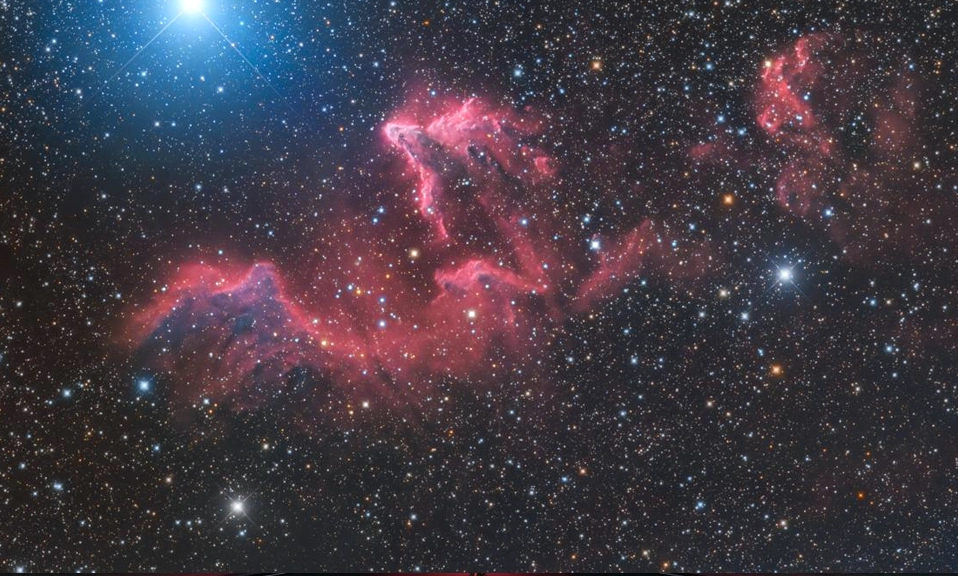
In the constellation Cassiopeia, astronomers have found three faint nebulae—dubbed Object 1, Object 2, and Object 3—that appear as “blue phantoms” in a new image that required 100 hours of observation and a special oxygen filter to capture. They glow with the signature of ionized oxygen, but the source of that ionization remains unknown. The leading hypothesis is that the massive star system γ Cassiopeiae is plowing through interstellar gas and dust, creating a bow shock—like the wake of a speeding boat—that compresses and heats the oxygen into visibility. Object 1 could even be a planetary nebula, if a central white dwarf can be identified.
But no explanation is confirmed. As NASA’s own caption puts it: “The origins of these astronomical apparitions remain a mystery to be solved” .
Cloud-9: The Galaxy That Never Was
In January 2026, astronomers announced the discovery of Cloud-9, an object 14 million light-years from Earth that defies easy categorization. It is a cloud of gas rich in dark matter, but it contains no stars at all. Its core is a compact sphere of neutral hydrogen about 4,900 light-years across—over a thousand times the distance from Earth to Proxima Centauri—yet it has never crossed the threshold of star formation.
Astronomers call it a “failed galaxy” : a relic from the early universe that had the raw material for stars but not enough mass to ignite them. The hydrogen alone is about a million times the mass of the Sun, but to keep the cloud from dispersing, it must contain roughly five billion solar masses of dark matter. Cloud-9 is the first confirmed example of a theoretical object called a Reionization-Limited HI Cloud (RELHIC) , and it offers a rare window into the universe’s “dark ages,” before the first stars lit up.
The Ghostly Galaxies That Lost Their Dark Matter
In October 2026, Quanta Magazine reported on a triplet of galaxies—DF2, DF4, and DF9—located about 65 million light-years away that have left astronomers “stunned.” These diffuse, pallid objects are “ghostly” not because they are faint, but because they appear to contain almost no dark matter—a shocking anomaly, since dark matter is thought to be the invisible scaffolding of nearly every galaxy.
The leading explanation is a cosmic collision. Two normal galaxies smashed together, and while their ordinary matter—gas and dust—clumped up to form new stars, the dark matter “passed right through” like a specter through a wall, leaving behind three dark-matter-deficient galaxies. The discovery is profound: it suggests that dark matter is a physical substance, not merely a misunderstanding of gravity. As one researcher put it, “The absence of dark matter is, in a way, some evidence of dark matter” .
CDG-2: The Galaxy Made Almost Entirely of Darkness
In February 2026, NASA scientists identified Candidate Dark Galaxy-2 (CDG-2) , an object about 300 million light-years away in the Perseus Cluster that appears to be composed of at least 99.9% dark matter. It is so faint that it barely qualifies as visible—an “almost-dark” galaxy with virtually no hydrogen gas and only a smattering of stars. Researchers found it indirectly, by tracking the gravitational stability of ancient globular clusters whose motions hinted at a vast unseen mass. CDG-2 may have lost its star-forming gas early on, stolen away by interactions with larger galaxies, leaving behind a nearly invisible relic that is one of the cleanest laboratories yet for studying dark matter.
GLIMPSE-17775: The “Ghost Star” From the Early Universe
Not all ghosts are cold and dark. In July 2026, astronomers using the James Webb Space Telescope identified a “ghost star” from 12 billion years ago—an object called GLIMPSE-17775 that is not a star at all, but a supermassive black hole enveloped in a dense, partially ionized gas shell. This is a theoretical object known as a “black hole star,” and it is one of the mysterious “little red dots” that have puzzled astronomers since JWST began observing the early universe. GLIMPSE-17775 existed just 1.8 billion years after the Big Bang, and its light has traveled for over 12 billion years to reach us. It is a ghost in the most literal sense: a relic of a time when the universe was young, appearing to us now as a tiny, crimson phantom.
The Dancing Ghosts: A Radio Mystery
And then there are the “Dancing Ghosts” —strange clouds of electrons around galaxies about one billion light-years away that, in radio images, look like two specters locked in a dance. Discovered by the ASKAP radio telescope in Australia, these ghosts are the result of supermassive black holes at the centers of two “host” galaxies, blasting jets of electrons that are bent into grotesque shapes by an intergalactic wind. But the wind’s origin, why it is so tangled, and what is causing the radio emission are all still unknown. As the lead researcher admitted: “When we first saw the ‘dancing ghosts,’ we had no idea what they were” .
Why the Ghosts Matter
These objects are not merely curiosities. They are probes of the universe’s invisible architecture.
Cloud-9 and CDG-2 are laboratories for dark matter, the substance that makes up most of the mass of the cosmos but has never been directly detected. The dark-matter-deficient galaxies DF2, DF4, and DF9 are a natural experiment that tests whether dark matter is real or whether gravity itself behaves differently on cosmic scales. The Cassiopeia ghosts and the Dancing Ghosts are puzzles of energetics and structure—how stars, black holes, and winds shape the interstellar and intergalactic medium. And GLIMPSE-17775 is a window into the early universe, a time when the first black holes and galaxies were forming.
Each ghost is a question without a definitive answer. And that is precisely why they matter. In astronomy, the objects that don’t fit are often the ones that teach us the most. The universe, it seems, is haunted—not by spirits, but by the limits of our understanding. And the hunt to explain these strange, silent apparitions is just beginning.