Every year, billions of creatures on Earth undertake life-or-death journeys in search of sustenance. These are not ordinary movements. They are the greatest migrations on the planet, where the line between life and death is sometimes separated by only a wingspan or a single step.
From the plains of the Serengeti to the frozen Arctic tundra, from the depths of the Pacific to the heights of the Himalayas, animals are on the move. They are driven by instinct, by the changing seasons, and by the simple, urgent need to survive. This is the story of the great animal migration—how it works, why it matters, and why it is more fragile than ever.
The Greatest Show on Earth: The Serengeti Migration
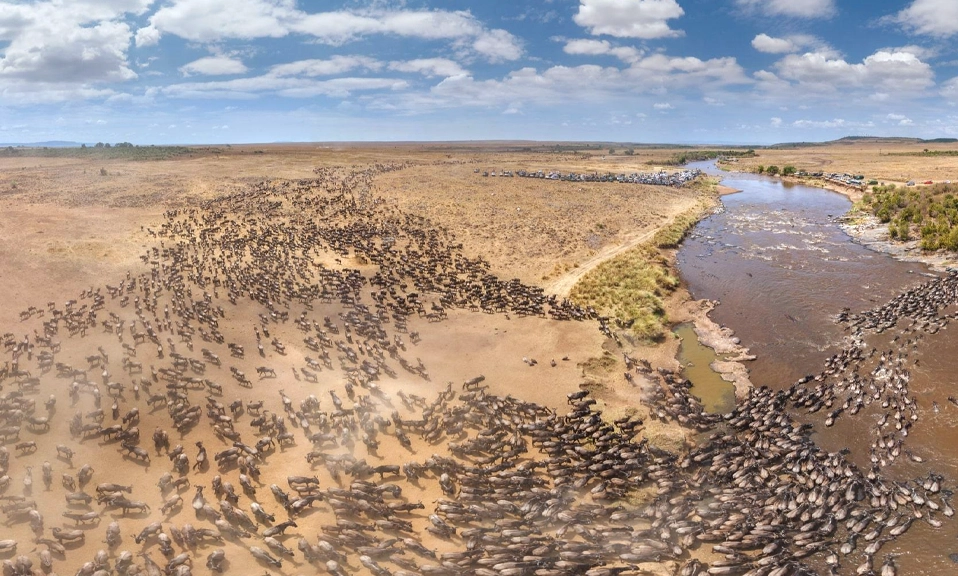
There is no migration on land that compares to the one that unfolds every year across the Serengeti and the Maasai Mara. It is the largest migration of mammals on the planet, a vast, circular journey undertaken by more than 1.5 million wildebeest, alongside hundreds of thousands of zebras and gazelles.
The herds move in a continuous loop, following the rains in search of greener pastures. The journey is not for the faint of heart. The animals must cross rivers teeming with crocodiles, navigate territories patrolled by lions and hyenas, and survive the relentless pressures of drought and starvation.
The wildebeest travel in “swarm intelligence,” coordinating their movements so that the entire group acts as a single, unified entity. The herds can stretch up to 40 kilometres long, a dark carpet of moving bodies that reshapes the landscape as it passes through.
The Longest Journeys on Earth
Beyond the Serengeti, the animal kingdom is full of record-breaking travellers.
The Arctic Tern holds the title for the longest known annual migration circuit. These small seabirds travel from their breeding grounds in the Arctic to the Antarctic and back again—a round trip of approximately 50,000 kilometres every year.
The Bar-Tailed Godwit makes the longest known non-stop flight of any bird. These remarkable migrants breed in Alaska and winter in New Zealand, crossing the Pacific Ocean in a single, non-stop marathon flight that lasts more than 200 hours and covers up to 12,000 kilometres.
In the oceans, the Gray Whale holds the record for the longest migration of any mammal. One individual was recorded completing a round trip of nearly 22,500 kilometres, from the waters off Russia to Mexico and back. The Humpback Whale undertakes a journey of up to 8,500 kilometres each way, migrating from warm tropical waters where they give birth to cold, food-rich polar seas.
And on land, the Caribou of North America’s Arctic undertake the world’s longest land migration. Herds of 100,000 caribou travel 5,000 kilometres through frozen wilderness, facing bears, wolves, and deadly rivers as they make their way to their calving grounds.
The Science of Navigation: How Do They Know Where to Go?
Perhaps the most extraordinary thing about migration is not the distance, but the navigation. A monarch butterfly, weighing less than a paperclip, can find its way to a specific mountain range in Mexico that it has never seen before. A sea turtle can cross an ocean and return to the beach where it was born.
The science is still catching up to the mystery, but 2026 has brought new insights.
The Geomagnetic Compass. For decades, scientists have known that many animals can sense the Earth’s magnetic field. A 2026 study using high-resolution GPS tracking of the Eurasian Curlew provided the first empirical evidence that birds rely on geomagnetic cues more strongly at night, using the intensity of the magnetic field to guide their way.
A Quantum Sense? One of the leading theories for how birds sense magnetic fields is that they exploit quantum entanglement in light-sensitive molecules in their eyes. A 2026 paper in PNAS explored a “hybrid compass mechanism” combining these radical pair mechanisms with magnetite crystals, suggesting that nature may have evolved a sophisticated, multi-layered navigation system.
Multi-Cue Navigation. Animals do not rely on a single sense. Research on greater white-fronted geese, published in May 2026, used inverse reinforcement learning to show that the birds integrate geomagnetic variation, atmospheric conditions, and visual landmarks—preferring flat coastal corridors and favourable winds—to make their migratory decisions.
Simple Rules, Complex Journeys. Even the monarch butterfly’s epic journey may not require a complex “map.” A 2026 study in Royal Society Open Science suggested that monarchs may reach their overwintering sites using simple behavioral rules—a general southward movement combined with following landscape features that act as “funnels”—rather than true navigation.
The Threats: A Fragile Phenomenon
The great migrations are among the most spectacular sights in nature. They are also among the most vulnerable.
The 2026 interim update to the State of the World’s Migratory Species report painted a stark picture. 49 per cent of migratory species populations are now in decline, up from 44 per cent just two years ago. And 24 per cent of migratory species face extinction globally.
The threats are numerous and overlapping.
Habitat Loss and Fragmentation. Migratory species depend on a network of habitats across their entire route. If any stopover site is lost—whether to agriculture, development, or deforestation—the entire journey can fail.
Climate Change. Warming temperatures are disrupting the timing of migrations. In the Arctic, spring is arriving earlier, creating a mismatch between when caribou calves are born and when the plants they need are available. A 2026 study in Nature Climate Change projected that with warming exceeding 4°C, 77.9% of global land area will experience a decline in the functional connectivity that migratory species rely on.
Infrastructure Barriers. Dams disrupt the migration routes of freshwater fish, while highways and fences fragment the paths of land mammals. Freshwater migratory fish populations have suffered an average decline of 81 per cent between 1970 and 2020, largely due to these barriers.
Overexploitation. Unsustainable hunting and fishing remain primary threats. For marine species like sharks and rays, populations have declined by roughly half since 1970.
A Test of Our Commitment
The great migration is not just a natural spectacle. It is a test. It tests the endurance of the animals that undertake these impossible journeys. It tests the ingenuity of the scientists who study them. And it tests our commitment to protecting the connected landscapes and seascapes that make these journeys possible.
Conservation efforts can work. The 2026 update noted that seven CMS-listed species, including the saiga antelope and the Mediterranean monk seal, have moved to a lower extinction risk category thanks to coordinated action. But the overall trend remains grim, and the window to act is closing.
The animals will keep moving. The wildebeest will cross the Mara River. The Arctic tern will fly from pole to pole. The monarch will find its way to Mexico. They will do what they have done for millennia, driven by instinct and the need to survive.
The question is whether we will give them somewhere to go.