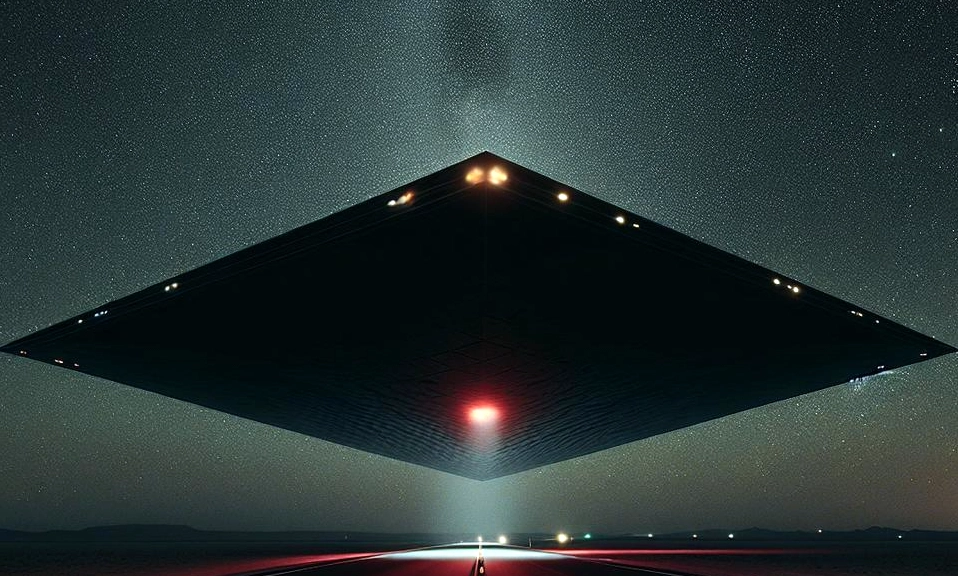
On October 23, 2026, the Pentagon released its seventh batch of declassified UFO files, and buried among the memos was a report that has reignited one of the most enduring mysteries in modern aviation: a silent, matte-black triangle that moved like nothing in the known inventory of any nation on Earth. The files describe a close encounter by federal agents at a sensitive U.S. site earlier this year—an object that climbed vertically without a sound, hovered, and then vanished at fighter-jet speed. But as striking as the account is, the documents also reveal how little we actually know—and how much of what we think we know is based on sketches rather than sensors.
Here is what the files say, what they don’t say, and why this sighting matters.
What the Files Actually Describe
The encounter occurred in June 2026 near an unspecified “national security site” in the western United States. Three federal agents—two with “extensive operational experience” working alongside government agencies and familiarity with drones—observed the object against the twilight sky after sunset. One agent had a handheld infrared monocular. The reports were filed with the FBI and the Pentagon’s All-domain Anomaly Resolution Office (AARO) .
The craft was unlike any conventional aircraft in several specific ways:
Shape and size: A “matte black triangle” with a “low aspect ratio,” resembling a delta-wing drone. Estimated wingspan was 9 to 15 feet, depth 6 to 9 feet, and thickness 1 to 2 feet .
Surface: “Continuous (seamless), featureless” — no rivets, panels, windows, cockpit, propulsion apertures, or aerodynamic control surfaces .
Flight profile: It rose vertically 200–300 feet above a ridgeline in about 10 seconds with “a completely static orientation without tilting, swaying, or wobbling.” It then hovered for roughly 20 seconds before accelerating horizontally at a speed “compared to that of a military fighter jet” and disappearing into a canyon .
Sound and exhaust: The entire sequence occurred in “absolute acoustic silence.” There were no exhaust plumes, no vapor trails, no smoke, and no ground disturbance. A survey the next morning found no wreckage or scarring .
Heat signature: Through infrared, the object appeared uniformly hotter than ambient temperature across the entire airframe, with no discrete heat sources that would indicate an engine. This is the opposite of a conventional aircraft or drone, which would show concentrated heat at its propulsion system .
Speed: Observers calculated that the craft covered 1.5 miles in three seconds—roughly 1,800 mph .
What Officials Ruled Out (and What They Didn’t)
The files state that government officials ruled out the possibility that the object was American technology . They also expressed skepticism that it was a foreign asset, “given that there are no known countries with those advanced technical capabilities” .
That does not mean the files conclude it was extraterrestrial. The documents are labeled “unresolved” because investigators lacked enough information to make a definitive identification—not because the phenomena have been linked to non-human intelligence . The release itself includes no final conclusion.
The Credibility Problem: Sketches, Not Sensors
The most significant limitation of the report is the evidence itself. Unlike some previous UAP releases that included photographs or video, the black-triangle report features nine identical images of the same canyon with tiny trilateral silhouettes crudely superimposed to illustrate the object’s movement .
Greg Eghigian, a professor of history and bioethics at Penn State and author of a history of the UFO phenomenon, was blunt in his assessment: “This does indeed look like little more than a black triangle shape superimposed on a landscape background to illustrate the report. I don’t think it really adds anything substantive to the report itself” .
The eyewitness accounts are detailed and consistent, and the agents’ professional backgrounds lend them weight. But eyewitness testimony, even from trained observers, is not instrument data. There are no radar tracks, no high-resolution photographs, and no recovered material. The report is a starting point for investigation, not a conclusion.
The Context: A Rolling Disclosure, and a Changing Tone
The black-triangle report is part of a broader effort by the Trump administration to declassify UAP records. Since May 2026, the Pentagon has released seven batches of documents under the Presidential Unsealing and Reporting System for UAP Encounters (PURSUE) , an initiative launched after President Trump signed an executive order directing the government to make UFO records public .
The seventh batch included 10 documents (or 28 PDF files, depending on the count), including:
A declassified 2010 report on Skinwalker Ranch in Utah, detailing alleged paranormal activity, animal mutilation, and “dog-like creatures running on two legs” .
Historical sightings from the 1940s and 1950s, including a 1957 B-52 radar contact over Saudi Arabia and a 1954 Swedish pilot’s account .
Documents on how NASA and the Defense Department would handle suspected fragments of space vehicles .
The releases have become less frequent and thinner in recent months, and the seventh batch contained no videos or images at all . The black-triangle report, for all its intrigue, is a text-and-sketch document in a disclosure process that has yet to produce the kind of hard, verifiable evidence that would settle the question.
Why It Matters (and Why It Doesn’t)
The black-triangle sighting matters because of where it happened and what it implies. The object was observed over a sensitive national security site. It demonstrated flight characteristics—silent vertical ascent, seamless thermal signature, instantaneous acceleration to supersonic speed—that are not explained by any known propulsion system. If the observations are accurate, the technology is beyond anything in the U.S. inventory or any adversary’s known arsenal.
Harvard astrophysicist Avi Loeb, who leads the U.S. government’s UAP Science Advisory Council, framed the stakes clearly: “The fundamental question is whether the triangular object was manufactured in a black project of an adversarial nation or an extraterrestrial project with off-world technology” . His council’s goal is to deploy new sensors in the areas where such objects have been observed, to replace eyewitness sketches with instrument data. “As we get higher quality data, we will be able to identify the nature of these mysterious objects,” he wrote .
That is the honest position. The files describe something extraordinary. They do not prove it. The gap between “we saw something we can’t explain” and “we know what it is” is the space where the real investigation begins—and where the next batch of files may, or may not, take us further.
A strange black triangle appeared
in newly released government files. We know its shape, its size, its flight profile, and its thermal signature. We know it was seen by trained federal agents at a sensitive site. We know officials ruled out American technology and are skeptical of foreign adversaries. We know the evidence is sketches and testimony, not sensors and samples. And we know the Pentagon has not concluded what it was.