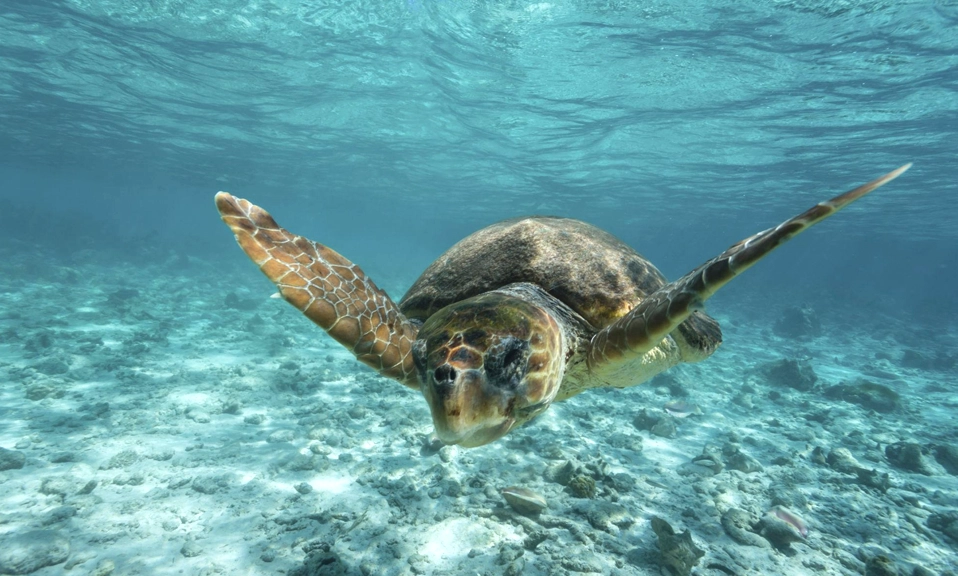
On a beach in Cabo Verde, a loggerhead turtle hauls herself out of the surf and begins to dig. She is earlier than her grandmother would have been. She will lay fewer eggs than her mother did. And when she returns to the sea, she will wait longer before she comes back to nest again.
This is not a single turtle’s story. It is a pattern that researchers are documenting across the world’s oceans—a quiet, profound shift in the behaviour of one of the planet’s most ancient mariners. Sea turtles are changing when they nest, where they nest, and how often they nest. And the reasons why tell us something deeply unsettling about the state of the seas they call home.
The Shift: Nesting Earlier, Expanding North
The most visible change is in timing. A 17-year study of loggerhead turtles in Cabo Verde, published in February 2026, found that warmer sea surface temperatures are causing turtles to arrive and nest earlier in the season. Higher temperatures also shorten the interval between successive nests, likely because warmth speeds up egg development.
The same pattern is appearing elsewhere. In the Cayman Islands, a 26-year analysis found that the onset of nesting has advanced by 0.6 days per year for green turtles and 0.7 days per year for loggerheads, with warmer temperatures correlating with earlier nesting for both species.
But timing is only part of the story. The other is geography.
In the Mediterranean, a landmark synthesis of six decades of nesting data found what researchers describe as an “exponential rapid increase” in nesting sites in the Western basin, following a distinct breakpoint around 2010. The phenomenon is characterised by a northward shift exceeding 38°N—a range expansion consistent with climate-driven warming. As summer temperatures have risen, coastlines that were previously too cool for successful incubation have become viable nesting niches.
The expansion is not limited to loggerheads. Green turtles, historically anchored in the Eastern Mediterranean, are now being recorded nesting in the Western basin—including a pivotal nest in Tunisia in 2019, the westernmost record for the species in the region. Genomic evidence suggests these pioneers may be arriving from the South Atlantic, carried by warming currents into newly suitable habitats.
In Italy, the LIFE TURTLENEST project recorded more than 700 loggerhead nests in 2025, up from 443 in 2023 and 601 in 2024. Much of the growth occurred in Sicily, Calabria, Campania, and Puglia—but there is now a growing presence along the coast of Liguria in northern Italy, where nesting was virtually unknown.
On the other side of the Atlantic, a rare olive ridley nest was recorded on a Florida beach in June 2026—a species known to nest primarily on the southern Atlantic coasts of Brazil, Trinidad, Suriname, and Gabon. Its northward expansion is one of several factors researchers are linking to warming waters.
The Hidden Cost: Fewer Eggs, Longer Waits
Earlier nesting and new nesting sites sound like adaptation. But the full picture is more complicated—and more troubling.
The Cabo Verde study reveals a tension that is easy to miss if you only look at the beaches. While warmer waters are bringing turtles ashore earlier, the ocean productivity along their West African feeding grounds is declining. And that decline is quietly eroding their reproductive output.
Sea turtles are “capital breeders”—they rely on energy stored during years spent feeding at sea to fuel reproduction. The study found that declining ocean productivity, measured using satellite estimates of chlorophyll, is strongly linked to longer remigration intervals, smaller clutches, and fewer nesting events.
Over the 17-year study period, renesting intervals increased from about two years to four years. When females do return, they lay fewer clutches and fewer eggs per nest.
“From the beach, everything is a conservation success—more nests, earlier nesting, lots of activity,” said Kirsten Fairweather, co-lead author and scientific coordinator at Associação Projeto Biodiversidade. “But when you follow individual turtles over many years, a more complex picture emerges. The turtles are working harder for less return”.
The message is stark: temperature alone doesn’t tell the full story. What happens thousands of kilometres away, in the feeding grounds, directly determines how many eggs a turtle can produce—and therefore the next generation of turtles.
The Squeeze: Rising Seas and Vanishing Beaches
Even as turtles expand into new nesting grounds, the beaches they depend on are under threat.
A 2026 study of nine of the most important sea turtle nesting beaches around the globe found that four show long-term erosion trends since 1980, losing nearly a metre a year in at least one place. Three of those sites offer little space for turtles to nest further inland, putting that habitat especially at risk from rising seas.
The findings highlight a cruel irony: as warming waters push turtles toward new, higher-latitude nesting sites, the beaches they leave behind—and the new ones they find—are being squeezed by sea level rise and coastal development. Some beaches are widening, but others are eroding with nowhere for the turtles to retreat.
The new nesting sites themselves come with their own dangers. In the Mediterranean, the LIFE TURTLENEST project warns that the beaches turtles are colonising are often located where there is already intense pressure from tourism and coastal development. Beach cleaning with bulldozers can crush nests buried just tens of centimetres below the surface. Light pollution disorients females and hatchlings, causing them to abandon nesting attempts or follow artificial lights inland instead of toward the sea.
“Every nest counts,” says Stefano Di Marco, the project’s manager. “Every hatching is a collective victory”.
The Deeper Problem: A Skewed Balance of Sexes
There is another consequence of warming that is less visible on the beach but arguably more consequential for the species’ future: sex ratios.
Sea turtles exhibit temperature-dependent sex determination. Warmer incubation temperatures produce more females; cooler temperatures produce more males. A 2026 study modelling green turtle populations found that hatchling sex ratios have trended toward female-biased ratios of over 80% over the past 50 years, and are projected to approach complete feminization by 2100 under continued warming.
The mechanisms that turtles might use to compensate are limited. A 2026 study on phenological plasticity found that while individual females can increase male hatchling production by nesting later and producing more nests, behavioural plasticity alone is unlikely to offset the accelerating impacts of climate change. Even extreme shifts in nesting phenology become ineffective by 2100.
Earlier nesting, in other words, may buy time—but it is not a solution. The window in which conditions are right for producing both males and females is narrowing, and the turtles can only shift their timing so far.
What This Means for the Oceans
The changes in sea turtle nesting habits are not just a curiosity for biologists. They are a signal—a visible, measurable indicator of what is happening beneath the waves.
Sea turtles are ancient creatures. They have navigated the oceans for over 100 million years, surviving ice ages, asteroid impacts, and the rise and fall of continents. Their nesting behaviour is finely tuned to the rhythms of the sea—to temperature, to currents, to the productivity of the waters where they feed.
When those rhythms change, the turtles change with them. They nest earlier. They move north. They lay fewer eggs. They wait longer between breeding seasons. Each of these adjustments is a response to a shifting environment—and each of them carries a cost.
The earlier nesting and the northward expansion are signs of flexibility, a capacity to adapt that is genuinely remarkable. But the declining reproductive output and the eroding beaches are signs of limits—limits that are being tested faster than the turtles can evolve.
“What happens thousands of kilometres away, in their feeding grounds, directly determines how many eggs they can produce and therefore the next generation of turtles,” says Christophe Eizaguirre, senior author of the Cabo Verde study.
The fate of sea turtles is not decided only on the beaches where they nest. It is decided in the oceans where they feed—and in the climate that is reshaping both.
A Story Written in Sand and Sea
Sea turtles are changing their nesting habits. They are arriving earlier, expanding north, and producing fewer offspring. Some of these changes are adaptations. Some are warning signs. And all of them are connected to a single, overarching force: the warming of the planet and the transformation of the oceans.
The turtles will keep nesting. They will keep hauling themselves onto beaches, digging their nests, and returning to the sea. They have done this for longer than we have existed. But the beaches are shrinking, the feeding grounds are thinning, and the balance of the sexes is tilting.
The question is not whether sea turtles can adapt. They can. The question is whether they can adapt fast enough—and whether we will give them the space, the clean water, and the stable climate they need to keep doing what they have always done.
Every nest counts. Every hatchling matters. And every degree of warming matters more than we might think.