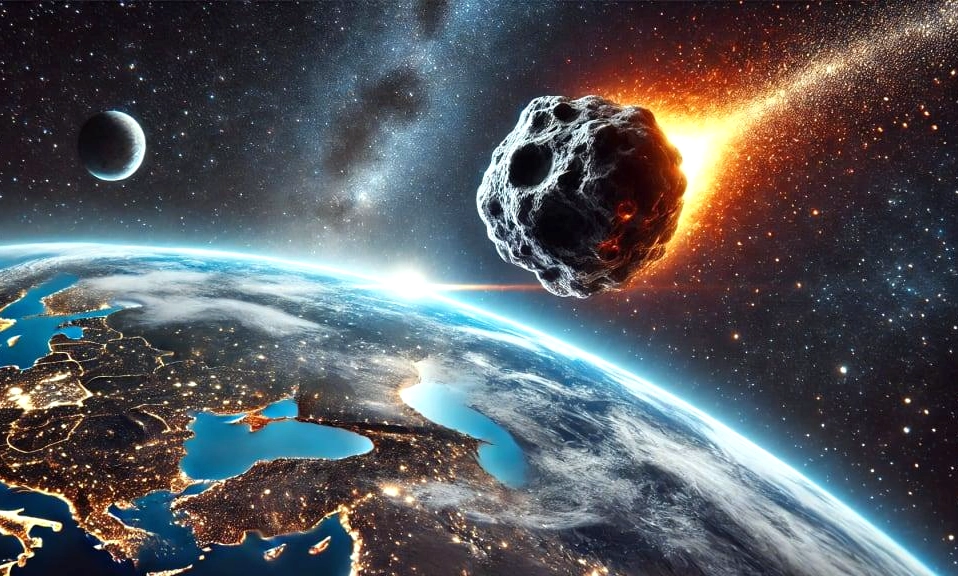
The idea has the clean, decisive logic of a Hollywood blockbuster: a menacing asteroid hurtles toward Earth, a nuclear warhead is launched, a blinding flash, and the threat is vaporized. For decades, “nuke it” has been the layperson’s favorite solution to the asteroid problem—a satisfying, definitive answer to a terrifying hypothetical. But in 2026, as scientists run ever more sophisticated simulations of nuclear asteroid deflection, they are uncovering a dangerous catch that turns the simple heroism of the movie plot into a high-stakes gamble with consequences that could be worse than the original threat.
The promise of nuclear deflection is real, and it is more credible than ever. Recent research from Lawrence Livermore National Laboratory (LLNL) has used advanced 3D simulations to show that a nuclear explosive device detonated near an asteroid could, in principle, vaporize enough of its surface to deflect it away from Earth. Unlike a kinetic impactor, which relies on the momentum of a spacecraft, a nuclear device delivers an immense pulse of X-ray energy that can ablate the asteroid’s surface and generate a powerful thrust. For a large object detected with little warning, it is the only option with enough energy to make a difference. The question is not whether the physics works. It is whether the outcome can be controlled.
The Dangerous Catch: When “Deflection” Becomes “Fragmentation”
The central risk is that a nuclear explosion will not gently nudge the asteroid onto a safe path. It may shatter it. And the fragments will still be on a collision course with Earth.
This is not a theoretical concern. It is the explicit warning of astronomers who have modeled the scenario. Mikhail Maslov, a leading engineer at the Vega Observatory, put it plainly: a nuclear strike carries the risk of “an unsuccessful explosion or another maneuver [that] could redirect the asteroid onto a collision course with Earth, or if large fragments remain after the explosion, they could still collide with Earth and cause serious consequences”. The nightmare scenario is not a clean miss. It is a shotgun blast of debris, each piece capable of causing damage, arriving over a wider area and with trajectories that are far harder to predict.
The LLNL simulations illustrate the problem. In one of the longest-running scenarios, involving an irregularly shaped asteroid roughly 160 meters across, about 98% of the asteroid material became fully damaged, and roughly 97% was moving faster than the asteroid’s escape velocity, with the majority of material moving in opposite directions—strong indicators that the body was breaking apart. For a smaller asteroid, this fragmentation might be acceptable, even desirable, because the pieces would burn up in Earth’s atmosphere. But for a larger object, the fragments would be too big to burn up, and the result would be multiple impacts instead of one.
The French scientific outlet Sciences et Avenir highlighted this specific danger: the “important differences between these results also underline the danger of remaining asteroid pieces,” estimating that the multiplication of debris larger than 10 meters wide would represent a major risk for Earth.
The Shape Problem: A Millimeter-Per-Second Difference
Even if the explosion does not fragment the asteroid, it may not deflect it as intended. The effectiveness of a nuclear strike depends on the asteroid’s shape and which side is hit—factors that are almost impossible to know in advance with the precision required.
A 2026 study published in ICARUS found that for one test asteroid, the deflection velocity was 3.9 millimeters per second when the explosion was on one side, but only 0.8 millimeters per second when it was on another. For a different object, the rotation speed after the explosion differed by a factor of seven. These differences are not academic. In planetary defense, a few millimeters per second can be the difference between a safe miss and a catastrophic impact. The researchers concluded that “an error in choosing the target could reduce the effectiveness of saving the planet”.
Previous models often simplified asteroids as perfect spheres to make calculations easier. But real asteroids have irregular surfaces and complex shapes, and the new modeling shows that the X-ray energy from a nuclear detonation interacts with those irregularities in ways that can dramatically alter the outcome. The choice of where to detonate the device is not a detail. It is the whole game.
The Technological Hurdle: We Have Never Done This
The risks are compounded by a simple fact: no one has ever attempted a nuclear deflection of an asteroid. The technology is entirely untested.
Maslov noted that “only spacecraft landings on small Solar System bodies, such as comets and asteroids, have been carried out so far,” and that “creating a hole (it is not entirely clear how exactly) and placing a nuclear charge inside it has never been done before and requires testing”. The Chinese “deep-impact” strategy, for example, involves first carving a crater into the asteroid and then detonating a warhead inside it—a two-stage mission of extraordinary complexity. Even a standoff detonation, which is the approach modeled by LLNL, requires precise trajectory calculations for a small, irregularly shaped, rapidly rotating object about which we may have only limited information.
The gap between a successful simulation and a successful mission is vast. The simulations tell us what might happen under ideal conditions. They do not tell us what will happen when a real spacecraft, with real sensors and real limitations, attempts to rendezvous with a real asteroid in the unforgiving environment of deep space.
The Silver Lining: Deflection May Be Safer Than Disruption
The research is not all bad news. A key insight from the 2026 studies is that a standoff detonation—exploding the device at a distance from the asteroid’s surface rather than embedding it—may actually be more effective and safer than a surface or subsurface burst. The LLNL simulations found that the explosion was “more effective if it occurred further away, a few tens of meters above the asteroid”. A standoff burst avoids the risk of a poorly placed subsurface detonation and distributes the energy more evenly across the asteroid’s surface, reducing the likelihood of creating a single large fragment.
There is also growing evidence that deflection, rather than disruption, should be the primary goal. The difference is crucial. Deflection imparts a small change in velocity that causes the asteroid to miss Earth while largely remaining intact. Disruption fragments the asteroid and disperses the pieces so that no remaining piece poses a significant threat. For a large, hazardous object, deflection is almost always the safer option—if there is enough warning time to achieve it. The danger arises when the object is detected late, and the only remaining option is disruption, with all the risks that entails.
A Last Resort, Not a First Choice
A nuclear explosion could, in principle, save Earth from an asteroid. The physics is sound, the simulations are increasingly sophisticated, and the energy available from a nuclear device is unmatched by any other mitigation method. But the dangerous catch is real, and it is not a minor technicality. It is the difference between a clean deflection and a catastrophic fragmentation event; between a precise strike and a millimeter-per-second error that sends the asteroid in the wrong direction; between a proven technology and an untested gamble.
The scientific consensus is clear: nuclear deflection should be a last resort, reserved for the most dire scenarios—a large object, detected late, with no time for a gentler approach. The preferred strategy remains what NASA demonstrated with the DART mission in 2022: a kinetic impactor, which is simpler, safer, and has been proven to work. But DART was a test on a small moonlet. A nuclear device is the only option with enough energy to deflect a true planet-killer. If that day ever comes, the decision to use it will be the most consequential choice humanity has ever made. And the scientists who study it are telling us, with increasing urgency, that it is not a choice to be made lightly.