For the first time, astronomers have found a dead star surrounded not by a single, uniform ring of debris, but by two distinct, concentric rings separated by a mysterious gap. The discovery, made with the European Southern Observatory’s Very Large Telescope (VLT) in Chile, offers a stunning preview of what our own Solar System might look like billions of years from now—and suggests that even in death, planetary systems can retain a surprising complexity.
The dead star is a white dwarf designated WD J1328−1450, located roughly 1,600 light-years from Earth. White dwarfs are the dense, burnt-out cores left behind when stars like our Sun exhaust their fuel and shed their outer layers, a process that engulfs and destroys any planets orbiting too close. The rocky remains of those destroyed worlds can form a disc of debris around the stellar corpse. Until now, every such disc observed around a white dwarf has been a single, flat, rotating structure. WD J1328−1450 breaks that pattern entirely.
A Structure Unlike Any Other
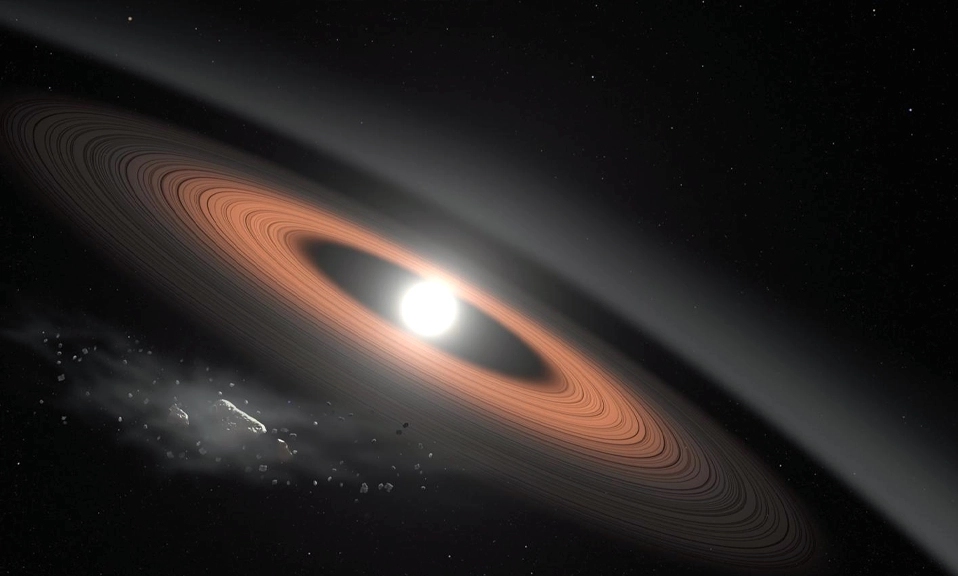
Using the X-shooter instrument on the VLT, an international team led by astronomers from the University of Trieste and the University of Warwick found that the debris around WD J1328−1450 forms two separate gaseous rings—an inner ring and an outer ring—separated by a clear, empty gap. The inner ring extends from about 100,000 to 240,000 kilometres from the star, while the outer ring stretches from roughly 375,000 kilometres to more than 1.3 million kilometres.
The observations, published in Nature Astronomy, showed that the two rings have remained remarkably stable, staying separate for more than two years of repeated monitoring between 2021 and 2023. “The structure we see in this system is particularly intriguing because the two gaseous rings are remarkably stable and remain separated by a gap,” said co-author Felipe Lagos-Vilches. “It hints that dead stars can have disc structures far more complex than previously realised”.
The Invisible Architects: Two Surviving Worlds
The team believes the gap between the rings is maintained by two surviving planetary bodies, each orbiting within its own ring and interacting with the surrounding dust to release the gas that is observed. Their sizes cannot be measured directly, but models suggest a striking contrast between them.
The object in the inner ring is thought to be no larger than a typical asteroid, just a few kilometres across. The object in the outer ring, however, could be as large as Pluto—or even our Moon. “We cannot see the two planetary bodies directly, but we can infer their likely presence from the shape and composition of the gas,” said lead author Nicola Gentile Fusillo. “It is like reconstructing the architecture of a destroyed planetary system from the traces left by its final pieces”.
A Chemical Fingerprint of Two Different Worlds
The composition of the two rings adds another layer of intrigue. The gas contains calcium, oxygen, magnesium, and iron—a mix similar to the rocky material found in our own Solar System. But the rings differ sharply: the inner ring is rich in magnesium gas, while the outer ring is largely stripped of it.
This suggests that the debris in the two rings came from two planets with different compositions, or possibly from different layers of a single body—like the crust and core of a disrupted world. Either way, the chemical dichotomy is a fingerprint of the violent history that created this system.
A Glimpse of Our Own Future
The discovery is more than a curiosity. It is a preview of what awaits our Solar System when the Sun reaches the end of its life. In roughly five billion years, the Sun will expand into a red giant, engulfing Mercury, Venus, and possibly Earth, before shedding its outer layers and collapsing into a white dwarf. The surviving rocky bodies—perhaps Mars, the asteroids, or the moons of the outer planets—could be torn apart by the white dwarf’s gravity, forming a debris disc just like the one around WD J1328−1450.
The double-ring structure suggests that even in the chaos of stellar death, some planetary bodies can survive and continue to shape their environment. “We have known for some time that planets may survive beyond the transformation of their central star, but this is the first example of a complex system with a double debris disc and potentially two surviving planetesimals,” Gentile Fusillo said.
WD J1328−1450 is a dead star
with a secret: two rings of planetary wreckage, separated by a gap, and shaped by the gravitational pull of two surviving worlds—one tiny, one possibly as large as Pluto. It is the first system of its kind ever observed, and it offers a rare glimpse of the violent, chaotic process by which a planetary system meets its end.
Our Sun will one day become a white dwarf. Whether it will be surrounded by a single ring or a double one, nobody knows. But WD J1328−1450 shows us that the afterlife of a star can be far more complex—and far more beautiful—than anyone imagined.