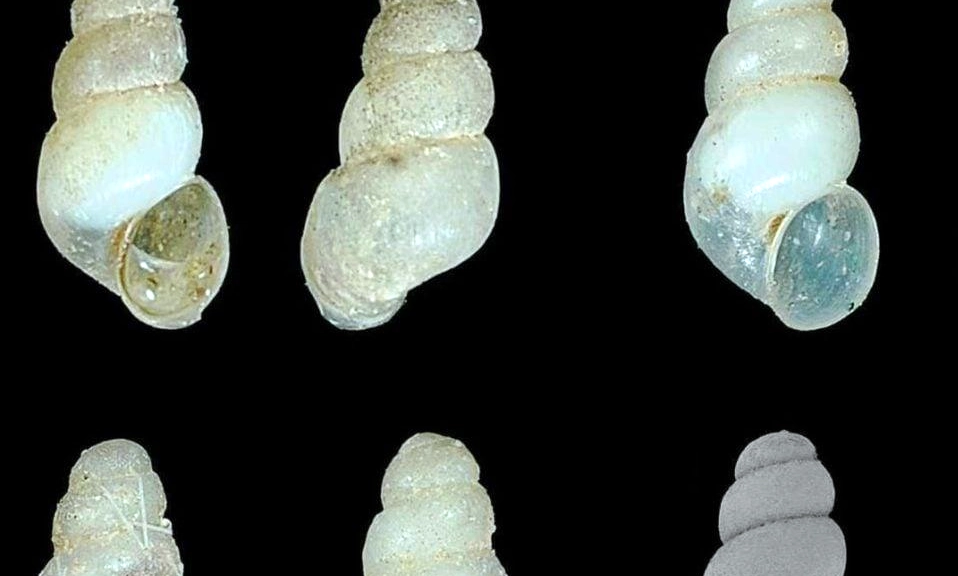
Deep beneath the mountains of Yunnan, China, in a world where sunlight has never reached, scientists have found a creature that seems more myth than mollusk. It is nearly transparent, completely eyeless, and so delicate it appears to have been sculpted from water and shadow. This is Erhaia dijiang—the first freshwater cave snail ever documented in China, and a haunting reminder of how much life remains hidden in the dark.
The discovery, published in the journal Subterranean Biology, describes a tiny freshwater snail that has evolved for a life in perpetual darkness. Its body is unpigmented, its cone-shaped shell is translucent, and its long, slender tentacles give it what researchers describe as an almost “ghostly” appearance. It is a creature built entirely for a world without light—and it is already on the brink.
A Ghost Made Flesh (and Shell)
The most striking feature of Erhaia dijiang is its complete lack of eyes. In the perpetual darkness of its cave habitat, vision is not just unnecessary—it is a liability. Over countless generations, the snail’s eye structures have fully degenerated, a classic example of regressive evolution in cave-dwelling animals. What remains is a body that is soft, colorless, and highly sensitive to light. In laboratory observations, the snails consistently retreated into dark crevices beneath rocks when exposed to illumination, confirming an extreme aversion to light that matches their subterranean existence.
The shell is equally remarkable. It is small, conical, and so transparent that the snail’s body is almost visible through it—a ghostly casing that offers protection without the need for pigment.
Life at 2,062 Metres
Erhaia dijiang was discovered at an elevation of 2,062 metres in a cave in Hongta District, Yuxi City, Yunnan Province. This makes it the highest-altitude cave snail recorded in the family Erhaiidae, and the first freshwater cavesnail found anywhere in China. The find fills a significant gap in the study of East Asia’s subterranean biodiversity—until now, there were no records of freshwater cavesnails in the country at all.
The snails live in shallow underground water less than a metre deep, among submerged gravel and broken rocks. The water temperature remains remarkably stable at around 20 degrees Celsius year-round, offering a constant environment in an otherwise variable world. During heavy rains, some individuals are occasionally washed out of the cave entrance, but researchers have never found them in nearby surface streams. Their known distribution is restricted to within two metres of the cave entrance—a microhabitat of astonishing specificity.
They feed primarily on diatoms, microscopic algae that grow on rock surfaces, though in laboratory conditions they also accepted fish food provided by researchers.
Named After a Faceless God
The species name, dijiang, is drawn from the Classic of Mountains and Seas (Shan Hai Jing), an ancient Chinese text that describes a mythical faceless creature named Di Jiang. The name is a perfect fit—not only because the snail lacks eyes, but because its light-averse behavior mirrors the elusive, otherworldly nature of the mythological being.
It is a rare moment where taxonomy and mythology converge, and it gives this tiny, unassuming mollusk a name that feels as haunting as its appearance.
A Population on the Edge
The discovery is scientifically thrilling, but the conservation outlook is deeply concerning. During the team’s first field investigation in August 2025, researchers found only three living adult snails and one empty shell. No juveniles were discovered. The researchers described the species’ survival prospects as “far from optimistic,” given its apparently tiny population and extremely restricted habitat.
Cave-dwelling animals are inherently vulnerable. They depend on specialised environments that are slow to form and easy to destroy. Even local disturbances—changes in water quality, alterations to the cave entrance, or increased human activity—could threaten the species’ continued existence. Because so few individuals have been found, it is also difficult to assess population size, reproductive success, or how the species might respond to environmental change.
The team is calling for more extensive surveys of China’s cave systems to identify other undiscovered species and to establish conservation measures before fragile underground ecosystems are irreversibly damaged. The discovery of Erhaia dijiang is a reminder that some of Earth’s most unusual life forms may remain hidden in darkness, waiting to be found—and that finding them is only the first step toward protecting them.
Erhaia dijiang is not
a monster or a myth. It is a tiny snail, barely visible to the naked eye, that has done something extraordinary: it has made a home in a place where home should be impossible. It has traded its eyes for survival, its pigment for transparency, and its place in the sun for a life in the shadows. And now, with only three known living individuals, it is teetering on the edge of disappearing before we have truly begun to understand it.
The ghost of the Chinese cave is real. And it needs us to notice it—before the darkness takes it back for good.