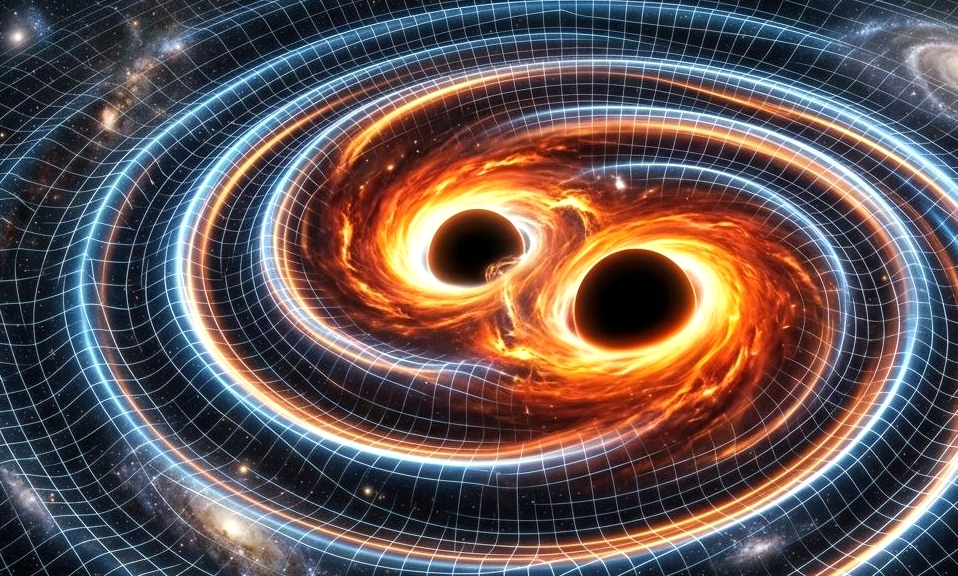
Black holes are the universe’s ultimate one-way street. Their gravity is so extreme that nothing—not even light—can escape once it crosses the event horizon. The idea that one could simply split in two sounds like a violation of everything we know about physics. But a new theoretical study has found a strange loophole: under conditions of extreme rotation, a black hole may be able to tear itself apart, birthing two smaller black holes in the process.
The research, published in Physical Review D, does not claim that black holes are splitting all over the cosmos. It is a careful, mathematical exploration of the limits of general relativity and thermodynamics—a “what if” that tests the boundaries of our understanding. And the answer, surprisingly, is that a split cannot be ruled out. The window is extraordinarily narrow, but it is not zero.
The Barrier: Why Black Holes Shouldn’t Split
To understand the loophole, you first have to understand the wall. Two independent physical laws conspire to prevent a black hole from splitting.
The first is gravity. A black hole is a region of spacetime where matter has collapsed to a point of infinite density. Its gravitational grip is absolute. For a piece of a black hole to “escape” the rest, it would have to overcome the very force that defines the object. That seems impossible.
The second, and more subtle, barrier is thermodynamics. Black holes have entropy—a measure of the disorder of their internal states. For a simple, non-rotating black hole, entropy is proportional to the square of its mass. If you take a black hole of mass M and split it into two black holes of mass M/2 each, the total entropy of the two smaller holes is less than the entropy of the original. Since the second law of thermodynamics demands that the total entropy of an isolated system can never decrease, the split is forbidden. It would be like a shattered vase spontaneously reassembling itself.
The Loophole: When Spin Changes the Rules
The team, led by Francesco Sannino of the University of Naples Federico II and the University of Southern Denmark, found that this thermodynamic barrier is not absolute. For a rapidly rotating black hole, the relationship between mass and entropy changes. Spin carries angular momentum, and angular momentum contributes to the total energy budget of the system in a way that alters the entropy calculation. In certain regimes, a spinning black hole can have lower entropy than a non-spinning one of the same mass.
This opens a crack in the thermodynamic wall. If a fast-spinning black hole splits into two smaller black holes that are spinning more slowly, the total entropy of the system can increase—or at least, the decrease can be avoided. The split becomes thermodynamically permissible, provided the original black hole is spinning close to the maximum rate allowed by physics.
But thermodynamics is only half the battle. The two newborn black holes must also separate. If they remain too close, their mutual gravity will pull them back together, and they will merge back into a single black hole, erasing the split. The researchers found that when this separation requirement is included, the window of opportunity “largely closes again”—except for black holes rotating at or extremely near their maximum possible spin.
The “Pair-of-Pants” Universe
If such a split were to occur, the geometry of the black hole’s event horizon would trace out a shape that physicists call a “pair-of-pants topology”. Imagine the horizon as a single tube extending through time. At the moment of splitting, the tube branches into two, like the legs of a pair of trousers. The original black hole is the waist; the two new black holes are the legs.
This is not a metaphor for the shape of the black hole in space. It is a description of how the horizon evolves over time—a branching structure in spacetime. The study’s title, “When Black Holes Admit Pair-of-Pants Topologies,” is a direct reference to this geometry.
A More Exotic Path: Extra Dimensions
The researchers also explored scenarios beyond the four dimensions of everyday experience. In theories that postulate additional spatial dimensions, certain black-hole-like objects—such as black strings—are known to be unstable. Under these conditions, splitting can become thermodynamically favourable, particularly when one of the resulting fragments is much smaller than the other.
This is a different kind of split: not an even division into two comparable halves, but the tearing away of a tiny fragment from a much larger parent. The mathematics of higher-dimensional gravity allows for this, though it remains purely theoretical. As the researchers note, demonstrating that fragmentation is thermodynamically favourable “does not demonstrate that the fragmentation will actually happen”.
What Could Actually Cause a Split?
The study does not identify a single, confirmed mechanism for triggering a split. The “crotch” of the pair-of-pants diagram is labeled, in the researchers’ own words, “unknown dynamics”. The split is a possibility allowed by the laws of physics, not a process that has been observed or fully explained.
One proposed driver is superradiance—a phenomenon in which waves become trapped near a spinning black hole and are amplified, potentially creating an instability that could shake the object apart. Another is the inherent instability of certain higher-dimensional objects. But these are hypotheses, not confirmed processes.
Where to Look: Primordial Black Holes and Gamma Rays
If black holes can split, which ones are most likely to do it? The answer, according to the researchers, is small primordial black holes—tiny relics formed in the extreme conditions of the early universe. These objects are far more prone to splitting than the giant astrophysical black holes that form from collapsing stars. Their small size and potentially extreme spin make them the best candidates for the kind of instability the study describes.
The split would be difficult to observe directly. But it might leave a detectable signature. The researchers suggest that gamma-ray telescopes like Fermi-LAT could search for signals from the tiny black-hole fragments that might be produced during black hole mergers or other violent events. A split would release a burst of radiation, and that radiation might be visible to our instruments.
A Crack in the Wall, Not a Door
The study does not prove that black holes split. It does not even provide a probability. As Sannino himself admits: “We cannot yet give a single probability for a black hole to split. It depends on how gravity behaves beyond Einstein’s theory, and we are working to quantify this”.
What the research does is challenge a assumption that seemed absolute. The laws of thermodynamics and general relativity, which seemed to forbid black hole fission outright, may contain a loophole under conditions of extreme rotation. The window is so narrow that such events may be vanishingly rare—or they may never happen at all. But the fact that the mathematics allows it is significant. It means that our understanding of black holes, and of the limits of physics, is not as complete as we thought.
The universe, it seems, may be stranger than we imagined. And somewhere, in the extreme spin of a primordial black hole, a pair of pants may be waiting to unfold.