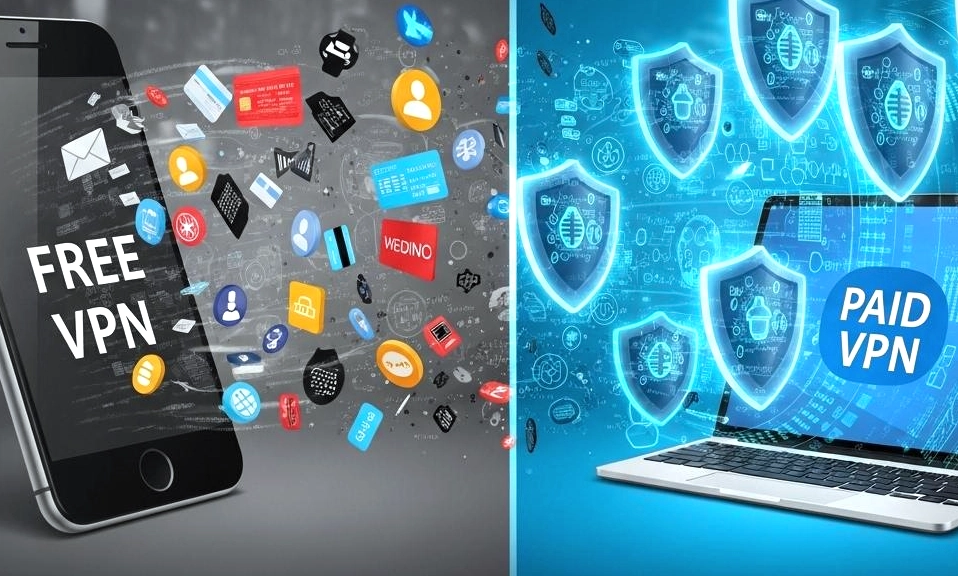
The VPN market has a simple pitch: protect your privacy, hide your IP address, and browse securely. But the price tags range from “completely free” to “premium subscription,” and the difference between those two options is far more consequential than most people realize. A free VPN can be a useful tool for casual browsing, but it can also be a privacy nightmare. A paid VPN is an investment in speed, reliability, and trust—but not everyone needs one. The right choice depends on what you are actually trying to protect, and from whom.
This guide breaks down the real differences between free and paid VPNs, the hidden costs of “free,” and how to decide which one fits your needs.
The Case for Free VPNs
Free VPNs are not all bad. Reputable providers like Proton VPN and Windscribe offer genuinely useful free tiers that can handle light, occasional use without compromising your security. If you fall into one of the following categories, a free VPN may be sufficient:
You need occasional privacy on public Wi-Fi. If you only connect to a VPN when you are at a coffee shop or airport, a free tier with a data cap can be enough to protect your traffic on untrusted networks.
You want to test a provider before committing. Many paid VPNs offer free trials or money-back guarantees, but a free tier lets you evaluate the app, the interface, and the connection quality before you spend anything.
You are on a very tight budget. A free VPN is better than no VPN at all, provided you choose a reputable provider and understand the limitations.
You are using it for a single device with minimal data needs. If you only need to check email or browse a few websites, a free tier’s data allowance may be adequate.
The key caveat is that “free” is not a business model—it is a marketing strategy. Every free VPN has to pay for servers, bandwidth, and staff somehow. The reputable ones use the free tier as a funnel to paid plans. The disreputable ones use it to harvest data, inject ads, or worse.
The Hidden Costs of Free VPNs
The phrase “if you are not paying for the product, you are the product” applies to VPNs more than almost any other category of software. Here are the hidden costs you need to understand.
Data caps and speed throttling. Most free VPNs limit you to 500MB to 10GB per month, and many throttle your speed after a certain threshold. That is enough for light browsing but not for streaming, gaming, or downloading large files.
Limited server networks. Free tiers typically offer access to a small fraction of the provider’s servers—often just a handful of countries. That means slower speeds, more congestion, and less ability to access geo-restricted content.
Ads and upsells. Many free VPNs display ads in their apps or inject ads into your browsing. Some sell your data to third parties. The reputable ones do not, but you need to read the privacy policy carefully.
Weak security and logging. Some free VPNs do not use strong encryption, keep logs of your activity, or share data with advertisers or law enforcement. A VPN that logs your activity is not a privacy tool—it is a surveillance tool with a friendly interface.
Malware and shady business practices. The free VPN market is flooded with apps that contain malware, request excessive permissions, or are operated by shell companies with no accountability. Downloading a free VPN from an unknown developer is a genuine security risk.
No streaming support. Free VPNs are almost universally blocked by Netflix, BBC iPlayer, and other streaming services. If you want to watch geo-restricted content, you will need a paid VPN.
Limited device support and no customer support. Free tiers often restrict you to one device, offer no live chat or email support, and provide minimal documentation.
The Case for Paid VPNs
Paid VPNs are not a luxury—they are the baseline for anyone who takes their privacy seriously. Here is what you get for your money.
Speed and reliability. Paid VPNs invest in high-bandwidth servers, optimized protocols (like WireGuard and proprietary options such as NordLynx and Lightway), and global networks with thousands of servers. The result is a connection that feels almost as fast as your normal internet, even over long distances.
Strong security and no-logs policies. Reputable paid VPNs use AES-256 encryption, RAM-only servers, and have undergone independent no-logs audits. They do not sell your data, and they have legal and technical safeguards to protect your identity.
Streaming and geo-unblocking. Paid VPNs are designed to work with Netflix, BBC iPlayer, Hulu, Disney+, and other streaming services. They maintain dedicated servers for streaming and regularly update their IP ranges to stay ahead of blocks.
Multiple devices and simultaneous connections. Most paid VPNs allow 5 to 10 simultaneous connections (Surfshark offers unlimited), so you can protect your phone, laptop, tablet, and smart TV with a single subscription.
Customer support and money-back guarantees. Paid VPNs typically offer 24/7 live chat, detailed setup guides, and a 30-day money-back guarantee, so you can try the service risk-free.
Advanced features. Paid tiers often include Double VPN, obfuscated servers, split tunneling, dedicated IPs, malware blocking, and ad blocking—features that are rarely available on free tiers.
When Free Is Enough (and When It Isn’t)
The decision comes down to your threat model and your usage patterns.
A free VPN is probably enough if:
You only need occasional privacy on public Wi-Fi.
You are browsing casually and not handling sensitive data.
You are testing a provider before committing to a paid plan.
You are on a strict budget and understand the limitations.
A paid VPN is probably necessary if:
You stream geo-restricted content regularly.
You torrent or download large files.
You work remotely and handle sensitive business data.
You want to protect multiple devices and family members.
You value speed, reliability, and customer support.
You want the assurance of independent audits and a proven no-logs policy.
The Reputable Free Options (If You Must Go Free)
Not all free VPNs are created equal. If you are going to use a free tier, stick to providers with a proven track record and a clear business model.
Proton VPN Free is the best free VPN available. It offers unlimited data, strong security, and a no-logs policy backed by independent audits. The trade-offs are a limited server network (five countries), slower speeds, and one device connection.
Windscribe Free offers 10GB per month with access to servers in multiple countries. It is a solid option for light browsing and occasional use.
TunnelBear Free offers 2GB per month with a simple, user-friendly app. It is a good choice for beginners who want to try a VPN without committing.
Avoid free VPNs from unknown developers, apps that request excessive permissions, and services that display aggressive ads or ask for unnecessary personal information.
Paid Is Better for Most People
The honest answer is that a paid VPN is the better choice for the vast majority of users. The cost—typically $2.50 to $5 per month on a long-term plan—is modest compared with the benefits: faster speeds, stronger security, streaming support, multiple devices, and the peace of mind that comes from using a service that has been independently audited and proven to protect your data.
A free VPN is not useless. It is a useful tool for occasional, low-stakes privacy, and reputable free tiers like Proton VPN’s are genuinely valuable. But if you are relying on a VPN for anything important—streaming, remote work, sensitive browsing, or protecting your family’s devices—the limitations of free tiers will quickly become frustrating, and the hidden costs may be greater than the subscription fee.
The right choice is the one that matches your needs. If you only need occasional privacy on public Wi-Fi, a reputable free VPN is sufficient. If you want a VPN that you can rely on every day, for everything, a paid VPN is worth the investment. The free option is a sample. The paid option is the product.