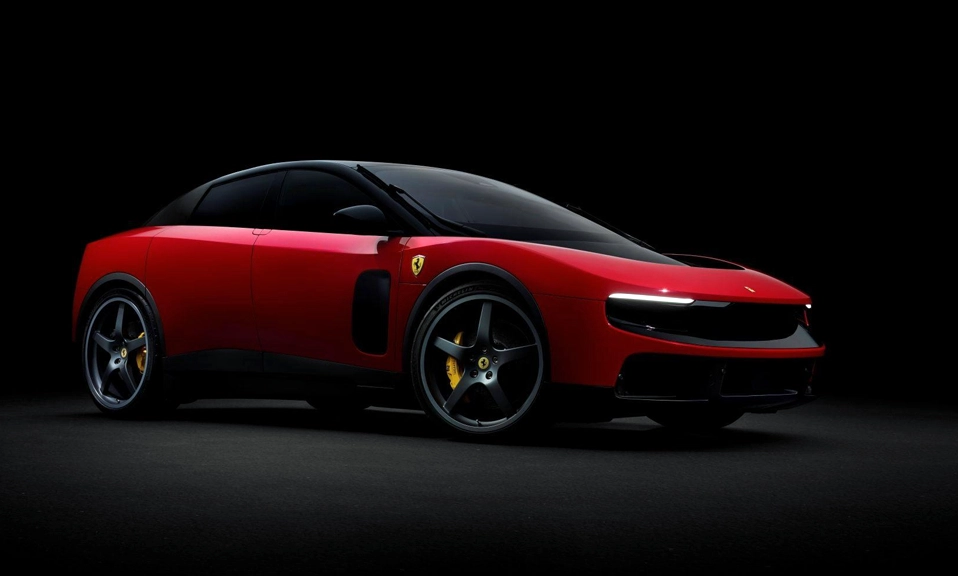
The critics called it a betrayal. The purists said it wasn’t a real Ferrari. And the wealthy buyers? They bought every single one before a single road test was published.
Ferrari’s first electric car, the Luce, is officially sold out for 2027. The confirmation came during Ferrari’s Q3 earnings call, when CEO Benedetto Vigna stated plainly that “the Luce that we plan to sell next year basically are all allocated” and that any new customer would have to wait a full year for delivery. It is a stunning rebuke to the online backlash that greeted the car’s reveal in May, and it raises a question that goes beyond specifications: what makes a car that looks nothing like a Ferrari so irresistible to the people who can actually afford one?
The Design: A Ferrari by Jony Ive, Not by Maranello
The Luce’s most controversial—and most consequential—feature is its design. For the first time in its history, Ferrari handed the styling of a production car to an outside studio: LoveFrom, the creative collective founded by former Apple design chief Sir Jony Ive and Marc Newson. The result is a car that deliberately rejects the low-slung, aggressive proportions that have defined Ferrari for decades.
Instead, the Luce is a high-riding, four-door grand tourer with an industrial-design aesthetic. It has been described as looking like “a mix of a station wagon, a crossover, and a luxury GT” rather than a classic supercar. The front features a sloping, two-layered design that allows air to flow through the fascia, and the cabin is almost visually independent from the bodywork, creating a “glass-house” silhouette. The doors open wide—suicide-style—to reveal a spacious interior, and the car measures 5,026 mm long, making it five centimetres longer than the Purosangue SUV and five centimetres lower.
The backlash was immediate. Former Ferrari chairman Luca di Montezemolo publicly suggested the Luce should lose its famous prancing horse badge. Ferrari’s share price fell more than 8% on the first trading day after the reveal. But Vigna’s response was telling: buyers, he said, were “better understanding” the car after seeing it in person and driving it. “We see when and how the perception changes when the people drive the car”.
The Performance: A Beast That Hides Its Violence
Underneath the polarising bodywork is a machine that is, by any measure, a genuine Ferrari.
The Luce is powered by four independent electric motors—one at each wheel— producing a combined 1,035 horsepower (772 kW) and 990 Nm of torque in Launch Control mode. It accelerates from 0 to 100 km/h in 2.5 seconds, reaches 200 km/h in 6.8 seconds, and tops out at 310 km/h. The battery is a 122 kWh unit developed in-house at Maranello, integrated into the floorpan as a structural element and paired with an 800V architecture that supports DC fast charging up to 350 kW. Claimed WLTP range is over 530 km.
The chassis is equally sophisticated. It uses active suspension derived from the F80 supercar, independent rear-wheel steering, and carbon-ceramic brakes (390 mm front, 372 mm rear). It rides on the largest staggered wheel setup ever fitted to a production Ferrari: 23-inch fronts and 24-inch rears. Despite weighing 2,260 kg—a hefty figure for a grand tourer—early reviews have been effusive. MotorTrend, after a first drive of a prototype, described the Luce’s dynamics as “beguilingly natural in its responses, fluid and concise in its change of direction, and beautifully balanced through all phases of a corner”.
The Interior: A Rejection of Touchscreen Minimalism
While the exterior divides opinion, the cabin has been almost universally praised. Ferrari made a deliberate choice to reject the touchscreen-dominated interiors of modern EVs, opting instead for a tactile, driver-focused environment filled with physical switches, rotary controls, and sculpted aluminium surfaces.
The steering wheel, digital instrument cluster, and torque-control paddle shifters are integrated into a single unit, and the instrument cluster moves with the steering wheel to improve driver focus. The screens are Samsung OLED displays developed exclusively for the Luce, ranging from 6.3 to 12.9 inches, with a layered binnacle design that gives digital information an analogue feel. There is a panoramic glass roof, a 21-speaker, 3,000W audio system, and an “Audio Signature” system that can pipe motor sound into the cabin for either the driver alone or the entire cabin. And crucially for a Ferrari, it is the brand’s first true five-seater, with a 597-litre boot and no front frunk—that space was dedicated entirely to aerodynamics.
The Price and the Paradox
The Luce starts at $560,800 in the U.S.** and **€550,000 in Europe**. In Australia, it is priced at **AU$991,446 before on-road costs, making it roughly AU$150,000 more expensive than the V12-powered Purosangue SUV. It is, by a significant margin, one of the most expensive electric cars on the market—and it is slower and pricier than rivals like the Lucid Air Sapphire on paper.
And yet, it sold out. Ferrari has not disclosed exact production numbers, but sources suggest the company aimed to sell just under 500 examples in 2026. Demand has come not just from existing Ferrari collectors but from new buyers—particularly in China and among technology entrepreneurs in the U.S.. The first production unit, nicknamed “Chassis 0,” was auctioned for a staggering $40 million at a charity event for The Ferrari Foundation.
The paradox is the point. The Luce is not selling because it is the fastest, the longest-range, or the best-value electric car. It is selling because it is a Ferrari—and because it represents something its buyers cannot get anywhere else: a radical reimagining of what a luxury car can be, designed by the man who shaped the iPhone, built with the engineering rigour of Maranello, and offered as a statement of intent rather than a concession to regulation.
Ferrari’s first electric car was
never going to be a quiet, conventional entry into the EV market. The Luce is a declaration: that electrification does not have to mean homogenisation, that a car can be tactile and analogue in its interface while being electric and software-defined underneath, and that Ferrari’s future will be shaped by bold design choices rather than nostalgia.
The critics may never love it. The purists may never accept it. But the people who matter—the ones with the means to buy one—have already made their verdict. The 2027 allocation is gone. The Luce is here, and Ferrari’s electric era has begun.