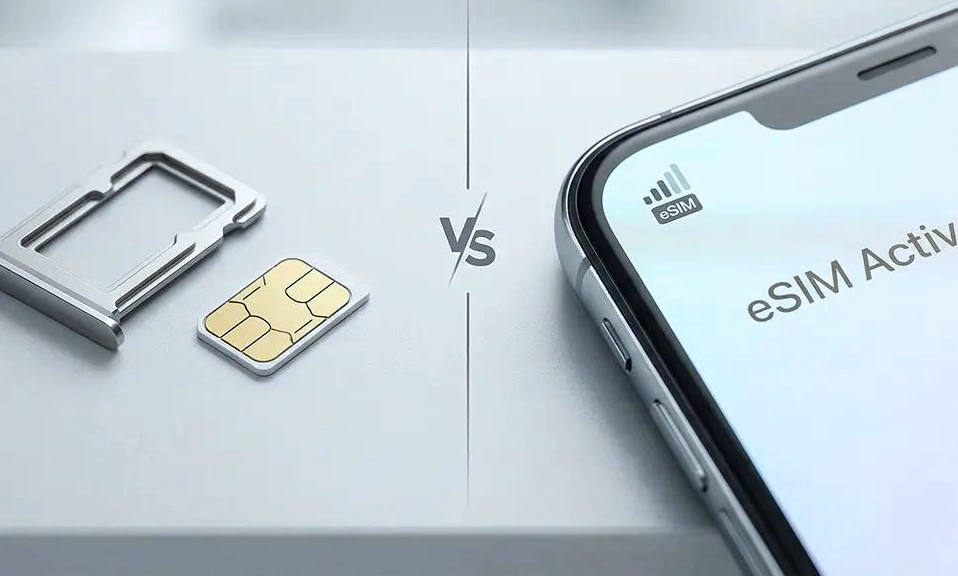
Your new phone has no SIM tray.
You look at the box. No little pin tool. No little plastic card to pop in. Just a QR code.
Is this the future, or is this Apple forcing you to do something annoying?
In 2026, eSIM is no longer a weird feature for travelers. It is the default on most new flagships. But physical SIM is not dead yet.
So which is actually better for you?
For most people in 2026, an eSIM is the better choice. It activates easily, can’t be lost, and lets you carry several numbers on one phone. A physical SIM still has its place if your device is older or you swap your line between phones often.
But the real answer is: It depends on how you use your phone. Let me show you.
What Is The Difference, Really?
eSIM and physical SIM both authenticate your phone to a carrier, they just do it differently. eSIM stores the carrier profile in a chip embedded in your device. Physical SIM uses a removable card.
Think of it like this:
Physical SIM is a key. You get a little plastic key, you put it in your phone, it unlocks the network. Lose the key, lose the network. Want to change phones? Move the key.
eSIM is a password. It is stored inside your phone. You scan a QR code, your carrier sends you the password, and your phone remembers it. Want to change phones? You transfer the password. No key to lose.
eSIM gives the same network, speed and coverage as a physical SIM.
Signal and speed are identical. Anyone telling you a physical SIM “holds a stronger signal” is repeating a myth, the SIM never touches your phone’s radio.
And we found no credible evidence that an eSIM affects battery life or signal compared with a physical SIM.
So speed is not the issue. Convenience, security, and travel are.
The 2026 Reality: eSIM Is Now The Default
Apple has the most mature eSIM rollout of any manufacturer: every iPhone since the XS, 2018, has supported eSIM, and US-market iPhone 14 and newer ship with no physical SIM tray at all, eSIM-only, since 2022. The iPhone 17 Air went further, becoming Apple’s first phone that’s eSIM-only worldwide, not just in the US.
Apple ripped it out with the iPhone 14 back in September 2022, and every US iPhone since, the 14, 15, 16, and 17, ships with no slot at all.
Apple went tray-free with the iPhone 14 in September 2022, and every US model since, 15, 16, 17, is eSIM-only.
iPhone Air and the entire iPhone 17 line are eSIM only in every market, not just the US.
Google followed with the Pixel 10 in the US market, and Samsung is moving select markets of the Galaxy S26 toward eSIM-only as well.
Apple has gone furthest: it removed the physical SIM tray from every US iPhone starting with the iPhone 14, and with iPhone Air and the iPhone 17 line, it dropped the tray worldwide. Google and Samsung, by contrast, still ship a physical nano-SIM in most regions.
Industry forecasts put eSIM-enabled device shipments above 633 million globally in 2026.
More than two-thirds of mobile operators worldwide now offer eSIM connectivity for smartphones.
Carrier support has expanded to the point where eSIM works in nearly every country you’d want to travel to.
In other words, you may not get to choose much longer. Apple has already chosen for you.
eSIM Pros: Why Most People Should Switch
1. You Cannot Lose It, And Thieves Cannot Steal It
For most iPhone owners an eSIM is the better choice: it can’t be pulled out of a stolen phone, it lets you add a travel plan without swapping anything, and it moves to a new iPhone in a few taps.
A physical SIM can be removed from a stolen phone and used to receive your 2FA codes. That is how SIM-swap fraud works.
eSIM is genuinely harder to hijack. SIM-swap fraud has exploded, and there’s no physical card to steal.
If your phone is stolen, the thief cannot pop out your SIM and put it in another phone. Your number stays locked to your phone until you transfer it.
2. Travel Is 10x Easier
So is an eSIM actually better? For most people, most of the time, yes, and for travel it’s not close.
For travel, with physical SIM you buy a local SIM after you land. With eSIM, you buy before you go, active when you land.
Imagine landing in Bangkok at midnight. With a physical SIM, you have to find a shop, show your passport, wait in line, swap the tiny card, and hope you do not lose your home SIM.
With eSIM, you buy a travel plan on Airalo or Holafly while you are still on the plane Wi-Fi. You land, your phone connects, you are online. Your home number still works for WhatsApp and banking.
3. You Can Have Many Numbers On One Phone
An eSIM phone can store 5 to 10 eSIM profiles at once, and have 2 active at the same time.
Want a work number and a personal number? Easy.
Want a US number and a UK number? Easy.
Want a data-only travel plan plus your home number? Easy.
With a physical SIM, you need dual-SIM phones with two trays, which most phones do not have anymore.
4. Setup Takes 2 Minutes
Instant delivery, no need to open up the SIM card tray of the phone, activated in a matter of moments from a QR code or transferred from another handset.
No waiting 3 days for a SIM to arrive in the post. No pin tool. Just scan, done.
5. More Battery, More Water Resistance
The iPhone 17 Pro Max gained 265 mAh of battery capacity just by removing the physical SIM tray in eSIM-only markets.
No hole in the side means fewer places for water to get in, and more space for battery. That is a real, physical benefit.
Physical SIM Pros: Why Some People Still Need It
Physical SIM still wins in two situations: when you swap phones often, including into older or non-Apple devices, and when your phone could die and you need your number working in a spare handset straight away.
1. Quick Phone Swaps
For most modern flagship phones, eSIM offers the more flexible choice. A physical SIM still has a clear advantage for quick phone changes and wider device compatibility.
If your phone dies, you can pull your physical SIM out and put it in any old backup phone in 30 seconds. You are back online.
With eSIM, you have to go through your carrier’s app, or scan a QR code, or call support. If your phone is dead and you do not have another phone to get the QR code, you are stuck.
A physical SIM still wins for older phones, card-only carriers, and quick device swaps, including dropping your line into a backup phone if yours breaks.
2. Older Phones And Smaller Carriers
Not every phone natively supports eSIM functionality, so SIM cards will be around for a while.
If you have a budget Android, a feature phone, or you use a small local carrier in Africa, Asia, or Latin America that does not support eSIM yet, you still need a physical SIM.
Carrier support improved but is uneven. Most major carriers support eSIM, yet activation smoothness varies.
In some countries, getting an eSIM still means visiting a store with your ID. Getting a physical SIM is faster.
3. It Just Feels Familiar
Getting a physical SIM in the post will be familiar to anyone who’s not tech savvy, as you just pop it in the phone and everything works as it has for decades.
If you are not tech-savvy, a physical card feels safer. You can see it. You can hold it.
eSIM vs Physical SIM: Side By Side
Feature | eSIM | Physical SIM |
|---|---|---|
Setup | Scan QR code, 2 minutes | Wait for delivery, pop in tray |
Travel | Buy before you fly, active on landing | Buy after you land, find a shop |
Multiple numbers | Store 5 to 10 profiles, 2 active | Need dual-SIM tray, usually 2 max |
Security | Cannot be removed if stolen | Can be removed and used in another phone |
Phone swap | Need carrier app or QR code | Pop out, pop in, 30 seconds |
Compatibility | Needs iPhone XS or newer, Samsung S20 or newer, Pixel 3a or newer | Works on any phone with a tray |
Battery / Design | Frees space for bigger battery | Takes up space, needs hole in phone |
Speed / Signal | Identical | Identical |
The Best Setup In 2026: Both
Here is the secret most guides do not tell you: You do not have to pick one.
The strongest setup in 2026 remains a phone with both options. A physical SIM can handle the main number, while an eSIM can hold a work line or travel plan.
eSIM wins on convenience: Ideal for travelers, multiple numbers, and digital activation. Physical SIM wins on flexibility: Easy to move between compatible phones, especially during emergencies. Dual-SIM is the best of both: Combines eSIM convenience with physical SIM backup.
For most people buying a new phone in 2026 it’s the better default: faster to set up, nothing to lose, and, if you want, easy to run alongside a second line.
If you are buying a Samsung Galaxy S26 or Pixel 11 outside the US, you still get both. Use the physical SIM for your main number, the eSIM for travel. Best of both worlds.
If you are buying an iPhone 17 Air, you have no choice. It is eSIM-only worldwide. And that is fine, because Apple’s eSIM transfer is now very smooth.
Which Phones Support eSIM In 2026?
Apple says eSIM needs an iPhone XS, iPhone XS Max, iPhone XR or later, plus a carrier or provider that supports eSIM.
iPhone 14, 15 and 16 models bought in the US, and iPhone 17 models bought in the US, Canada, Mexico, Japan and some other countries, work with eSIM only.
Samsung UK lists eSIM support on the Galaxy S20 series and later, including the S26 line, the Z Fold and Z Flip lines.
In short: Every iPhone since the XR, every Samsung Galaxy S since the S20, and every Google Pixel since the Pixel 3a supports eSIM.
If your phone is from 2023 or later, it almost certainly supports eSIM. Check Settings > Mobile / Cellular > Add eSIM. If you see that option, you are good.
When Should You Switch To eSIM?
Switch to eSIM if:
- You travel abroad, even once a year
- You want two numbers on one phone, work + personal
- You have a phone without a SIM tray, iPhone 14 US, iPhone 17 Air, Pixel 10 US
- You hate losing tiny SIM cards and pin tools
- You want better theft protection
Keep a physical SIM if:
- You often move your SIM between phones or keep a backup phone
- Your carrier does not support eSIM well yet
- You have an older phone that does not support eSIM
- You want the fastest possible phone swap in an emergency
eSIM is better for travel, two numbers and theft protection; a physical SIM is better for switching phones quickly.
Which Is Better?
For most modern users, eSIM offers more convenience and security. Physical SIM remains useful for older phones and frequent device switching.
In 2026, eSIM is the better default for most people. It is faster to set up, safer if your phone is stolen, and it makes travel 10 times easier.
But physical SIM is not dead. It is still the best backup. It is still the fastest way to move your number to a spare phone when yours dies.
If your next phone has both, use both. If your next phone is eSIM-only, do not panic. You will not miss the tray after a week. You will wonder why we ever used tiny plastic cards to connect to the internet.
The SIM card had a good 30-year run. It is time to let it go.