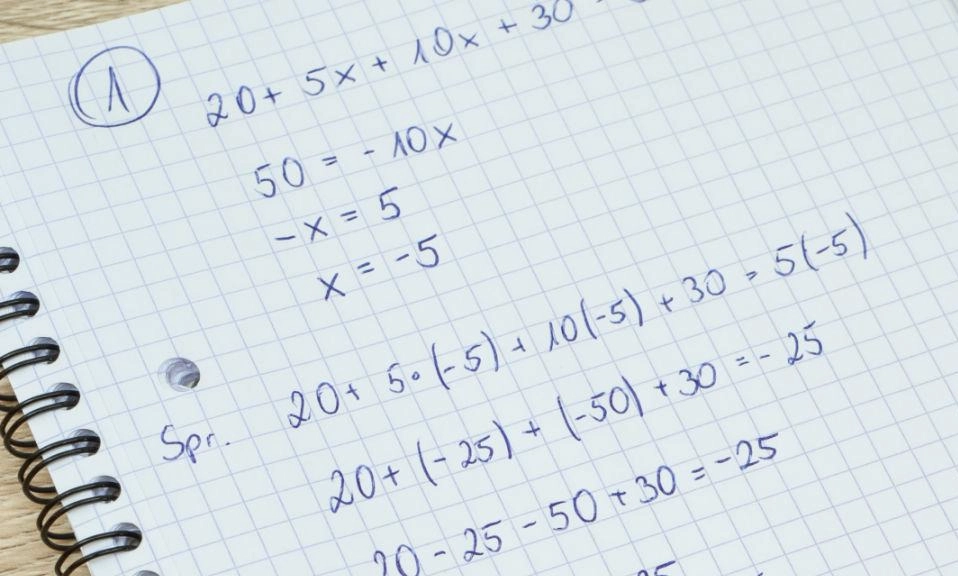
“I am just not a maths person.”
Have you ever said that? Most students have. And it is a lie.
Maths is not a talent. It is a skill. And like any skill, you can learn it if you learn it the right way.
The problem is, most students learn maths the wrong way. They memorize formulas, they copy solutions from the board, they do 50 identical questions the night before the exam, and then they panic when the exam asks a question that is slightly different.
The best way to get better at maths is to understand the concepts, practise regularly, learn from mistakes and strengthen your foundational skills.
To get better at maths, start by identifying the topics you find difficult, revising the foundational concepts and practising problems regularly. Learn from worked examples, explain your reasoning, review mistakes and gradually attempt more challenging questions.
A better approach is to understand the concept, solve problems step by step, learn from mistakes, and revise regularly.
Here are 10 techniques that will change how you learn maths, from “I don’t get it” to “Oh, that actually makes sense.”
Why Maths Feels So Hard
Maths is different from other subjects. In History, you can forget Chapter 1 and still understand Chapter 5. In Maths, you cannot.
Maths is a tower. If you miss one brick at the bottom, the whole tower wobbles.
If you do not understand fractions, you will struggle with algebra. If you do not understand algebra, you will struggle with trigonometry. If you do not understand trigonometry, calculus will feel impossible.
That is why “just practice more” does not work if you have a gap at the bottom. You need to find the gap, fix it, then build up.
Deep Conceptual Understanding Trumps Memorization: Focus on the ‘why’ behind formulas and methods to build versatile problem-solving skills.
1. Find Your Missing Foundation First
This is the most important technique. Do not start at the topic you are failing. Start below it.
How to do it:
You are failing Trigonometry. Do not start with Trigonometry. Ask: What do I need to know to do Trigonometry?
- Do I know Pythagoras? a² + b² = c²
- Do I know fractions and ratios?
- Do I know what a right triangle is? Opposite, Adjacent, Hypotenuse?
If you cannot answer those in 10 seconds, that is your gap. Go back and fix that first, for 30 minutes. Then Trigonometry will suddenly make sense.
Start by reviewing these essential areas: fractions, basic algebra, and number sense, before you jump to advanced topics.
The 5-Minute Test: Before you start a new topic, write down 5 questions from the previous topic. If you cannot solve 4 out of 5, you are not ready for the new topic yet. Go back.
Mistake to avoid: Skipping foundations because they feel “too easy” or “too embarrassing.” There is nothing embarrassing about fixing a gap. Every top mathematician does it.
2. Chunk It – Break Big Topics Into Tiny Pieces
Break It Down into Smaller Steps. Break big topics into smaller parts. Struggling with geometry? Start with lines and angles before jumping into complex proofs.
This is called chunking, and it’s a killer technique for learning math.
Example: Calculus feels impossible? Break it:
Do not learn “Calculus.” Learn:
- Chunk 1: What is a slope? What is a gradient?
- Chunk 2: What is a limit? What happens as x gets closer and closer?
- Chunk 3: What is a derivative? It is just the slope at one point.
- Chunk 4: What is an integral? It is just the area under a curve.
Learn Chunk 1 perfectly. Then Chunk 2. Then Chunk 3. Do not move on until Chunk 1 is easy.
How to chunk any topic:
- Write the big topic at the top: “Quadratic Equations”
- Break it into 5 small questions:
- What is a quadratic?
- How do I factorise?
- How do I complete the square?
- What is the quadratic formula?
- When do I use which method?
- Learn one question per day.
You cannot eat a whole pizza in one bite. You eat it slice by slice. Maths is the same.
3. Learn The WHY, Not Just The HOW
Focus on understanding, not memorising.
Math needs to make sense. That means don’t just memorize formulas but understand why they work.
Explain the “why,” not only the “how.”
Example: The Quadratic Formula
Most students memorize:
x = [-b ± √(b² – 4ac)] / 2a
They have no idea where it comes from. So when they forget one part, they are lost.
Smart students ask: Where does it come from? It comes from completing the square on ax² + bx + c = 0. Once you see the derivation once, you will never forget the formula, because you understand it.
Try this for every formula:
- Where does it come from?
- What does each letter mean?
- What happens if I change one number? What happens to the answer?
- Can I draw it?
If you can answer those, you know it. If you can only recite it, you do not know it yet.
4. The Cover-And-Solve Method – How To Use Worked Examples
A powerful technique is solving problems without looking at the answers immediately.
Most students read a worked example like this: They read the question, they read the solution, they say “yeah, that makes sense,” and they move on.
That is fake learning. You understood the teacher’s thinking, not your own.
Do this instead:
Step 1: Study: Read the worked example carefully. Understand each step. Why did they do that step?
Step 2: Cover: Cover the solution with your hand.
Step 3: Solve: Solve the same question from scratch, without looking. Talk out loud as you go: “First I need to… because…”
Step 4: Check: Uncover. Where did you get stuck? That is your gap.
Learn from worked examples, explain your reasoning, review mistakes and gradually attempt more challenging questions.
Do this for 3 worked examples, then try a new question on your own, without any help. If you can do the new one, you have learned it. If you cannot, go back to Step 1.
This one technique alone will double your maths grade.
5. Deliberate Practice – Easy, Medium, Hard, Not Just Easy
Consistent, Active Practice is Non-Negotiable: Regularly solving diverse problems solidifies understanding far more than passive reading.
But not all practice is equal. Doing 50 easy questions you already know is not practice. It is comfort.
The 3-Level Practice System:
- Level 1 – Easy (20% of your time): Questions you can do. Warm-up. Builds confidence.
- Level 2 – Medium (50% of your time): Questions that make you think for 2-3 minutes. This is where learning happens.
- Level 3 – Hard / Exam Style (30% of your time): Questions that scare you. Past paper questions. Questions that mix 2 topics together.
Rule: If you get 10 in a row right, the questions are too easy. Move up. If you get 10 in a row wrong, the questions are too hard. Move down one level.
And: Practice every day, not just before exams.
15 minutes of maths every day beats 5 hours on Sunday. Maths is like a muscle. It needs daily training.
6. Teach It Out Loud – The Feynman Technique For Maths
Talk It Through Out Loud.
Teach What You Learn to Someone Else.
How to do it:
- Pick one topic. Example: “How to solve simultaneous equations.”
- Explain it out loud, as if you are teaching a 12-year-old. Use simple words. No “then you just do it.” Explain why you do each step.
- Record yourself on your phone. Or teach your friend, your mum, your dog. It does not matter who listens. What matters is you say it.
You will discover gaps in 30 seconds. You will say: “And then you… um… you move the x over… because… um…” That “um” is where you do not understand.
Go back, fix that one gap, explain again.
If you can teach it simply, you know it. If you cannot, you do not.
Bonus: Teaching forces you to organize your thinking. That organization is what the exam tests.
7. Draw It – Maths Is Visual
Build visual intuition first.
Most students try to learn maths with only numbers and symbols. That is hard. Your brain loves pictures.
For every topic, ask: Can I draw it?
- Algebra: Draw a balance scale. x + 3 = 7. What do you need to take away from both sides to balance it?
- Trigonometry: Draw the triangle. Label Opposite, Adjacent, Hypotenuse. Do not just write sin, cos, tan.
- Calculus: Draw the curve. Draw the slope. Draw the area under the curve. The derivative is the slope. The integral is the area. Once you see it, you get it.
- Geometry: Do not just read the proof. Draw it. Color the angles. Move them around.
- Statistics: Draw the graph. What does the data look like?
Pay attention to “big ideas” (key concepts).
In maths class, listen to understand.
When you draw, you turn abstract symbols into something real. That is when it clicks.
8. Keep A Mistake Log – Your Most Valuable Notebook
Watch out for the mistakes to avoid.
Do not just do more questions. Learn from the questions you got wrong.
Get a notebook. Title it: My Maths Mistakes
Every time you get a question wrong, write:
Question | My Wrong Answer | Why I Got It Wrong | Correct Method |
|---|---|---|---|
Solve 2x + 5 = 15 | x = 10 | I forgot to subtract 5 first, I divided by 2 first | Subtract 5, then divide by 2. Order matters. |
Find sin 30° | I used cos | I mixed up opposite and adjacent | Draw triangle, label O, A, H first. |
Before your exam, do not re-do 100 random questions. Re-do your Mistake Log. Those are the mistakes you will make again if you do not fix them.
Most students make the same 5 mistakes over and over. Top students make a mistake once, log it, and never make it again.
9. Space It And Mix It – Spaced Repetition + Interleaving For Maths
Maths is perfect for spaced repetition, because you need to remember methods for months.
Spaced Repetition for Maths:
- Day 0: Learn factorization
- Day 1: Do 5 factorization questions from memory
- Day 3: Do 5 more, mixed with other topics
- Day 7: Do 5 more, timed
Interleaving for Maths: Do not do 20 factorization questions in a row. Mix them.
Do:
- Factorization
- Quadratic formula
- Simultaneous equations
- Factorization again, but harder
- Word problem that uses all three
Why? Because in the exam, questions are mixed. You need to practice choosing the right method, not just doing the method when someone tells you which one to use.
Leverage Smart Study Techniques & Resources: Combine methods like spaced repetition and active recall with online tools, tutoring, and collaborative learning for optimal results.
10. Use Focused + Diffuse Thinking, And Ask For Help Early
Embrace Both Focused and Diffused Thinking.
Your brain has two modes for learning maths:
Focused Mode: You are concentrating, solving, writing, actively working. This is Pomodoro time: 25 minutes on, 5 minutes off.
Diffuse Mode: You are relaxed, walking, showering, sleeping, doing something else. Your brain is quietly connecting ideas in the background.
This is why you often solve a hard maths problem in the shower, or the next morning. You were stuck in Focused Mode. Your brain needed Diffuse Mode to connect the dots.
How to use it:
- Study a hard problem for 25 minutes. If you are stuck, STOP. Go for a walk. Do something else. Sleep on it.
- Come back tomorrow. You will often see the solution immediately.
Do not sit for 3 hours stuck on one question. That is not productive. That is torture. Take a break, let your brain work in the background.
And: Ask for help.
Ask Questions During Class.
Ask Your Teacher for Help or Get a Tutor to Assist With the Difficult Math Topics.
Join a Math Study Group.
Use Multiple Resources and Explanations.
Channels like The Organic Chemistry Tutor, Professor Leonard, PatrickJMT, and others explain the same topic in different ways.
If your teacher’s explanation does not click, it is not your fault. It is just not the right explanation for you. Find a second explanation. Watch one YouTube video. Ask a friend to explain it. Ask your teacher a different way: “Can you show me with a picture?”
Do not wait 2 weeks to ask. Ask the same day you get confused. Maths gaps grow fast. A 10-minute question today saves you 10 hours next month.
The Ultimate Maths Study Session – Put It All Together
Here is a perfect 60-minute maths session using all 10 techniques:
Minute 0-5: Diagnose (Technique 1)
What is my gap? What foundation do I need? Write it down.
Minute 5-15: Learn The Why (Technique 2 + 3)
Break the topic into one chunk. Learn why the formula works. Draw it (Technique 7).
Minute 15-30: Cover-And-Solve (Technique 4)
Study 2 worked examples. Cover them. Solve them yourself out loud (Technique 6).
Minute 30-50: Deliberate Practice (Technique 5)
Do 5 questions: 1 easy, 3 medium, 1 hard. Mix topics (Technique 9). Time yourself.
Minute 50-60: Mistake Log + Plan (Technique 8)
Log every mistake. Write what you will review tomorrow (Technique 9). Stop. Go for a walk (Technique 10).
That is it. 60 minutes, done right, beats 3 hours of copying solutions.
You are not bad at maths.
You were just taught to memorize maths, not to understand it.
Find your gap. Chunk it. Learn the why. Cover and solve. Practice deliberately. Teach it. Draw it. Log your mistakes. Space it. Let your brain rest. Ask for help.
Maths is not about being fast. It is about being clear. If you can explain it simply, draw it, and solve a new question you have never seen before, you understand it. And if you understand it, the grade will follow.