For decades, the nutrition industry has been stuck in a loop of failure. We are fed generic, one-size-fits-all advice: “Eat less, move more,” or “Follow the food pyramid,” or “Cut carbs after 6 PM.”
But if these rules worked universally, we wouldn’t have a global metabolic health crisis.
The problem? You are not a population average. You are a biological individual. Your genetics, your gut microbiome, your sleep quality, and your stress levels make your metabolic response to a banana completely different from your coworker’s response to that exact same banana.
Enter AI-Powered Nutrition.
By 2027, the marriage of artificial intelligence, wearable tech, and biological data has shifted the paradigm from “guessing” to “knowing.” AI is no longer just generating generic meal plans; it is analyzing your real-time biomarkers to engineer a diet uniquely optimized for your body.
But can an algorithm actually create the “perfect” diet? Let’s look at how the technology works, the incredible benefits, and the very real limitations of letting AI dictate what’s on your plate.
🧬 1. How AI is Rewriting the Rules of Dieting
To understand the AI dietitian, you have to understand the data it’s feeding on. The “perfect” diet isn’t pulled from thin air; it’s calculated using a triad of modern tracking:
- Continuous Biomarker Tracking: Continuous Glucose Monitors (CGMs), once reserved for diabetics, are now mainstream. AI analyzes your real-time blood sugar responses to thousands of foods, learning exactly which meals give you energy and which cause a crash.
- Microbiome Sequencing: By analyzing a simple stool sample, AI can map the exact strains of bacteria in your gut. It can then predict how your specific microbiome will extract calories and produce inflammation-causing compounds from different foods.
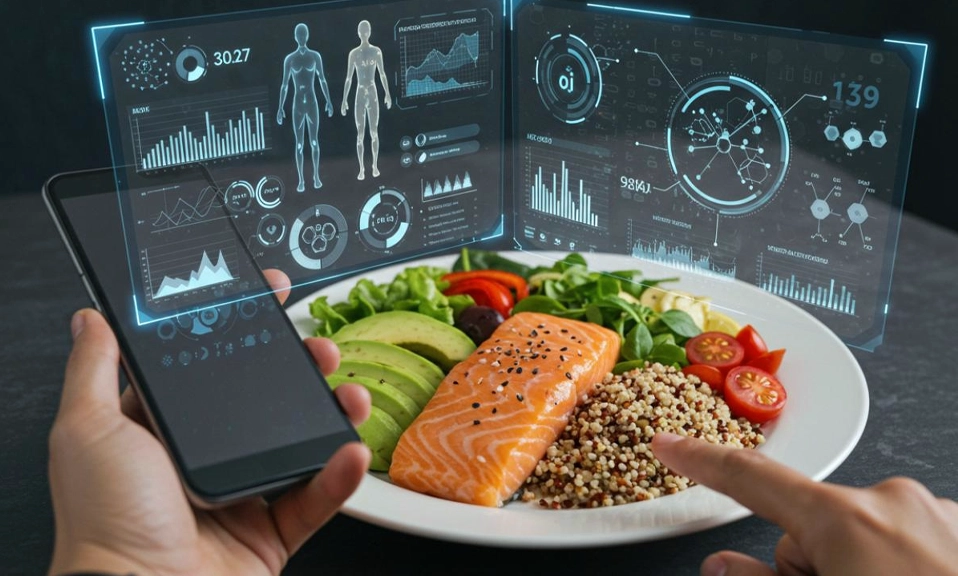
- Computer Vision & Frictionless Logging: Weighing chicken breast and typing it into an app is a thing of the past. You snap a photo of your plate, and AI instantly identifies the ingredients, estimates the portion sizes, and logs the macros in seconds.
🦸♂️ 2. The Superpowers of an AI Dietitian
When you combine this data with advanced machine learning, the results are nothing short of revolutionary.
- Hyper-Personalization: Landmark studies (like the PREDICT trials) have proven that people have wildly different blood sugar and fat responses to the exact same meals. AI maps your unique metabolic fingerprint, telling you exactly which foods make you thrive, rather than relying on outdated population averages.
- Real-Time Course Correction: A human dietitian gives you a PDF and sees you once a month. An AI dietitian adapts daily. If your smart ring detects that you slept poorly and your stress (cortisol) is high, the AI might suggest a higher-carb, nutrient-dense breakfast to support your nervous system, rather than the fasting protocol it suggested on a day you slept perfectly.
- Eliminating the “Mental Load”: The hardest part of dieting is the constant decision fatigue. AI removes the friction by generating recipes based on the exact ingredients left in your fridge, optimizing them for your specific macro and micronutrient goals for that day.
🚧 3. The Glitch in the Algorithm (The Limitations)
As powerful as this technology is, handing over your dietary autonomy to a machine comes with significant caveats.
- The Empathy Deficit: Nutrition is not just biology; it is deeply psychological. We eat to celebrate, to comfort ourselves, and to connect with culture. An AI can tell you that a slice of birthday cake will spike your glucose, but it cannot hold your hand when you are stress-eating after a terrible day, nor does it understand the social joy of sharing a meal.
- The “Perfect” Fallacy: If you ask AI to optimize purely for biological markers, it might suggest a diet of highly optimized, flavorless nutrient pastes. But humans aren’t robots. A “perfect” diet that makes you miserable because you can’t enjoy the foods you love is a diet you won’t stick to. Compliance and joy matter just as much as cellular optimization.
- Data Privacy Nightmares: To give you the perfect diet, AI needs to know everything: your blood sugar, your bowel movements, your sleep, and your location. You are handing over the most intimate biological data imaginable to tech companies. In an era of data breaches, this is a massive vulnerability.
🛠️ 4. How to Use AI for Your Nutrition Right Now
You don’t need a $5,000 comprehensive biological workup to start leveraging AI for your health today. Here is how to use it as a tool, not a master:
- Use AI for Culinary Creativity: Got half a zucchini, some chickpeas, and a lemon? Ask an AI: “Give me a high-protein, high-fibre recipe using these ingredients that takes under 20 minutes.” It’s an incredible tool for reducing food waste and eating whole foods.
- Use AI to Decode Your Blood Work: If your doctor hands you a printout of blood test results with confusing numbers, you can paste the data into a secure, private AI tool and ask, “Explain these lipid panel results in plain English and suggest lifestyle interventions.”
- Use AI as a Socratic Coach: Instead of asking AI, “What should I eat?” ask it, “I’m trying to reduce my afternoon energy crashes. Based on my typical lunch of a turkey sandwich, what biological mechanisms might be causing this, and what are three alternative meals to test?” Let it guide your experimentation.
AI is the Ultimate Co-Pilot, Not the Autopilot
Can artificial intelligence create the “perfect” diet for you? Biologically, yes. Psychologically, no.
AI is the most powerful nutritional tool ever created. It can strip away the guesswork, optimize your metabolic health, and help you understand your unique body in ways we couldn’t have imagined a decade ago.
But the “perfect” diet isn’t just a math equation. It’s a sustainable, joyful way of eating that nourishes your cells and your soul. AI can build the ultimate nutritional roadmap, but you still have to drive the car. And more importantly, you still have to enjoy the scenery along the way.
Use AI to optimize your health, but never let an algorithm rob you of the human experience of food.