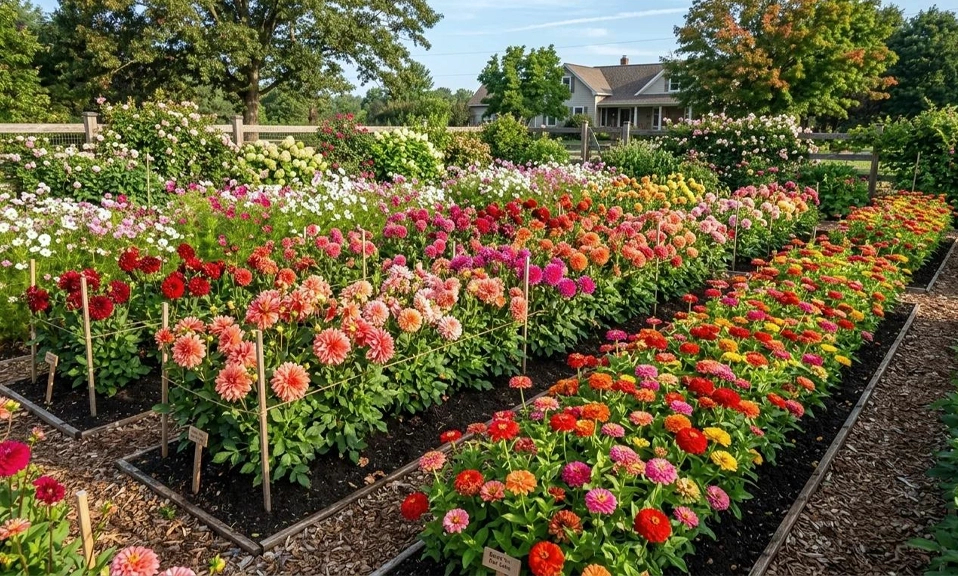
There is a specific kind of magic that happens on a Saturday morning in mid-July. You walk out into your garden with a pair of scissors and a bucket of water. Twenty minutes later, you walk back inside carrying an armful of zinnias, cosmos, sweet peas, and dusty eucalyptus. You trim the stems, arrange them in a jug on your kitchen table, and suddenly your home looks like it belongs in a magazine.
And the best part? You did it yourself. For pennies. From a patch of dirt no bigger than a dining table.
Cut flower gardening is having a massive moment right now, and it’s easy to see why. In a world of £25 supermarket bouquets wrapped in plastic, there is something quietly radical about growing your own. Your home-grown flowers will be fresher, more fragrant, and far more interesting than anything you can buy. They’ll last longer in the vase, they’ll support pollinators, and they’ll give you that rare, deeply satisfying feeling of creating something beautiful with your own hands.
If you’ve ever wanted to grow your own cutting garden but didn’t know where to start, this is your complete, beginner-friendly guide. By the end of this post, you’ll know exactly what to plant, when to cut, and how to keep your bouquets looking fresh for weeks.
🌸 Why Grow Your Own Cut Flowers? (Beyond the Pretty Petals)
Before we get to the seeds, let’s talk about why this is worth your time and space.
- The Cost: A single bouquet from a florist can cost £20 to £50. A packet of zinnia seeds costs about £2 and produces enough flowers for a dozen bouquets. The math is staggering.
- The Freshness: Shop-bought flowers have often been cut days (sometimes weeks) before they reach your home. Your home-grown flowers go from soil to vase in seconds. They last longer and smell infinitely better.
- The Varieties: Commercial flower farms grow varieties bred for shipping durability, not beauty or scent. When you grow your own, you can choose the most fragrant roses, the most delicate sweet peas, and the most unusual colours that would never survive a trip in a lorry.
- The “Cut and Come Again” Effect: Most cut flowers actually produce more when you harvest them. The more you cut, the more they bloom. It’s one of the few areas in life where taking actually creates abundance.
🌱 The Golden Rule: Grow “Cut-and-Come-Again” Annuals
If you take only one thing from this guide, let it be this: start with annuals.
Annuals complete their life cycle in one year. They grow fast, bloom heavily, and—crucially—they respond to cutting by producing more flowers. Perennials (like peonies and delphiniums) are gorgeous, but they bloom for a short window and don’t take kindly to heavy harvesting. Annuals are the workhorses of the cutting garden.
The best cut-and-come-again annuals are:
- Zinnias (the undisputed queen of cut flowers)
- Cosmos
- Sweet peas
- Snapdragons
- Sunflowers (branching varieties)
- Dahlias (technically tubers, but behave like annuals in most climates)
- Statice
- Bells of Ireland
🌷 The 15 Best Flowers for Your Cutting Garden
Here is your starter roster, organised by season so you can plan for continuous blooms from spring through the first frost.
🌷 Spring Bloomers
1. Sweet Peas (Lathyrus odoratus) The Vibe: The most fragrant flower in the garden. Period. Why it’s perfect for cutting: The more you pick, the more they produce. A single row can supply bouquets for months. How to grow: Sow in autumn or early spring. Provide a tall trellis. Pick every 2–3 days or they’ll go to seed and stop flowering.
2. Tulips The Vibe: Classic, elegant, and endlessly varied. Why it’s perfect for cutting: Grow “double” or “parrot” varieties for dramatic, peony-like blooms. How to grow: Plant bulbs in autumn. Cut when the buds are just starting to show colour—they’ll continue opening in the vase.
3. Ranunculus The Vibe: The paper-thin, rose-like showstopper. Why it’s perfect for cutting: Each corm produces 8–10 stunning blooms. They last up to 10 days in a vase. How to grow: Plant corms in early spring (or autumn in mild climates). Soak them overnight before planting.
🌻 Summer Bloomers (The Peak Season)
4. Zinnias (Zinnia elegans) The Vibe: The cheerful, bullet-proof backbone of every cutting garden. Why it’s perfect for cutting: They come in every colour except blue, bloom non-stop from July to frost, and are almost impossible to kill. How to grow: Direct-sow seeds after the last frost. Pinch the tops when they’re 15cm tall to encourage branching. Cut frequently. Pro tip: Try the ‘Benary’s Giant’ or ‘Oklahoma’ series for long, sturdy stems.
5. Cosmos (Cosmos bipinnatus) The Vibe: The airy, daisy-like filler that makes everything look effortless. Why it’s perfect for cutting: They add movement and lightness to bouquets. The more you cut, the more they bloom. How to grow: Direct-sow in spring. They thrive on neglect and poor soil.
6. Sunflowers (Branching Varieties) The Vibe: Bold, joyful, and impossible not to love. Why it’s perfect for cutting: Branching varieties (like ‘Autumn Beauty’ or ‘ProCut’) produce multiple blooms per stem, unlike the single-headed pollen-free types. How to grow: Direct-sow every 2 weeks for a continuous supply. Stake tall varieties. Pro tip: Cut in the early morning when petals are just opening, before the pollen drops.
7. Snapdragons (Antirrhinum) The Vibe: The tall, dramatic spires that add vertical interest. Why it’s perfect for cutting: They have incredible vase life (up to 2 weeks) and come in gorgeous pastel and jewel tones. How to grow: Start indoors 8 weeks before last frost, or direct-sow. Pinch when young for bushier plants.
8. Dahlias The Vibe: The extravagant, dinner-plate showstoppers. Why it’s perfect for cutting: They bloom from midsummer until the first frost. Cutting them actually signals the plant to produce more tubers for next year. How to grow: Plant tubers after last frost. Stake heavily. Deadhead religiously. Pro tip: ‘Café au Lait’ and ‘Kelvin Floodlight’ are the most sought-after varieties for bouquets.
9. Cosmos ‘Chocolate’ (Cosmos atrosanguineus) The Vibe: The velvety, cocoa-scented perennial that behaves like an annual. Why it’s perfect for cutting: The deep burgundy blooms are unforgettable, and they genuinely smell like chocolate. How to grow: Plant in full sun, well-drained soil. Lift tubers in cold climates.
🍂 Autumn Bloomers (The Grand Finale)
10. Chrysanthemums The Vibe: The reliable, long-lasting autumn staple. Why it’s perfect for cutting: They bloom when everything else is fading, and they last forever in a vase. How to grow: Plant in spring for autumn blooms. Pinch until mid-summer for bushy plants.
11. Anemone (Anemone coronaria) The Vibe: The delicate, papery blooms with dramatic dark centres. Why it’s perfect for cutting: They have an incredible 10–14 day vase life and look stunning in minimalist arrangements. How to grow: Soak corms overnight, plant in autumn or early spring.
🌿 The Essential Fillers & Foliage
A great bouquet isn’t just flowers—it’s texture, greenery, and air. These are the supporting cast that makes your arrangements look professional.
12. Bells of Ireland (Moluccella laevis) The Vibe: The tall, architectural, apple-green spires. Why it’s perfect: They add height, structure, and a cool colour that complements everything. How to grow: Start indoors early. They’re slow to germinate but worth the patience.
13. Ammi Majus (False Queen Anne’s Lace) The Vibe: The lacy, white, cloud-like filler that florists adore. Why it’s perfect: It adds airiness and makes expensive flowers look even more luxurious. How to grow: Direct-sow in spring or autumn. It self-seeds gently.
14. Eucalyptus (Eucalyptus populnea or gunnii) The Vibe: The silvery, fragrant foliage that elevates any bouquet. Why it’s perfect: It lasts for weeks in water and smells incredible. How to grow: Grow as an annual in cold climates, or as a shrub in mild ones. Cut stems and strip lower leaves.
15. Dusty Miller (Jacobaea maritima) The Vibe: The velvety, silver-white foliage that looks almost artificial. Why it’s perfect: It provides stunning contrast against bright flowers and deep greens. How to grow: Grow as an annual. Pinch for bushy growth.
📐 How to Plan Your Cutting Garden (The “Three-Thirds” Rule)
A common beginner mistake is planting only “feature” flowers and ending up with bouquets that look flat and one-dimensional. Professional florists use a simple formula: every bouquet needs three elements.
- Focal Flowers (1/3): The big, bold blooms that draw the eye. (Dahlias, sunflowers, ranunculus, zinnias)
- Secondary Flowers (1/3): Smaller blooms that add colour and variety. (Cosmos, snapdragons, sweet peas)
- Fillers & Foliage (1/3): The texture, greenery, and air that hold everything together. (Ammi majus, bells of Ireland, eucalyptus, dusty miller)
When planning your garden beds, plant in roughly these proportions. You’ll always have the right ingredients for a balanced bouquet.
✂️ How to Cut Flowers the Right Way (This Matters More Than You Think)
Cutting flowers isn’t just about snipping stems. How and when you cut determines how long they’ll last in the vase.
1. Cut in the Early Morning (or Late Evening) This is non-negotiable. Plants are most hydrated first thing in the morning, before the sun has drawn moisture out of their tissues. Flowers cut at noon on a hot day will wilt within hours, even if you put them in water immediately.
2. Cut at the Right Stage
- Too tight: They may never open in the vase (especially peonies and dahlias).
- Too open: They’ll drop petals quickly.
- The sweet spot: Cut when buds are just starting to show colour or have just opened. They’ll continue to open in the vase and last far longer.
3. Cut at an Angle Always cut stems at a 45-degree angle with sharp, clean secateurs. This increases the surface area for water uptake and prevents the stem from sitting flat on the bottom of the vase, which blocks water absorption.
4. Cut Above a Leaf Node When you cut a stem, make your cut just above a set of leaves or a “node” (the bump where leaves emerge). This encourages the plant to branch out and produce two new stems instead of one. This is the secret to the “cut and come again” effect.
5. Immediately Into Water Have a bucket of clean, room-temperature water ready. As soon as you cut a stem, plunge it into the water. Don’t let them sit in the sun or wind, even for a few minutes.
🏺 How to Condition Your Flowers (The Secret to Long-Lasting Bouquets)
This is the step most beginners skip—and it’s the difference between a bouquet that lasts 3 days and one that lasts 10.
Step 1: Strip the Lower Leaves Remove any leaves that will sit below the waterline in your vase. Leaves in water rot quickly, breeding bacteria that clogs stems and shortens vase life.
Step 2: Recut the Stems Once indoors, recut each stem under water (or immediately after removing from the bucket) at a fresh 45-degree angle. This removes any air bubbles that may have entered the stem.
Step 3: Use Flower Food (Or Make Your Own) The packet that comes with shop-bought flowers isn’t marketing fluff—it contains sugar (for energy), acid (to lower pH and improve water uptake), and bleach (to kill bacteria). If you don’t have it, make your own:
- 1 teaspoon sugar
- 1 teaspoon household bleach
- 2 teaspoons lemon juice or vinegar
- 1 litre of lukewarm water
Step 4: Condition Overnight This is the pro secret. After preparing your stems, place them in a bucket of water in a cool, dark place (a garage, a shady corner, or even a fridge if you have space) for 6–12 hours before arranging them. This allows them to fully hydrate and firm up. They’ll last dramatically longer once arranged.
Step 5: Change the Water Every 2 Days Bacteria is the enemy. Every 2 days, empty the vase, rinse it, recut the stems by 1cm, and refill with fresh water and flower food. Your bouquet will last twice as long.
🚫 5 Beginner Mistakes That Kill Cut Flower Gardens
1. Planting Too Little One zinnia plant is not a cutting garden. To have enough for regular bouquets, you need volume. Plant in rows of 10–20, not single plants scattered around the border.
2. Not Succession Sowing If you sow all your seeds on the same day in spring, everything will bloom at once in July and then you’ll have nothing in September. Sow a new row of zinnias, cosmos, and sunflowers every 2–3 weeks for a continuous supply all summer.
3. Being Too Reluctant to Cut It feels wrong to cut off beautiful flowers. But flowers are like a bank account—the more you withdraw, the more the plant produces. If you leave flowers on the plant to “enjoy them,” the plant will go to seed and stop blooming. Cut them. Enjoy them indoors. The plant will make more.
4. Ignoring the “Ugly” Stage Many cut flowers (especially sweet peas and snapdragons) look messy and tired before they die. Don’t wait for them to look perfect—cut them when they’re at their peak, even if it means the plant looks bare for a few days. It will regrow.
5. Not Staking Tall Varieties Dahlias, snapdragons, and sunflowers will flop in wind and rain without support. Install stakes or netting when plants are small, not after they’ve already fallen over.
💐 A Simple Beginner’s Bouquet Recipe
Not sure how to put it all together? Here’s a foolproof formula for a gorgeous, balanced bouquet:
- Start with foliage: Add 3–5 stems of eucalyptus or dusty miller to your vase first. This creates the “skeleton.”
- Add your focal flowers: Place 3–5 of your largest blooms (dahlias, zinnias, or sunflowers) at varying heights.
- Fill in with secondary flowers: Add 5–7 medium blooms (cosmos, snapdragons, sweet peas) around the focal flowers.
- Add fillers and air: Tuck in sprigs of ammi majus, bells of Ireland, or grasses to add lightness and movement.
- Step back and edit: Remove anything that looks crowded or out of place. Less is almost always more.
Start Small, Cut Often
You don’t need a sprawling cutting garden to enjoy the magic of home-grown flowers. A single 1m x 1m bed, or even three large containers on a balcony, can supply you with bouquets all summer long if you plant the right things and cut them regularly.
Start with the easy wins: a row of zinnias, a handful of cosmos, and some sweet peas climbing a trellis. Learn how they respond to cutting. Watch how they regenerate. Feel the quiet thrill of walking out with scissors and coming back with an armful of colour.
Cut flower gardening is one of the most rewarding forms of gardening there is. It’s creative, it’s productive, and it fills your home with beauty that you created with your own hands.
Buy some seeds. Find a sunny patch. And get ready to start cutting.