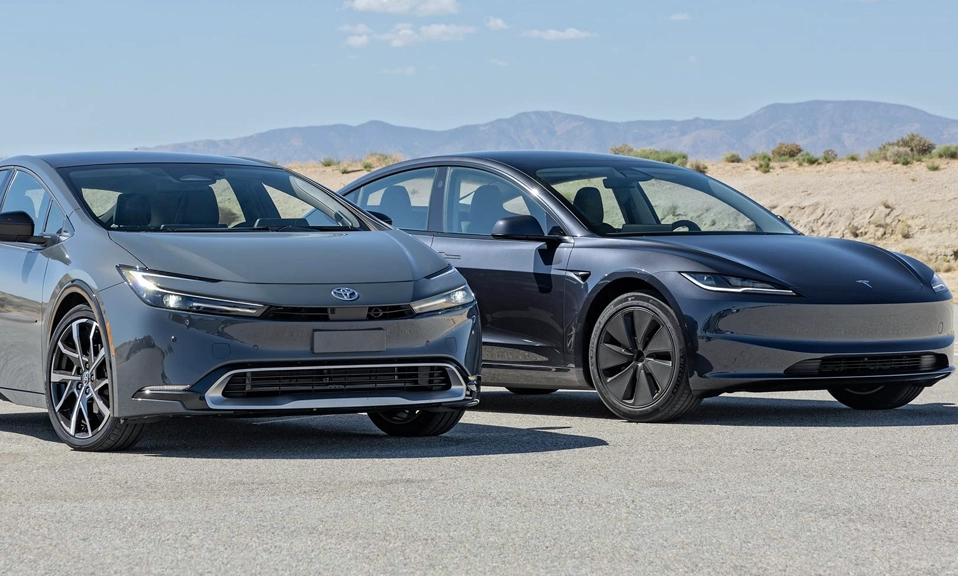
One car wants to save you from gas stations. The other wants to make gas stations irrelevant.
They both look like the future. They both promise low running costs. But they solve the problem in opposite ways, and picking the wrong one for your life will cost you thousands.
The Toyota Prius says: Keep your freedom, use far less fuel.
The Tesla Model 3 says: Ditch fuel completely, plug in at home, and never visit a petrol station again.
So which one actually makes more sense in 2026? It depends on one question: Where do you charge, and how do you drive?
The Quick Verdict
Buy the Prius if: You have no reliable home charging, you do long road trips often, you want the lowest upfront price, or you live where fast chargers are still rare.
Buy the Model 3 if: You can charge at home, most of your driving is city and commuting, you want instant torque and tech, and you can stomach higher insurance and depreciation.
Buy the Prius Plug-in Hybrid if: You want both, and your daily commute is under 40 miles.
Head To Head: 2026 Models
Toyota Prius (Hybrid) | Tesla Model 3 (Electric) | |
|---|---|---|
Starting price (US) | Around $28,550 | $36,990 |
Power | 194 hp FWD, 196 hp AWD | 283 hp and up, depending on trim |
0 to 60 mph | 7.2 seconds | 5.8 seconds for Standard RWD, 2.9 seconds for Performance |
Range / Economy | Up to 57 mpg combined | 321 to 363 miles EPA, depending on trim |
Fueling / Charging | 5 minutes at any petrol station | Home overnight, or 25 to 33 minutes at a Supercharger for 10 to 80 percent |
Tank / Battery | 11.3 gallon tank, about 644 miles | 57.5 to 79 kWh battery, depending on trim |
The 2026 Toyota Prius pairs a 2.0L four-cylinder engine with the fifth-generation Toyota Hybrid System (THS) for a net 194 horsepower with front-wheel drive, or 196 horsepower with available electronic on-demand all-wheel drive (AWD).
The 2026 Toyota Prius starts at a TSRP of $28,550 for the LE and keeps things simple with four hybrid grades.
The most efficient Prius LE is EPA-rated at 57 mpg combined, while Toyota rates front-wheel-drive models at 194 horsepower and estimates 0–60 mph in 7.2 seconds.
The 2026 Toyota Prius LE front-wheel drive has an 11.3 gallon gas tank. It can travel for around 644 miles on a single tank of gas.
The Tesla Model 3 starts higher. Price Range: $36,990 – $54,990.
- Model 3 rear-wheel drive (the “Standard”), $36,990: 321 miles of EPA range, 0–60 mph in 5.8 seconds.
- Model 3 Premium rear-wheel drive, $42,490: 363 miles, 4.9 seconds.
- Model 3 Performance AWD, $54,990 and 0 to 60 in 2.9 seconds.
One creator broke it down on a whiteboard as Prius LE at $28,850 and a higher trim at $36,965 versus Model 3 at $36,990, noting the Prius gets 56 MPG while the Model 3 is rated at 139 MPGe.
1. The Real Cost: Purchase Price vs Running Cost
The Prius wins on purchase price. The Model 3 can win on running cost, but only if your electricity is cheap and your insurance is not too high.
In one 5-year comparison for 15,000 miles per year, the Tesla cost about $38,380 to buy, the Prius about $29,745. After five years the Tesla spent about $3,310 on electricity versus $5,257 on gas for the Prius, but paid about $495 more per year for insurance.
In that same comparison, depreciation hit the Tesla harder, with about $20,966 lost versus about $9,548 for the Prius, putting total 5-year cost at about $41,191 for the Tesla and $30,395 for the Prius.
That is not a universal rule. It shows how much depreciation and insurance matter. In another real-owner story, a driver who switched from a Prius to a used Model 3 found electricity cost about $500 per year versus about $1,600 for his old Prius, but Tesla insurance was $60 to $70 per month more expensive, plus he paid for a home charger install, leaving him roughly breaking even financially versus the Prius.
The math you should do:
- Prius: Take your yearly miles, divide by 50 mpg, multiply by your local fuel price.
- Model 3: Take your yearly miles, multiply by about 0.25 kWh per mile, multiply by your home electricity price.
If you pay high electricity prices and cheap fuel, the Prius can actually cost the same or less per 1,000 miles. One comparison at California rates put the Prius at $90 for 1,000 miles versus $95.54 for the Model 3, though commenters argued the comparison mixed a high California electricity rate with a national average gas price.
At the US average of $0.18 per kWh (EIA, January–July 2026), a 20–80% charge at home costs about $8.48 in a Model 3.
At the US average residential electricity rate of ∼$0.17/kWh, fully charging a Model 3 Long Range (79 kWh) costs about $13.40, roughly $0.04 per mile.
2. Driving: Smooth And Sensible vs Instant And Addictive
The Prius is no longer the slow, boring car from 2010. With 194 hp, it feels normal, quiet, and confident in traffic. It is the car you forget you are driving, in a good way.
The Model 3 is a different animal. Even the base model feels fast because electric motors give instant torque. No gears, no waiting, no engine noise. The Performance version is supercar fast.
If you love driving, the Model 3 wins easily.
If you just want comfortable, stress-free commuting, the Prius is more than enough.
3. Fueling vs Charging: The Lifestyle Question That Decides Everything
This is the real decision.
Prius life: You fill up in 5 minutes, anywhere, and go 644 miles. You never think about charging. You never plan a trip around chargers. On a long road trip, you just drive.
Model 3 life: You plug in at home at night, and you wake up to a full “tank” every morning. You almost never visit a public charger for daily driving. For road trips, you stop at a Supercharger.
Measured 10–80% sessions on a V3 or V4 Supercharger take about 27 minutes in a Model Y Premium, 30 in a Model 3 Premium and 33 in a Model 3 Standard.
That 30-minute stop is fine if you plan for coffee and a stretch. It is painful if you are in a hurry, or if chargers are full, broken, or far away.
Ask yourself honestly:
- Do you have a garage, driveway, or dedicated parking where you can install a home charger?
- Do you drive more than 200 miles in one day, more than twice a month?
- Is public fast charging reliable where you live?
If you answered no, yes, no, the Prius is the smarter choice right now. If you answered yes, no, yes, the Model 3 will feel effortless.
In places like Kampala, where public fast charging is still rare and fuel stations are everywhere, that infrastructure gap alone often tips the balance toward the Prius, even if you love the Tesla idea.
4. Maintenance, Reliability, And Peace Of Mind
Both cars are cheap to maintain compared to most gas cars, but for different reasons.
One list of 10-year maintenance costs put the Tesla Model 3 at $3,587 and the Toyota Prius at $4,008, ahead of most other cars.
Prius: Still needs oil changes, but less often than a normal gas car because the engine works less. Brakes last very long thanks to regenerative braking. Toyota hybrids have a 20-year reputation for lasting 250,000+ miles with basic care.
Model 3: No oil changes, no spark plugs, no exhaust, no transmission fluid. Just tires, cabin filter, wipers, and brake fluid checks. That is a huge win.
The catch: When something does go wrong on a Tesla, like a screen, suspension, or body repair, it can be more expensive and slower to fix, especially outside major Tesla service areas. Prius parts are available almost everywhere.
5. The Secret Third Option: Prius Plug-in Hybrid
Do not skip this one. It is the compromise most people actually want.
The 2026 Prius Plug-in Hybrid, also known as the Prius Prime, represents the technical peak of the manufacturer’s fifth-generation hybrid lineage.
On a full charge, the SE trim offers an EPA-estimated all-electric range of up to 44 miles. The XSE and XSE Premium trims, which utilize larger wheels, provide an estimated 39 miles of electric range.
SE 4dr Hatchback which starts at $33775.
All three share 19-inch wheels, the same 220-hp combined plug-in system, and the same 39-mile EPA-estimated electric range and 114 MPGe combined for the higher trims.
If your daily commute is under 40 miles and you can charge at home overnight, you can drive electric all week, then use gas for weekend trips with no range anxiety. That is the best of both worlds, and for many drivers, it beats both the regular Prius and the Model 3.
Who Should Buy Which?
Buy the Toyota Prius if you:
- Want the lowest total cost and lowest risk
- Drive long distances, do road trips, or live in an apartment with no charger
- Keep cars for 10+ years and want parts everywhere
- Want a car that just works, anywhere
Buy the Tesla Model 3 if you:
- Can charge at home every night
- Drive mostly under 200 miles per day
- Want the best tech, the best performance for the price, and the lowest daily running cost
- Are comfortable with higher insurance and faster depreciation in some markets
Buy the Prius Plug-in Hybrid if you:
- Want electric commuting plus gas freedom
- Have home charging but also do long trips
- Want lower fuel bills without changing your life
The Prius is the smart,
safe, sensible choice. It saves you money without asking you to change anything about how you live.
The Model 3 is the bold, exciting, future-proof choice. It saves you even more on daily running costs, but only if your charging life supports it.
If you have home charging and mostly do city driving, the Model 3 makes more sense, and you will love it every morning when you wake up to a full battery.
If you do not have home charging, do frequent long trips, or live where chargers are scarce, the Prius makes more sense, and you will never regret it.
There is no wrong answer. There is only the wrong answer for your life.