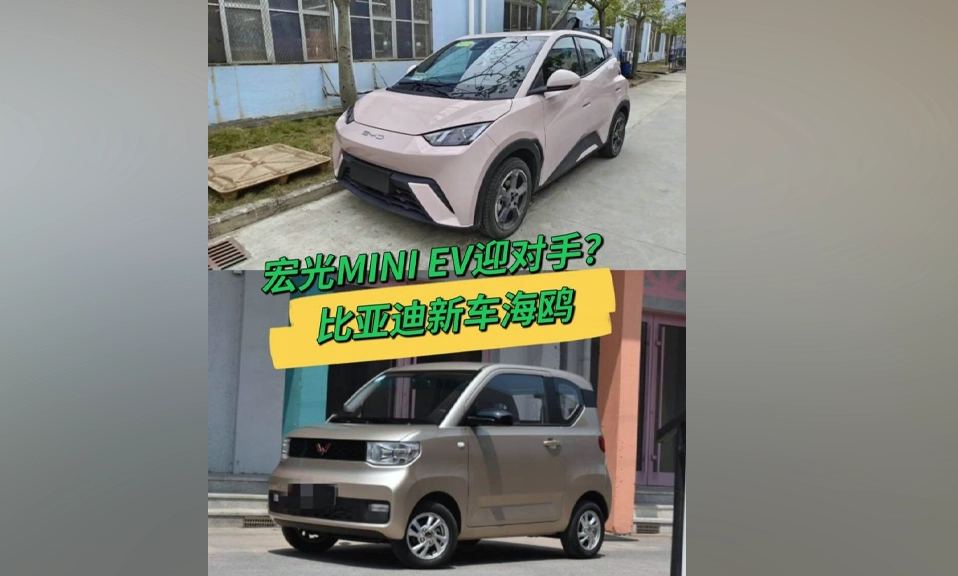
One costs less than a used motorbike in some markets. The other costs less than a new iPhone collection.
Both are electric. Both are tiny. Both have already changed what a car can cost.
But they are not the same car at all.
The Wuling Hongguang Mini EV is the cheapest way to own a brand-new electric car on earth.
The BYD Seagull is the cheapest way to own a real electric car that can actually leave the city.
So which one is better? It depends on whether you need a city toy, or a city car that can also do highways.
The Quick Verdict
Buy the Wuling Hongguang Mini EV if: You want the absolute lowest price, you drive only in town, you need something tiny for tight streets and tight parking, and you do not need highway speed.
Buy the BYD Seagull if: You want a proper 5-seat hatchback, you sometimes drive on highways, you want faster charging, more range, more safety tech, and you can spend about $3,000 more.
If you can afford the Seagull, buy the Seagull. The Wuling wins on price. The Seagull wins on almost everything else.
Head To Head: 2026 Models
Wuling Hongguang Mini EV (2026) | BYD Seagull (2nd Gen, 2026) | |
|---|---|---|
Price in China | $6,200 to $7,600, before subsidies | $9,829 to $14,900 |
Seats / Doors | 4 seats / 4 doors | 5 seats / 5 doors |
Length | 3,268 mm | 4,205 mm |
Power | 30 kW, about 40 hp | 85 kW (114 hp) or 95 kW (127 hp) |
Top speed | 100 km/h | 130 km/h |
Range (CLTC) | 205 km or 301 km | 320 km or 420 km |
Real-world range | About 140 to 200 km | About 220 to 300 km |
DC fast charging | 30 to 80 percent in 35 minutes | 30 to 80 percent in 30 minutes, flash charging on top trims |
Best for | Pure city, short trips | City plus suburbs plus highway |
Wuling introduced the updated Hongguang Mini EV (2026) in late March 2026 with four variants priced between $6,200 and $7,600 (before subsidies).
The top trim delivers up to 187 miles (301 km) of CLTC-rated driving range, or roughly 130 miles under EPA standards.
BYD launched it in Zhengzhou, Henan on 20 October 2026 with five trims priced from CNY 65,900 ($9,829) to CNY 99,900 ($14,900).
Two second-generation Blade battery packs of 30.1 kWh and 39.2 kWh give 320 km and 420 km on the CLTC cycle.
1. Price: Wuling Is Unbeatable, Seagull Is Still Shockingly Cheap
Let us be honest. No other new car in the world starts at $6,200.
The current four-door, four-seat version launched in March 2026. It measures 3,268mm long and has a 2,190mm wheelbase. Power comes from a 30kW electric motor, while its LFP battery options provide claimed CLTC ranges of 205km and 301km. Prices for the current model range from RMB 44,800 to RMB 54,800.
It costs RMB 44,800 to RMB 54,800 (approx. US$6,600 to US$8,100), or from RMB 42,800 with a trade-in subsidy.
That is why it became a phenomenon. The Wuling Mini EV became one of China’s best-selling cars, especially in smaller cities, and made EV ownership accessible to millions of middle-class families rather than just wealthy elites.
The Seagull is more expensive, but still absurdly cheap for what you get. One viral explainer put it like this: In the US market, where Tesla‘s cheapest car costs around $35,000, in China options start at a few thousand dollars. He cites the BYD Seagull as an example, priced under $10,000, offering up to 250 miles of range, fast charging, and a rotating iPad-style touchscreen, and then introduces the Wuling Mini EV, shown driving on roads and on a factory line, noting it starts at around $5,000.
A graphic that went viral this year called the BYD Seagull a ‘game-changer’ hatchback priced at approximately $7,800 to $9,700, featuring BYD’s ‘Blade Battery’ and offering up to 190 to 250 miles of range depending on trim, while describing the Wuling Hongguang Mini EV as a compact four-seater for urban commuting with over 180 miles of range.
Important: Those China prices are not what you will pay in Africa, Latin America, or the Middle East. Import tax, shipping, and dealer markup can double the price. Always check your local landed price, not the China price.
2. Size And Space: Microcar vs Real Hatchback
This is the biggest difference you feel in 5 seconds.
Wuling: 3,268 mm long. That is shorter than most motorbikes with a sidecar. You can park it anywhere. You can U-turn anywhere. But the back seats are for kids, short trips, or bags, not adults for an hour. The boot is basically a shopping bag space.
Seagull: 4,205 mm long, 1,810 mm wide, and 1,570 mm high, with a 2,650 mm wheelbase.
The new Seagull measures 4,205 mm in length, 1,810 mm in width and 1,570 mm in height, making it 425 mm longer than the previous model.
It is now the size of a normal small hatchback, like a Toyota Yaris or Suzuki Swift. Five adults can actually fit. You can do a weekly shop. You can put a baby seat in and still close the door without a fight.
The second-gen Seagull also adds a 94-liter storage compartment under the bonnet.
If you have a family, or you carry more than one passenger often, the Seagull is not just better, it is the only one of the two that makes sense.
3. Performance: City Scooter vs Highway Car
Wuling: A rear-mounted permanent magnet synchronous motor delivers around 30 kW (approximately 40 to 41 hp) and sufficient torque for brisk city driving (0 to 50 km/h in about 4.5 seconds).
That 0 to 50 km/h time sounds fast, but it stops there. Top speed is 100 km/h, and 0 to 100 km/h takes about 31 seconds.
In town, it feels zippy. On a highway, it feels scared. You will not overtake trucks. You will not keep up at 110 km/h. It is a 0 to 80 km/h car.
Seagull: The new Seagull is powered by electric motors producing 85 kW (114 hp) or 95 kW (127 hp), both delivering 130 N·m of torque.
Acceleration 0 to 50 km/h in 4.9 seconds with a top speed of 130 km/h.
That is three times the power of the Wuling. It can merge on a highway. It can overtake. It can do 110 km/h without screaming.
If you ever leave the city, the Seagull wins easily.
4. Range And Charging: Both Good For City, Seagull Better For Real Life
Both use LFP batteries, which are safer, longer-lasting, and cheaper than other chemistries.
Wuling: Battery options (LFP chemistry) of 205 km and 301 km CLTC. The car accelerates from 0 to 50 km/h in 4.56 seconds, with an energy consumption figure of 8.9 kWh per 100 km. DC fast charging brings the battery from 30 to 80 percent in 35 minutes.
That 301 km is CLTC, which is optimistic. In real city driving, expect 200 to 220 km. In cold weather or with AC on full, expect less.
Seagull: It is available with two LFP battery packs: 30.1 kWh and 39.2 kWh, providing CLTC ranges of 320 km (199 miles) and 420 km (261 miles), respectively.
Fast DC Charging: 30 percent to 80 percent charge in 30 minutes (up to 40 kW DC input).
And on top trims, BYD is now pushing flash charging. The new Seagull EV launches in China at around ₹9.33 lakh with a claimed 420 km range, five-minute flash charging, a bigger cabin and premium features.
Do not take the 5-minute claim as a full charge. It means a very fast top-up, not 0 to 100 percent. But even 30 minutes for 30 to 80 percent is a game-changer for a $10,000 car. The Wuling’s 35 minutes is also good, but older Wuling models had no DC fast charging at all, only slow home charging.
For daily use, both can charge overnight on a normal home socket. For weekend trips, the Seagull’s bigger battery and faster charging make it usable. The Wuling is still a city-only car.
5. Interior, Tech, And Safety: Seagull Feels Like A Car, Wuling Feels Like A Gadget
Wuling: Simple, cute, basic. Small screen, hard plastics, two airbags on most trims, ABS and stability control. It has what you need, nothing more.
Safety features include two front airbags, and safety upgrades include 67 percent high-strength steel body, dual airbags, ABS+EBD, tire-pressure monitors, ESC stability control.
Seagull: Rotating touchscreen, digital cluster, better seats, better materials, and on higher trims, up to 6 airbags, 360 camera, adaptive cruise control, lane keep, auto park, and driver assistance.
One listing for the Seagull Fly cited its market success since April 2023, safety and battery test scores (91.8% safety, 90.3% battery life, 94.5% crash resistance), and specs: 55kW motor, 38.8 kWh Blade Battery with up to 405 km range, energy consumption 10.1 kWh/100km, plus adaptive cruise control, front/rear radar, and auto park.
The Seagull’s Blade LFP packs support modest DC fast-charging speeds appropriate to the price point: peak DC at 30-40 kW completes a 30-80% top-up in approximately 30 minutes.
The Blade LFP chemistry brings BYD’s typical safety advantages, cell-to-body integration, no thermal-runaway events observed in the model’s 530,000+ unit fleet, and excellent cycle longevity (rated >3,000 cycles to 80%).
In a crash, size matters. Both are small. Neither is a tank. But the Seagull is bigger, heavier, has more airbags on top trims, and more driver assistance. If safety is your top priority, the Seagull is the safer bet.
6. Running Costs: Both Are Almost Free To Run
This is where both destroy petrol cars.
Electricity is cheap. Maintenance is almost nothing: No oil, no spark plugs, no clutch, no exhaust. Just tires, brakes, and cabin filter.
The Wuling is even cheaper because it uses less electricity: 8.9 kWh per 100 km. The Seagull uses about 10.1 kWh per 100 km on the older model, but goes further.
If you drive 50 km per day in Kampala, Lagos, Nairobi, or Dhaka, your monthly electricity bill for either car will be less than one tank of fuel for a petrol car.
That is why institutes in Nigeria are now testing these cars seriously. One institute in Lagos announced it was starting a practical evaluation of three compact EVs, the BYD Seagull, Wuling Bingo, and Dayun Yuehu, to test taxi suitability, daily commuting, family use, road handling, charging performance, air-conditioning efficiency, and battery behavior under Nigerian conditions, asking which one would you drive daily in Lagos.
For taxi and boda-style fleet use, the Wuling’s low price is tempting. For private family use, the Seagull’s comfort and AC performance in hot weather will matter more.
7. Reliability And Resale: Wuling Has History, BYD Has Technology
The Wuling Hongguang Mini EV has surpassed 2 million sales in China.
That is not a typo. Two million. It is a proven, simple car with a huge parts network in China.
The Seagull is newer, but BYD is now the world’s biggest EV maker, and its Blade Battery is used across its whole lineup. Parts and software support are better if you buy the export version, sold as Dolphin Mini, Dolphin Surf, or Atto 1 in different markets.
Also marketed in export markets as BYD Dolphin Mini, Dolphin Surf and Atto 1.
If you are buying grey import in Africa or South Asia, check one thing before you pay: Who will fix it? A Wuling with no local dealer is a risk. A Seagull with a local BYD dealer is much safer.
Who Should Buy Which?
Buy the Wuling Hongguang Mini EV if you:
- Want the cheapest new EV possible
- Drive only in the city, under 50 km per day
- Need the tiniest car for parking and traffic
- Have a second car for highway trips
- Want a simple second car, campus car, or delivery car for town
Buy the BYD Seagull if you:
- Want one car that can do everything, city plus highway
- Carry family, do weekly shopping, or drive 100 km plus per day
- Want more safety, more tech, and faster charging
- Want a car that feels like a normal car, not a toy
- Can spend $3,000 to $4,000 more upfront
The Wuling Hongguang
Mini EV proved that electric cars do not have to be expensive. It opened the door for millions of people.
The BYD Seagull walked through that door and built a real car on the other side.
If your budget is absolutely fixed at $6,000 to $7,000, the Wuling is a miracle. Buy it, love it, and enjoy never buying petrol again for city trips.
If you can stretch to $10,000 to $12,000, the Seagull is better in every way that matters for daily life: Bigger, faster, safer, longer range, better charging, and far more usable as your only car.