If you picture the global tech landscape, you probably imagine a world dominated by a few familiar names: Microsoft Windows on desktops, Android and iOS on smartphones, and Linux on servers.
But if you look specifically at China—the world’s largest smartphone market and a massive hub for enterprise tech—the picture is rapidly changing.
While Western operating systems still hold significant market share, China is undergoing a quiet, state-backed revolution in “digital sovereignty.” Driven by geopolitical tensions, trade restrictions, and a national policy known as Xinchuang (IT Application Innovation), the country is aggressively building, adopting, and scaling its own domestic operating systems.
So, what operating systems are actually running the devices in China today? Here is the definitive breakdown of the OS landscape in the world’s second-largest economy.
💻 Desktop & Laptop: The Windows Stronghold vs. The “Xinchuang” Revolution
1. Microsoft Windows (The Incumbent King)
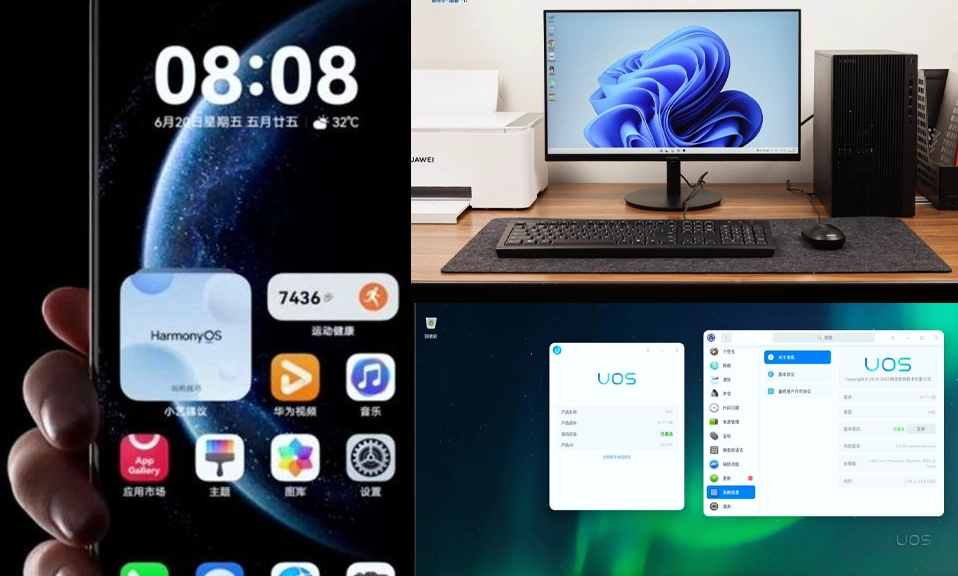
Market Share: Still dominates the consumer and general enterprise market (estimated at 70%+). The Reality: For the average Chinese consumer, student, or private business, Windows is still the default. The ecosystem of compatible software, games, and peripherals is simply too massive to abandon overnight. However, its growth is stagnating as government and critical infrastructure sectors actively phase it out.
2. UOS (Unity Operating System) & Kylin
Market Share: Rapidly growing in government, state-owned enterprises (SOEs), and finance. The Reality: These are the twin pillars of China’s desktop substitution strategy. Both are heavily customized distributions of Linux, but they are explicitly designed to mimic the look, feel, and workflow of Windows to minimize the learning curve for civil servants and office workers.
- UOS (developed by UnionTech) is known for its polished UI and strong compatibility with domestic office software like WPS Office.
- Kylin (developed by KylinSoft, backed by China Electronics Corporation) is deeply integrated with domestic hardware, particularly processors from Loongson and Phytium.
3. Deepin
Market Share: Niche, but globally respected. The Reality: Deepin is a community-driven, open-source Linux distribution originating from China. Unlike UOS or Kylin, which are heavily focused on government contracts, Deepin is beloved by tech enthusiasts for its stunning, macOS-like “Deepin Desktop Environment” (DDE). It serves as the upstream foundation for many commercial Chinese Linux distros.
📱 Mobile: The Battle for the Pocket
4. HarmonyOS (Hongmeng)
Market Share: The fastest-growing mobile OS in China, now firmly holding the #2 or #3 spot nationally. The Reality: This is the crown jewel of China’s OS ambitions. Originally launched as a workaround after US sanctions cut Huawei off from Google Mobile Services (GMS), HarmonyOS has evolved into a fully independent ecosystem. By 2026, HarmonyOS NEXT has fully decoupled from Android, dropping support for Android APKs entirely. It now powers a seamless “1+8+N” ecosystem, connecting Huawei smartphones, smartwatches, tablets, and even electric vehicles (via the Harmony Intelligent Mobility Alliance) with unprecedented fluidity.
5. Customized Android (The “No-GMS” Reality)
Market Share: The majority of the non-Huawei smartphone market. The Reality: Because Google Play and GMS are blocked in China, brands like Xiaomi (HyperOS), OPPO (ColorOS), vivo (OriginOS), and Honor (MagicOS) use the open-source Android core but build entirely proprietary software layers on top. They have their own app stores, cloud services, and AI assistants. For the average user, these feel like distinct operating systems, not just “Android skins.”
6. Apple iOS
Market Share: Strong, but facing intense pressure. The Reality: Apple remains highly popular among China’s affluent urban consumers, prized for its brand prestige, ecosystem integration, and privacy features. However, iOS has lost significant ground in recent years to the resurgence of Huawei and the rapid maturation of domestic Android alternatives, forcing Apple to aggressively localize its features (like integrating with local AI models) to stay competitive.
“1+8+N” strategy).
🖥️ Server & Cloud: The Backbone of Digital Infrastructure
7. openEuler
Market Share: The fastest-growing enterprise server OS in China. The Reality: When CentOS reached its end of life, China needed a reliable, domestic alternative for its massive data centers. Backed by Huawei and the OpenAtom Foundation, openEuler has become the de facto standard for Chinese servers, cloud infrastructure, and edge computing. It is heavily optimized for domestic ARM-based processors (like Kunpeng) and is completely open-source.
8. Alibaba Cloud Linux & TencentOS
Market Share: Dominant in the public cloud sector. The Reality: China’s tech giants run their own show. Alibaba Cloud Linux (Aliyun Linux) and TencentOS are heavily optimized, lightweight Linux distributions built specifically to maximize performance, security, and efficiency within their respective cloud ecosystems. They power a vast portion of China’s e-commerce, gaming, and digital services.
🚀 The Driving Forces: Why Is This Happening?
The shift toward domestic operating systems isn’t just about national pride; it’s driven by three hard realities:
- Geopolitical Catalyst: US export controls and entity list restrictions (like those placed on Huawei and SMIC) proved that relying on foreign technology is a strategic vulnerability. Self-reliance is now a matter of national security.
- The “Xinchuang” Mandate: The Chinese government has mandated the replacement of foreign IT hardware and software with domestic alternatives in “critical” sectors: government, finance, energy, telecommunications, and transportation. This guarantees a massive, captive market for OS developers like UOS and Kylin.
- The AI and IoT Boom: China is betting that the next generation of computing won’t be defined by a single PC or phone, but by interconnected ecosystems (smart homes, connected cars, industrial IoT). HarmonyOS and openEuler are being built from the ground up to handle this distributed, AI-driven future better than legacy Western systems.
A Dual-Track Reality
If you visit China today, you will still see millions of people using Windows laptops and iPhones. The consumer transition to domestic operating systems is gradual, as habits and software compatibility are hard to break.
However, behind the scenes, the foundation is being swapped out. In government offices, bank servers, telecom networks, and millions of new smart devices, Chinese-developed operating systems are no longer just “alternatives.” They are the new standard.
China has proven that building a viable, large-scale alternative to Silicon Valley’s software monopoly is no longer a theoretical dream—it is an ongoing, rapidly accelerating reality.