The deepest point on Earth has just delivered a discovery that geologists are calling “mind-boggling”—and it is one that, by the laws of physics, should not exist. In the Challenger Deep of the Mariana Trench, more than 6,100 metres below the surface of the Pacific Ocean, a robotic submarine has found the remnants of an explosive volcanic eruption. It is the deepest evidence of such an event ever documented, and it forces scientists to reconsider what is possible at the bottom of the world.
The Discovery: Pyroclastic Rock at Record Depth
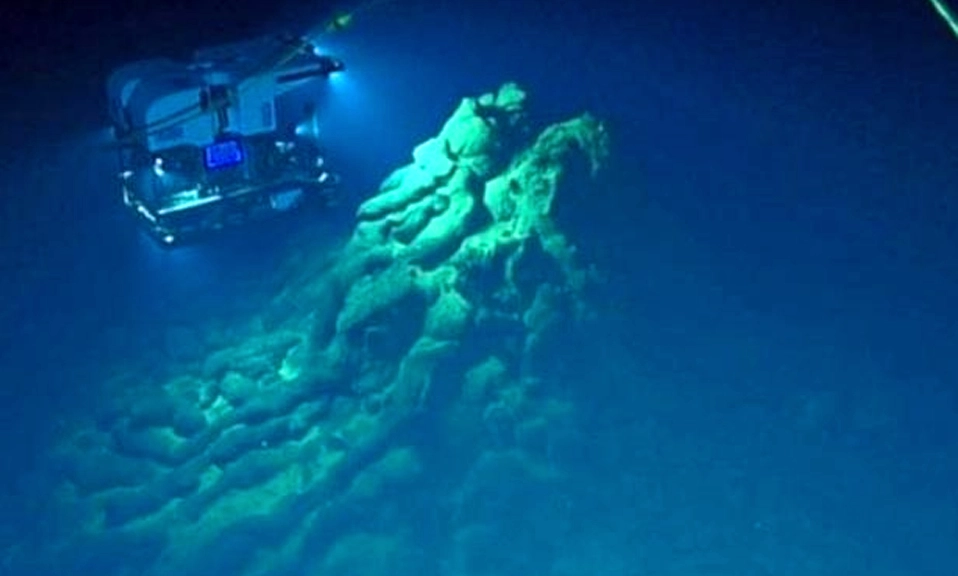
The find was made by a remotely operated vehicle (ROV) named Jason, operated by the Woods Hole Oceanographic Institution. During a 2024 expedition aboard the research vessel Thomas G. Thompson, the team was collecting geological samples along the Challenger Deep Forearc Segment, a stretch of seafloor near the trench. They were not looking for volcanoes. They were looking for rocks that might help explain the geology of the deepest oceanic trench on the planet.
What they brought back, however, changed the purpose of the mission. The samples included thin, flat, lobe-shaped rocks that the scientists identified as pyroclastic deposits—the remnants of a pyroclastic flow, the fast-moving mixture of hot gas, ash, and volcanic rock that is produced by explosive eruptions. On land, these flows are among the most lethal volcanic phenomena known; the eruption of Vesuvius that buried Pompeii was a pyroclastic flow.
The discovery was published in the journal Frontiers in Earth Science on November 22, 2026. The lead author, Robert Stern, a professor emeritus of geosciences at the University of Texas at Dallas, described the find as a “complete surprise”. The team had not expected to find any evidence of volcanic activity near the trench, let alone evidence of an explosive eruption at such extreme depth.
Why It Shouldn’t Be There
The reason the discovery is so startling lies in the physics of deep-sea volcanism. Under several kilometres of water, the immense pressure should prevent the gases inside magma from expanding enough to trigger an explosion. The weight of the ocean above Challenger Deep is roughly 1,000 times the pressure we experience at sea level—enough to suppress the kind of violent gas release that produces pyroclastic flows on land.
As National Geographic explains, the difference between a Hawaiian lava fountain and a Mount St. Helens-style blast is the behaviour of the gas in the magma. At the surface, that gas expands freely and drives the explosion. At 6,000 metres down, the pressure is so extreme that the gas should remain trapped, producing a slow, goopy, seeping flow rather than an explosive eruption. Volcanism at such depths was thought to be possible, but explosive volcanism was considered physically implausible.
And yet, the rocks tell a different story. The pyroclastic material recovered by Jason had welded onto the rocks at the sample site, indicating that it was still hot when it was deposited. If the eruption had happened much higher up the trench wall, the ash and rock would have cooled significantly before reaching that depth. The eruption must have occurred nearby, in the same deep zone where the samples were found.
The Science: A Tectonic Setup That Shouldn’t Work—But Does
The location of the eruption is unusual for another reason. Volcanic activity is not typically found so close to an oceanic trench. The Mariana Trench formed when the Pacific Plate began to slide, or subduct, beneath the Philippine Sea Plate roughly 52 million years ago. The conventional understanding is that the mantle in this zone is not hot enough to melt, and that any magma that does form would struggle to reach the surface in a way that produces explosive eruptions.
But the new evidence suggests something else is happening. Peter Rowley of the University of Bristol suggests that the Pacific Plate may be subducting deeper beneath the Philippine Plate than previously thought, creating a stretching effect on the upper section of the Philippine Sea plate that thins the crust. That thinning may make it easier for mantle material to punch through and trigger volcanic activity. “Material that was originally quite deep down, stuff from the upper mantle, is actually quite accessible,” Rowley said. “It’s an unusual tectonic setup”.
Peter Kokelaar of the University of Liverpool put it simply: “It’s probably the deepest product of an active volcanic system that’s been recorded. It’s particularly interesting because it’s a peculiar place for active volcanism, so close to the trench”.
What It Means: Rewriting the Limits of Deep-Sea Volcanism
The discovery does not just add a data point to the record of volcanic activity. It challenges a fundamental assumption about how the deep ocean works. If explosive eruptions can occur at 6,000 metres, then scientists may have been underestimating the range and intensity of volcanic processes on the seafloor.
It also raises new questions. How often do these deep eruptions happen? What triggers them? And what role do they play in the chemistry of the deep ocean, or in the exchange of material between the Earth’s interior and its surface? The team has not yet identified the exact location of the eruption, nor determined when it occurred, but the search is now underway.
There is also a broader implication for the search for life and habitable environments beyond Earth. If volcanic activity can produce explosive events in the most hostile, high-pressure environments on our own planet, then the conditions for similar processes on other ocean worlds—such as Jupiter’s moon Europa or Saturn’s Enceladus—may be more plausible than previously thought.
A Discovery That Expands the Possible
The volcanic eruption at Challenger Deep is not just the deepest ever found. It is a reminder that the deep ocean remains one of the least explored and most surprising environments on Earth. Scientists went looking for rocks and found evidence of an event that the textbooks said could not happen. The physics still needs to be worked out, and the full implications for tectonics and deep-sea chemistry are only beginning to be understood.
But one thing is already clear: the “impossible” eruption at the bottom of the Mariana Trench has expanded the boundaries of what geologists thought the planet was capable of. As William Chadwick of Oregon State University, who was not involved in the study, told Science News, “imagining this happening is … pretty mind-boggling”. The deepest place on Earth has just become a little less predictable—and a lot more interesting.