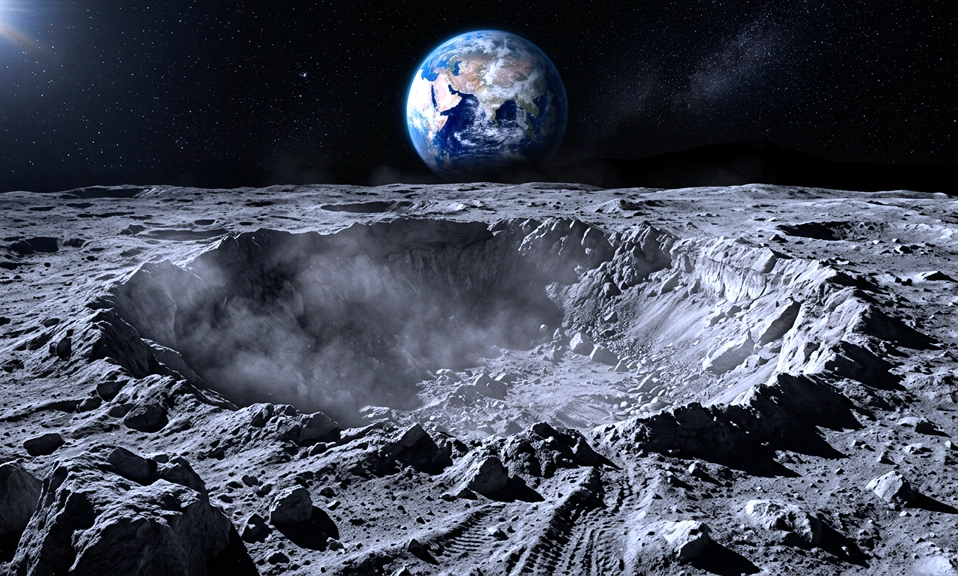
A space rock the size of a three-story building slammed into the Moon in 2024. It carved out a hole bigger than the Roman Colosseum. And nobody noticed for over a year.
Scientists have discovered the largest new impact crater ever found in the solar system — a 222-meter-wide, 43-meter-deep scar on the lunar surface created by a powerful collision in the spring of 2024. The impact was so significant that researchers estimate an event of this magnitude happens on the Moon only about once every 132 years. “This event constitutes a statistically rare, effectively once-in-a-lifetime observation,” the scientists wrote in one of two studies published Wednesday in the journal Science Advances.
The crater, named “McGetchin” after the late Thomas McGetchin, a former director of Houston’s Lunar and Planetary Institute, is three times bigger than the previous record-holder found by NASA’s Lunar Reconnaissance Orbiter (LRO) a decade ago. It’s a discovery that has profound implications for our understanding of the Moon’s geology — and for NASA’s plans to build a permanent base there.
But it also raises an uncomfortable question: how did something this big slip past us for so long?
A “Once in a Century” Event
The object that hit the Moon is estimated to have been the size of a building three to six stories high — a fragment of an asteroid or comet that struck the lunar near side in May 2024. The resulting explosion churned the lunar surface for more than 100 kilometers, hurling dust and rocky soil outward at a higher angle than scientists expected.
The crater itself is a striking feature: a steep-sided hole that appears as a “large bright spot circled by a dark halo” in LRO imagery, thanks to the freshly exposed material blasted out by the impact. A separate study identified a 7-kilometer-wide cold spot around the crater, consistent with a loosening of the Moon’s topsoil — a process co-author David Paige of UCLA likened to gardening.
How Did Scientists Miss It?
The short answer is: they didn’t miss the crater. They missed the impact.
The collision itself was never detected in real time by telescopes on Earth or in space. The Moon has virtually no atmosphere, so incoming debris doesn’t burn up or slow down — it just hits. And this particular impact happened on the near side, but at a moment when no telescope was watching, and the resulting flash was too brief and faint to register.
The LRO, which has been orbiting the Moon since 2009, actually captured wide-angle images of the crater in May 2024, shortly after it formed. But those images sat unidentified in the spacecraft’s massive data archive for over a year. It wasn’t until August 2025 that Robert Wagner, a researcher with the LRO team, noticed the anomaly during a new scan of the lunar surface.
The spacecraft then gathered more detailed pictures in the fall of 2025, and the discovery was confirmed earlier this year.
The delay wasn’t negligence — it was a data problem. The LRO has been photographing the Moon for nearly two decades, generating an enormous volume of imagery. Finding a single new crater in that flood of data requires either luck or targeted analysis, and in this case, it took both.
Why This Matters for NASA’s Moon Base
The discovery comes at a critical moment. NASA is preparing to build a permanent base for astronauts on the Moon, and understanding the frequency and force of recent impacts is essential for designing structures that can survive them.
“The next step is to calculate the risk of ejected crater material striking NASA’s planned moon base,” said Mark Robinson, chief scientist for the LRO’s cameras and lead author of one of the studies. “That information will help engineers harden structures so one won’t have to worry about damage, or maybe worry less”.
The McGetchin crater offers a rare data point: a fresh, large impact that scientists can study in detail. Most lunar craters are ancient, eroded by billions of years of micrometeorite strikes and solar wind. This one is brand new — geologically speaking — and its features are still sharp.
The Moon Is Still Being Reshaped
Perhaps the most striking finding from the research is just how dynamic the lunar surface remains. Robinson noted that LRO’s crater discoveries since 2009 show the Moon’s top inch of soil is being overturned by ejected material every 80,000 years — faster than previously thought.
That finding has a bittersweet implication. The Apollo astronauts’ dusty footprints, long assumed to be permanent fixtures on the lunar surface, will “definitely be long gone in that time frame,” Robinson said. The Moon is not a museum. It’s an active, evolving world, constantly reshaped by impacts large and small.
The McGetchin crater is a reminder that even as we prepare to return to the Moon, we’re still learning how little we know about it. A building-sized rock hit our nearest neighbor, carved out a hole bigger than the Colosseum, and we didn’t notice for over a year. If that’s what we missed on the Moon, what else is still waiting to be found?