Inside the Desperate Race to Rescue These Endangered Apes
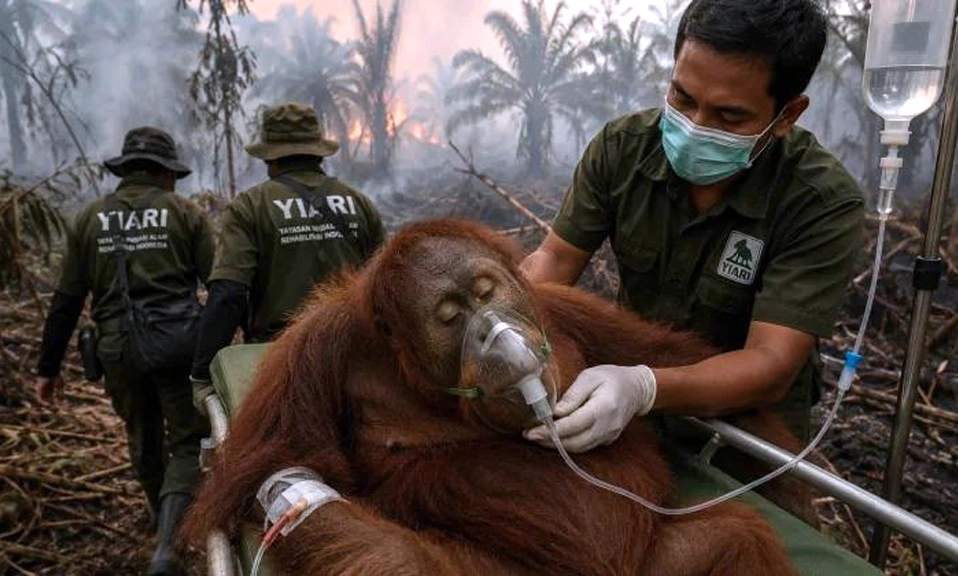
The orangutan clings to the top of a nearly leafless tree, thick smoke billowing around her. She has already walked through fire to get there. The soles of her feet and palms of her hands are burned. And she is one of the lucky ones.
Across Indonesia’s Borneo island, wildfires are raging through rainforests that contain more than half of the world’s critically endangered Bornean orangutan population. Rescuers are racing against time — and the flames — to save the apes that survive. But for every orangutan pulled from the smoke, thousands more remain trapped in an inferno that shows no sign of relenting.
This is the story of the crisis, the rescues, and the people risking everything to save a species on the brink.
The Crisis: A “Super El Niño” Meets Slash-and-Burn
This year’s fire season is one of Indonesia’s worst in years. The causes are a devastating combination of climate and human behaviour.
El Niño has brought severe drought to the region — “one of the strongest since comparable records began four decades ago,” according to experts. Temperatures in some areas are running five to six degrees above normal. The dry conditions have turned normally fire-resistant rainforests into tinderboxes.
But the spark is largely human. Illegal slash-and-burn practices, used by farmers and companies as a cheap way to clear vegetation for plantations, have ignited fires across vast tracts of forest. The drying of peatlands — carbon-rich soils that are notoriously flammable once drained — has made previously resilient landscapes increasingly fire-prone.
The scale is staggering. Between January and July alone, more than 202,000 hectares (780 square miles) burned, according to government figures. The Nusantara Atlas project estimated that nearly 896,000 hectares — more than five times the size of Greater London — had burned by the end of September.
And the fires are burning directly in orangutan territory. The International Union for Conservation of Nature (IUCN) warned in September that fires were affecting habitats containing 52 percent of Borneo’s orangutan population. Fires are burning in rainforests that contain 13 of the 20 largest remaining populations of Bornean orangutan.
“Without urgent action, thousands more orangutans could be killed, injured or displaced,” warned the IUCN SSC Primate Specialist Group.
The Rescues: Walking Through Fire to Survive
The rescue teams are doing work that is as dangerous as it is vital.
Novita: The Face of the Crisis
The orangutan in the footage — clinging to a tree in a scorched landscape, smoke swirling around her — is a three-to-four-year-old female named Novita. She was rescued by the Borneo Orangutan Survival Foundation (BOSF) in late September from the Katune forest in Central Kalimantan province.
Her story is one of survival against impossible odds. “We rescued her from an area that was burning,” said Jamartin Sihite, CEO of BOSF. “Before we reached her, she had to walk through the fire to get to the tree and climb it, so the soles of her feet and her toes were burned”.
Novita was tranquilised, given oxygen and intravenous fluids, and taken to the Nyaru Menteng rehabilitation centre in Palangkaraya. She remains in intensive care. “The burns on her hands and feet are improving,” said Andi Muhammad Khadafi, head of the Central Kalimantan Natural Resources Conservation Agency. “Although even after she recovers, she may not return 100 percent to how she was before she suffered the burns”.
Sihite remains hopeful. “We have previously released orangutans missing several fingers and they were still able to survive in the forest, so we remain hopeful that Novita can eventually return to the wild”.
Bara: Found on Razed Land
On Thursday, October 8, rescuers found another orangutan — a male named Bara — on top of a tree in an area of razed land in Central Kalimantan. The haze was thick, and fires were burning nearby.
“Seeing the condition of the recently burned lands… we didn’t dare to gamble and assume he’ll survive,” said Handi Nasoka, a local conservation agency official. Bara was relatively healthy, with minor burn injuries, and will be moved to a nature reserve elsewhere in Central Kalimantan.
Sampurna: A Tragic Loss
Not every rescue ends in survival. In September, an adult male orangutan named Sampurna, believed to be around 20 years old, was found severely weakened and struggling to breathe in an oil palm plantation. Despite emergency treatment, he died. An examination indicated that smoke exposure had caused acute oxygen deprivation.
Sampurna’s death is a reminder of the stakes. Orangutans that survive the flames often succumb to smoke inhalation — a threat that is invisible but just as deadly.
46 Rescued, and Counting
Between August and October 9, Indonesian authorities and the wildlife rehabilitation foundation YIARI rescued 46 orangutans from fire threats. More than 270 wild animals in Kalimantan had been rescued, rehabilitated, or guided to safer habitats as of Saturday.
On Friday, October 9, eight orangutans were released into the Batu Nyambu Protected Forest in West Kalimantan — a 23,000-hectare reserve with primary and secondary forest cover. The group included three mother-and-offspring pairs and two juvenile males.
“Protection of habitats will always be a top priority to ensure orangutans continue to have safe forests to live in,” said YIARI CEO Karmele Llano Sanchez. “But as long as their habitat remains threatened, rescue is one of the best options we can take to help them survive”.
The Human Cost: Rescue Centres on the Front Line
The fires aren’t just threatening orangutans in the wild. They’re threatening the people and facilities trying to save them.
International Animal Rescue, a UK-based charity with a conservation project in Borneo, told the BBC that wildfires came “worryingly close” to its rescue centre — “literally within a few hundred metres”. The team had to move animals to keep them safe.
Dr Karmele Sanchez, who works for the charity in Indonesia, said she was sleeping deep within the forests to rescue more orangutans. “We are experiencing a very hot season,” she said, explaining that temperatures were about five to six degrees above normal for the time of year.
“Forest fires in the area have got even more out of control”.
The Deeper Threat: A Species on the Brink
The fires are compounding an already dire situation for orangutans.
There are only around 104,000 orangutans remaining in Borneo and Sumatra — down from more than 230,000 a century ago, according to the WWF. The species is classified as critically endangered, and its habitat has been shrinking for decades due to logging, mining, and the expansion of oil palm plantations.
Now, fires are destroying what little remains. And the risk isn’t evenly distributed. Females with young are particularly vulnerable. Their tendency to remain in established home ranges makes them less able to flee when flames spread, and their young cannot move quickly enough to escape.
There is precedent for catastrophe. During the 1997-98 El Niño fires, researchers estimated that thousands of orangutans died — possibly as many as one-third of the global population at the time.
Conservationists fear this year could be just as bad, or worse. “In locations where orangutans are surrounded by fire and have nowhere to go, they can literally burn alive,” said Anton Nurcahyo, CEO of the Borneo Nature Foundation.
The haze from the fires has also created a public health crisis. Tens of thousands of cases of respiratory illness have been reported across Indonesia, and air pollution spikes have been recorded in Singapore and Malaysia.
What Comes Next
The immediate priority is rescue. Teams on the ground are continuing to search for orangutans trapped in fire zones, and the Borneo Orangutan Survival Foundation has taken in several apes caught up in the blazes.
But the long-term solution is harder. Experts say the fires must be addressed at their source: the slash-and-burn practices that ignite them, the peatland drainage that makes them uncontrollable, and the climate change that is making El Niño events more severe.
“The protection of habitats is the only way to ensure orangutans survive,” said Sanchez. “As long as their habitat remains threatened, rescue is one of the best options we can take — but it is not enough”.
For Novita, for Bara, for the 46 others rescued this season, the immediate danger has passed. They are safe, for now, in rehabilitation centres and protected forests. But they are the fortunate few.
The fires are still burning. The smoke is still rising. And somewhere in the haze, another orangutan is clinging to a tree, waiting for help that may not come in time.
To support orangutan rescue and conservation efforts, consider donating to the Borneo Orangutan Survival Foundation, YIARI, or International Animal Rescue.