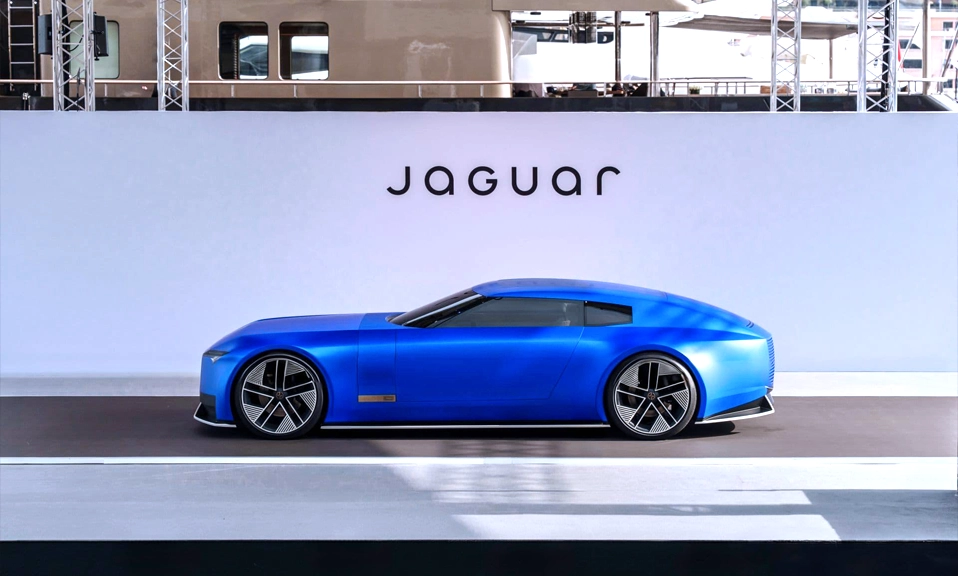
Meet the Type 01 That Is Dividing Car Fans
Jaguar has unveiled the Type 01, its first new model in eight years and the culmination of a rebrand that has been one of the most scrutinised in automotive history. It has no rear window, it costs $172,000, and it’s designed to be “the type of car that you park up and everybody stops and says: ‘Fucking hell, what have you just turned up in?'”
The Type 01 — pronounced “Zero One” — was unveiled in New York on Tuesday night. It is a four-door electric grand tourer that marks Jaguar’s radical break from its heritage. There is no curvaceous design language, no classic leaper on the hood, no rear window. In its place: brutalist minimalism, a 1,030-horsepower tri-motor powertrain, and a price tag that doubles the brand’s previous average transaction price.
This is not a car designed to be loved by everyone. And Jaguar seems perfectly fine with that.
The Design: “Brutalist Minimalism” and a Missing Rear Window
The most immediately striking thing about the Type 01 is what it’s missing. There is no rear window.
Instead, Jaguar has fitted a high-definition camera that feeds video onto a slim, letterbox-shaped screen positioned in the centre of the dash at the base of the windscreen. To see behind you, you glance low on the dash rather than up to a traditional rearview mirror.
It’s a decision that has divided opinion. Some critics have called it a safety concern. Others have praised it as a bold design statement. What it certainly does is signal that this is not a conventional Jaguar.
The car itself is enormous: 5.2 metres long and two metres wide, making it longer than most UK parking spaces and almost certainly aimed at the wide-open roads of America rather than the narrow streets of London. The Guardian noted that it “will not fit into a UK parking space”. CNN’s automotive journalist Mark Smyth described it as “probably too big for most UK cities, suggesting the US is its main target market”.
The design language is a deliberate departure from Jaguar’s past. Smyth wrote that “gone is the curvaceous design legacy of the brand, replaced by brutalist minimalism and cold surfaces”. The long bonnet deliberately echoes the 1960s E-Type, but the overall silhouette is something entirely new.
The Specs: 1,016 Horsepower and 400 Miles of Range
Under the dramatic exterior sits Jaguar’s most powerful road car ever.
The Type 01 features a tri-motor setup — two at the rear, one at the front — producing up to 1,030PS (1,016hp) and 1,365Nm of torque. It accelerates from 0 to 62mph in 3.2 seconds and from 62 to 112mph in just 4.0 seconds. Top speed is 150mph.
The battery is a 118kWh usable unit with an 850-volt architecture. Jaguar expects an EPA range of up to 400 miles, with WLTP range of up to 450 miles. A 350kW DC rapid charger can add 200 miles in 13 minutes, and a 10-80% charge takes around 22 minutes.
The car weighs approximately 2.7 tonnes, with a 50:50 weight distribution. In Dynamic mode, up to 87% of power can be sent to the rear axle.
It is, by every measure, a serious performance machine.
The Price: $172,000 and a Strategy Bet
The Type 01 starts at £130,000 ($172,000)** in the UK. In the US, it starts at **$130,500. Orders open in early 2027, with first deliveries expected in the second half of the year.
That’s more than double the starting price of the F-Type, Jaguar’s previous sports car, which started at around £62,000. It’s also a dramatic shift for a brand whose average US transaction price had been around $60,000 to $70,000.
Managing Director Rawdon Glover was blunt about the strategy: “If we double the price point, the expectation is going to double in terms of how you treat this individual”. He added that it was better than “to toil away as we have done for the last two decades in the volume premium space”.
Jaguar is betting that there is a market for a bold, expensive, design-led electric car that doesn’t look like anything else on the road. The early signs are mixed. More than 50,000 people have registered interest in the Type 01, and 78% of them are new to Jaguar. But in customer clinics, the car scored both the highest and the lowest ratings of any Jaguar — drawing more nines and tens than any previous model, but also more ones and twos.
Glover’s response to the polarisation: “Great design should have the confidence to polarize”.
The Controversy: “Woke” Backlash and a Culture War
The Type 01 is the culmination of a rebrand that began in 2024 and immediately became a culture war flashpoint.
In November 2024, Jaguar released a promotional video under the tagline “copy nothing” that featured no cars at all — just a diverse cast of models in brightly coloured outfits moving through an otherworldly landscape. The internet exploded. Critics accused Jaguar of going “woke”. Elon Musk criticised it. Two weeks later, Jaguar’s design chief Gerry McGovern unveiled a pair of concept cars in Miami Pink and London Blue, quipping: “Jaguar has no desire to be loved by everybody”.
The backlash was furious. Critics claimed JLR was betraying its heritage. The launch colour was derided as “Barbie pink”.
The Type 01’s reception has been similarly polarised. On social media, one Facebook user wrote that it “looks like a Cybertruck and a Bentley Continental had an illegitimate child”. Craig Kinnersley, who runs a luxury car consultancy, wrote on LinkedIn that the design was an “unmitigated catastrophe” that looked like a hearse and lacked any “memorable Jaguar flourish”.
But others have praised it. Electrifying.com‘s review called it “very special” and “a bold reimagining of a classic Jaguar”. The Globe and Mail described it as “long, low and wildly powerful” with power “delivered with more sophistication than violence”.
Why Jaguar Had Nothing to Lose
The context behind the Type 01 is important. Jaguar was struggling long before the rebrand.
In its final full year before pausing production, Jaguar sold just 66,900 vehicles — barely a third of the level it achieved after the I-Pace launched in 2018. Its core demographic was “men in their 50s,” and its badge had “lost its lustre”. Where it once supplied E-Types to Brigitte Bardot and Steve McQueen, it now struggled to sell upmarket saloons to corporate executives who preferred Audis and BMWs.
“Jaguar’s core demographic, despite the uproar, gave up on the brand years ago, so they effectively had nothing to lose,” said Matthias Schmidt of Schmidt Automotive Research.
The rebrand was a deliberate gamble. JLR invested billions in reinventing Jaguar as a luxury electric brand, pledging £15bn in new models and technologies. The Type 01 is the first product of that investment. If it fails, the brand’s future is uncertain. If it succeeds, Jaguar could establish itself as a genuine alternative to Bentley, Porsche, and Aston Martin.
What Happens Next
The Type 01 goes on sale in early 2027. International deliveries begin in mid-2027, with India following months later at around ₹2 crore. Jaguar has decided not to launch the car in China for “a couple of years,” though Glover acknowledged that China would eventually be “an important part of the equation”.
The car will be built in the UK, designed and engineered at Jaguar’s Gaydon headquarters. Florence Pugh has been announced as Jaguar’s inaugural brand ambassador for its new era.
Whether the Type 01 succeeds will depend on whether enough wealthy buyers are willing to pay $172,000 for a car that looks like nothing else on the road. Jaguar is betting that the answer is yes — and that the controversy is the point.
As one senior JLR executive put it: “It’s the type of car that you park up and everybody stops and says: ‘Fucking hell, what have you just turned up in?'”
That’s not a car for everyone. But it’s exactly the car Jaguar wanted to build.