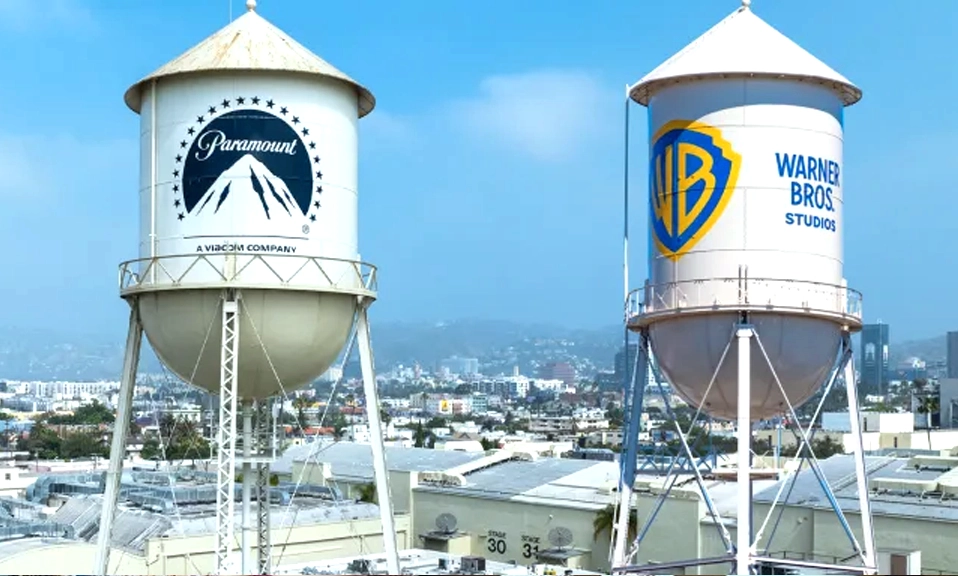
The $110 billion deal is done. Paramount Skydance has swallowed Warner Bros. Discovery whole, creating a media empire that controls everything from The Godfather to Harry Potter, CNN to CBS, and HBO Max to Paramount+. The question now is whether a Hollywood with fewer studios means better movies or just fewer of them.
On October 6, 2026, Paramount Skydance officially completed its acquisition of Warner Bros. Discovery. The newly formed entity is called Skydance Corporation, led by David Ellison as Chairman and CEO, with Ynon Kreiz — the former Mattel CEO who turned Barbie into Warner Bros.’ highest-grossing film ever — joining as co-CEO.
But what does that actually mean for the movies you watch, the shows you stream, and the people who make them?
What Skydance Actually Owns Now
The combined company is, by any measure, a leviathan.
It owns two of Hollywood’s five major legacy studios — Paramount Pictures and Warner Bros. Pictures — leaving only Disney, Universal, and Sony as competitors. It controls a catalogue that includes The Godfather, Top Gun, Star Trek, Mission: Impossible, and SpongeBob SquarePants from Paramount, alongside Harry Potter, Game of Thrones, Friends, and the entire DC universe from Warner Bros..
It also now owns two major news networks (CNN and CBS News), two flagship streaming services (HBO Max and Paramount+), plus Discovery+, Pluto TV, and BET+. And it owns HBO itself — the network behind The Sopranos, The Wire, Succession, and The White Lotus.
It is, as NPR’s David Folkenflik put it, “an extraordinary moment for Hollywood and for the media writ large”.
The Streaming Reckoning: HBO Max + Paramount+ = One Service?
The most consequential change for consumers is the eventual merger of HBO Max and Paramount+ into a single streaming service.
David Ellison confirmed that “long term,” he plans to “bring [HBO Max] and [Paramount+] together” as one platform. In the near term, the two services will operate separately with bundling options before full integration.
For subscribers, this is a double-edged sword. A combined service would offer an extraordinary library — imagine The Sopranos and Star Trek under one roof, Succession and Yellowstone in the same app. But analysts expect prices to rise. Mike Proulx, research director at Forrester Research, was blunt: “There’s no way that a combined Paramount+ and HBO Max streaming service won’t end up costing more for those who subscribe to only one of the services”.
The merged company carries approximately $80 billion in debt** from the deal and is targeting **$6 billion in annual cost savings.
The Human Cost: 4,500 Jobs and Counting
Hours after the merger closed, Ellison and Kreiz sent a memo to employees that left little doubt about what was coming.
“Integrating two companies will bring change, including difficult decisions that affect our workforce,” they wrote. “We are committed to handling this process thoughtfully and respectfully”.
A report from Los Angeles County estimated the merger could eliminate roughly 4,500 direct film and TV jobs, causing $1.26 billion in lost wages over three years. CNN staffers, in particular, have been described as “panicking over a potential bloodbath”.
Hollywood journalist Kim Masters said the company is “absolutely strapped with debt” and needs to act quickly to get its finances in order. “Hollywood is cringing in terms of those lay-offs”.
Beyond the layoffs, the merger leaves filmmakers with fewer major studios to approach for funding. As Masters noted, the industry is now “pretty much down to Universal, Sony, Apple” — and it’s unclear how committed Apple is to theatrical film.
“I think it’s going to be more difficult for our auteur directors to find that kind of backing,” she said.
What Comes Next: The Five-Year Countdown
The settlement’s film quota obligations expire in five years. Once they do, Skydance will have “far more flexibility” to prioritize streaming over theatrical releases.
The Disney-Fox precedent is instructive. When Disney acquired 21st Century Fox in 2019, 20th Century Fox’s annual theatrical slate shrunk from 12 to 17 films per year to just three to six under Disney’s ownership. If Skydance follows a similar path, the 30-film commitment could prove to be a temporary floor, not a permanent standard.
For now, the movies will keep coming. The quota is real, the penalties are real, and the independent film requirement ensures that at least some smaller voices will still find their way to screens. But the long-term trajectory of Hollywood — fewer studios, fewer buyers, more consolidation, and a streaming-first future — has only accelerated.
The $110 billion question is no longer whether this merger will change Hollywood. It’s how much of the old Hollywood will survive it.