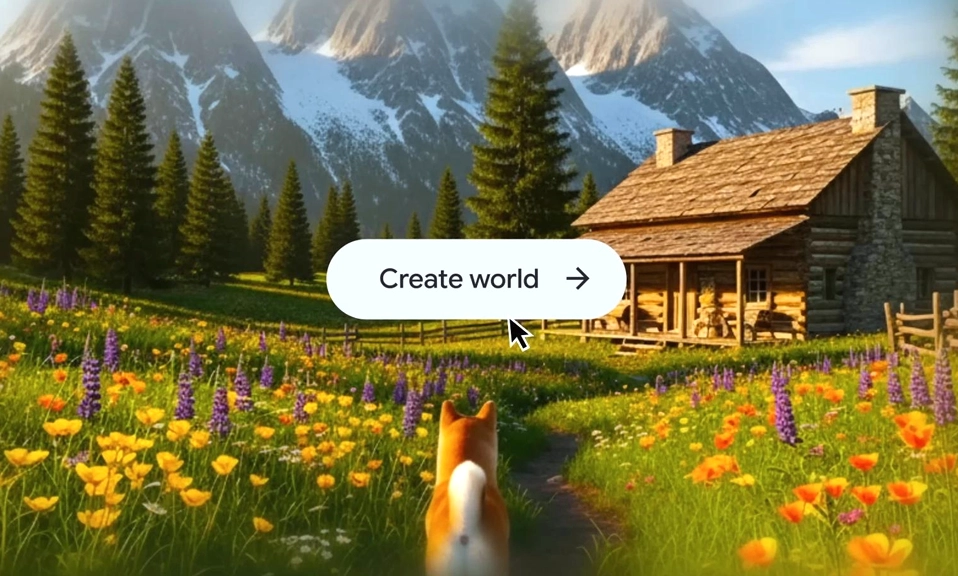
For decades, the dream of stepping into a world conjured from pure imagination has belonged to science fiction. Game engines require teams of artists, designers, and programmers. Even the most advanced generative AI, until recently, could produce a video or an image—but not a place you could move through, a place that responds to your input and evolves in real time.
On October 27, 2026, Google DeepMind announced Genie 4, a world model that comes closer to that dream than anything before it. It generates explorable, interactive 3D environments from nothing more than a text prompt or a reference image, in real time, with native audio and characters that speak. It is not a game engine. It is something stranger and more ambitious: a system that synthesizes reality frame by frame, on the fly, as you explore it.
What Genie 4 Actually Is
Genie 4 is a world model, not a video generator. That distinction matters. A video generator produces a fixed sequence of frames. A world model responds to your actions, generating the next frame based on what you do. You describe a scene in natural language—”a Japanese train station in the 1980s,” or “a first-person view skiing in the Alps”—and Genie 4 renders it. You move with the WASD keys. The world draws whatever lies in the direction you turn, instant by instant. If you type “add a blizzard” mid-session, the weather changes in real time. If you ask for a new character, one appears, and it can speak to you.
This is the fourth generation of DeepMind’s world model. Genie 3, announced in 2025, generated interactive environments at 720p and 24 frames per second with roughly one minute of visual memory. Genie 4 doubles that coherence window to about two minutes, adds native audio for the first time, and introduces a fundamental architectural shift: a Gemini model now runs inside the simulation loop as a planner, keeping the world coherent as it evolves.
How It Works: Gemini as the Director
The most important technical innovation in Genie 4 is not the visuals. It is the hybrid architecture that pairs Genie’s frame-by-frame rendering with Gemini’s reasoning. The two work in concert.
Gemini Omni anchors the look and behavior of each world, grounding the simulation in photorealistic detail and plausible physics. Gemini 3.8 Flash acts as a guiding agent, continuously observing the scene, breaking down goals into steps, reviewing incoming frames, and verifying that each step succeeded. When the world shifts or you intervene, it revises the plan. This is what allows Genie 4 to model complex, multi-step events—not just a static environment, but a sequence of cause and effect, with a language model handling structure and narrative while Genie renders pixels and sound.
DeepMind calls this an early step toward a “hybrid world model” , and it has implications far beyond entertainment. In one research demo, Gemini 4 Argon worked with Genie 4 to break down a task into steps and simulate an Apptronik Apollo humanoid robot playing checkers—testing how an AI system navigates an environment before bringing it into the real world.
The Four Breakthroughs
DeepMind frames Genie 4 around four key advances:
1. Real-time world simulation. You can use natural language to modify a simulation on the fly—changing the weather, moving the camera, introducing a new person or object—and Gemini contextually adapts your prompt to match the surrounding scene. Between your inputs, Gemini monitors and steers the scene to keep it progressing cohesively.
2. A new standard of realism for physics and human action. Genie 4 simulates aerodynamics, collisions, and other real-world physics with greater fidelity than its predecessors. The most dramatic leap is in how it simulates people: characters move naturally, respond organically to their environments, and can be interactively steered in real time.
3. Native audio. Genie 4 is DeepMind’s first real-time world model to generate audio natively. Every world carries the ambient sound of its own setting—wind in the trees, waves crashing on a beach. The frontier is interactive dialogue: characters converse and react to your inputs or events in the world, all in real time.
4. Simulating complex events with Gemini reasoning. The integration of Gemini models adds a layer of reasoning that allows Genie 4 to model multi-step events and test how AI systems navigate different environments before bringing them to the real world.
What You Can Do With It
The practical applications are already taking shape. Early testers include creative professionals, journalists, educators, game developers, and engineers. Film teams use it to preview scenes and run multiple “takes” in real time. Photojournalists have explored turning old photographs into walkable scenes. Game developers prototype explorable worlds before writing a line of engine code. Enterprise partners are evaluating it for rapid scenario simulation.
Google has also built a new Project Genie Agent that takes creation beyond a single prompt. You describe what you have in mind in plain language, and the agent pulls in Google’s multimodal models to create the initial visuals and a background score matched to the mood. Gemini can join a session as a companion, watching what is happening on screen, offering suggestions for where to head next, and triggering events on its own. A new community gallery lets users share and remix worlds, with curated experiences like “Living Memory,” which turns personal photos into explorable spaces, and “Dino Field Guide,” which offers prehistoric habitats built from 360-degree panoramas.
Availability and Pricing: A Paid, Developer-First Launch
Genie 4 arrived first as a research preview for trusted testers in late October. On November 18, 2026, it was added to Project Genie for eligible Google AI Ultra subscribers, with AI Pro subscribers able to join a waitlist. A day later, on November 19, it became generally available to developers through the Gemini API (via the Interactions API) and Google AI Studio.
The pricing is token-based. Input (text and reference images) costs $1.50 per million tokens**. Text output costs **$9.00 per million tokens. Video output with synchronized stereo audio costs $17.50 per million tokens**—roughly **$0.10 per second, or about $6.05 per minute of generated world. There is no free tier. Paid tiers support 2, 5, or 10 concurrent active sessions, with daily request caps of 50, 250, or 1,000 depending on the tier.
The model outputs 720p video at 24 frames per second in a fixed 16:9 aspect ratio, with synchronized 48 kHz stereo audio streamed over WebRTC and WebSockets. Every output includes SynthID watermarking, Google’s imperceptible digital marker for AI-generated content.
The Honest Limitations
Google is candid about the gaps. The most significant is consistency. Simulations remain coherent for up to two minutes before details begin to drift. Objects can lose persistence when they leave the frame and reappear. Text rendered within the world can become garbled. Complex physical interactions and long-term spatial accuracy remain unsolved.
The interaction model also imposes constraints. The world is generated frame by frame from a rolling window, not built from persistent 3D assets. Once a session ends, it cannot be resumed. Keyboard response latency is about 0.2 to 0.5 seconds on a low-latency connection, but rises to 1–2 seconds for mid-session text edits. If round-trip network latency exceeds 150 milliseconds, controls become noticeably laggy—which is why the service is currently hosted only in U.S. data centers.
Perhaps most importantly, Genie 4 is not a game engine. It does not build persistent 3D assets, it does not support objectives or gameplay depth, and it cannot yet replace the creative and technical workflows of professional game development. As one analysis put it, it functions closer to a “procedurally generated interactive video” than a full game experience. Take-Two’s president was blunt: “Genie is not a game engine”.
The Bigger Picture: A Step Toward AGI, Not a Replacement for Game Engines
The temptation is to frame Genie 4 as a threat to Unity, Roblox, or the game industry itself. When Project Genie first launched with Genie 3 in early 2026, game company stocks tumbled on the news. But that framing misses what DeepMind is actually building.
Genie 4 is, in Google’s own words, a step toward AGI. Understanding and simulating the world is a crucial aspect of building general intelligence, and world models that can predict the consequences of actions in a physically plausible environment are a foundational technology for robotics, autonomous agents, and any AI system that needs to operate in the real world. The ability to generate infinite training environments for robots and agents—safe, variable, and controllable—may prove far more consequential than the ability to generate a playable world for humans.
That is why the limitations matter less than the trajectory. Genie 4 is not the final product. It is a research preview, released to gather feedback and iterate. The coherence window will lengthen. The physics will improve. The latency will drop. The question is not whether Genie 4 can replace a game engine today—it cannot. The question is what happens when a world model can sustain a coherent, physically plausible, audio-rich interactive environment for ten minutes, or thirty, or an hour. At that point, the line between “simulation” and “world” begins to blur.
A Glimpse of the World-to-Come
Google Genie 4 is not a finished product, and it is not meant to be. It is a research milestone that demonstrates something genuinely new: an AI system that can generate a world you can inhabit, steer, and change with your words, complete with sound and characters that respond to you. It is expensive, limited in duration, and dependent on low-latency network conditions. It is also unlike anything that has come before it.
For creators, it is a prototyping tool of astonishing speed. For roboticists and AI researchers, it is a training ground. For the rest of us, it is a glimpse of where computing is heading: away from static applications and toward dynamic, generated environments that respond to intent. The world model is not yet a game engine. But it is, unmistakably, the beginning of something. And for the first time, you can step inside it and look around.