How Volkswagen and Stellantis Are Fighting Back
For decades, the global automotive industry followed a predictable path: German engineering, Italian design, and American scale led the way, with China serving as a vast production and consumption market. But the electric vehicle revolution has flipped that script. Chinese automakers like BYD, Xpeng, and Leapmotor now set the pace for battery technology, software integration, and manufacturing speed. And Europe’s biggest car companies are no longer too proud to admit it.
At the 2026 Paris Motor Show, Volkswagen and Stellantis — the two pillars of Europe’s auto industry — made their message clear. They are not just competing with Chinese rivals. They are learning from them. Partnering with them. And in some cases, inviting them to build cars in European factories to meet European regulations.
This is a historic pivot. And it might be the only way these legacy giants survive.
The New Playbook: What Europe Is Learning
The lessons European automakers are taking from China can be distilled into three hard-won truths.
First, speed matters more than prestige. Chinese automakers develop new models in 18 to 24 months. European companies have traditionally taken three to four years. The gap has become existential.
Second, software is the new engine. While Volkswagen and Stellantis were perfecting combustion engines, Chinese companies were building software-defined vehicles with integrated digital ecosystems. Companies like Xiaomi, Huawei, and Alibaba entered the auto space, and Chinese OEMs embraced them rather than fighting them.
Third, cost discipline is a competitive weapon. Chinese EVs are structurally cheaper to build, not because of subsidies, but because of vertical integration, efficient supply chains, and scale. Even with EU tariffs of up to 45%, they undercut European equivalents.
Volkswagen: The “Fitness Centre” Strategy
Volkswagen’s approach to learning from China is built around a simple concept: use China as a training ground.
CEO Oliver Blume has called China a “fitness centre” for the industry — a place where competitive pressure forces companies to get faster, leaner, and more innovative. That philosophy is most visible in Volkswagen’s Hefei research complex, a 100,000-square-meter facility that houses software teams, battery labs, and full-vehicle testing under one roof.
The results are striking. Volkswagen says its localized development model has shortened vehicle development cycles by about 30% and reduced costs by roughly 40%. The company’s China Technology Company (VCTC) in Hefei is now Volkswagen Group’s largest R&D center outside Germany, with direct product decision-making authority.
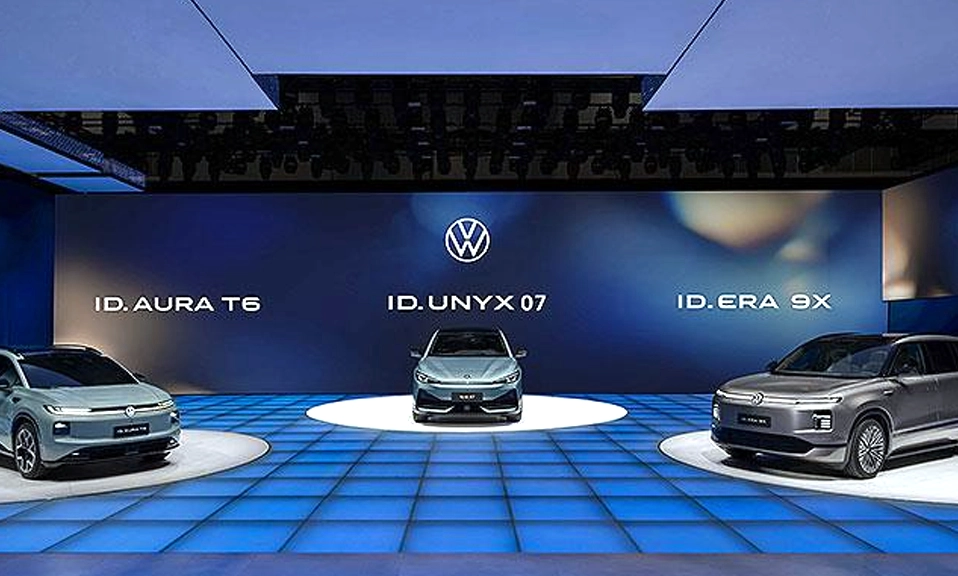
The centerpiece of this strategy is Volkswagen’s partnership with Xpeng, a Chinese EV maker in which it acquired a 5% stake in 2023. Together, they have developed a new architecture that has already produced two models: the ID. UNYX 08 SUV and the ID. UNYX 09 sedan. The latter was brought to production in just 24 months — about 30% faster than Volkswagen’s traditional timeline.
The ID. UNYX 09 represents the new playbook. It uses batteries from CATL, Xpeng’s VLA intelligent driving assistance system, and Volkswagen’s manufacturing expertise. It’s priced from 199,900 yuan (approximately $29,785) and went on sale in China in late October 2026.
But here’s the catch: Volkswagen’s China-first strategy hasn’t stopped the bleeding. The company’s deliveries in China fell 26% to 971,000 units in the first half of 2026 — its lowest level in 16 years. The competition from BYD and Geely is fierce, and Volkswagen is still playing catch-up.
Stellantis: The Deep Integration Gambit
If Volkswagen is treating China as a fitness centre, Stellantis is treating it as a full merger partner.
The Franco-Italian-American group has gone further than any other Western automaker in embedding Chinese technology into its European operations. Its strategy centers on two partnerships: one with Leapmotor, and another with Dongfeng.
The Leapmotor Partnership: Chinese Tech, European Factories
Stellantis acquired a 21% stake in Leapmotor in October 2023 and formed Leapmotor International (LPMI) , a joint venture it controls with 51% ownership. LPMI has exclusive rights to sell and manufacture Leapmotor products outside Greater China.
The partnership has already exceeded expectations. LPMI has expanded to more than 850 points of sale across Europe and shipped over 40,000 vehicles in 2025 alone. In March 2026, Leapmotor registrations in Europe exceeded 11,000 units — a 754% increase compared to the previous year.
Now, Stellantis and Leapmotor are taking their partnership to the next level. The plan includes:
Building Leapmotor’s B10 SUV at Stellantis’ Zaragoza plant in Spain, allowing Leapmotor to bypass EU tariffs on Chinese-made EVs
Developing an all-new electric Opel C-SUV at the same plant, using LPMI-sourced components to “significantly enhance affordability for European customers”
Allocating future Leapmotor products to Stellantis’ Villaverde plant in Madrid, with the intention to transfer ownership to LPMI’s Spanish subsidiary to meet “Made in Europe” requirements
Opel CEO Florian Huettl described the speed of the project as “remarkable,” calling it “a rare example of a Western automaker drawing directly on a Chinese partner to bring new vehicles to market in as little as two years”.
The Dongfeng Partnership: Building Jeeps in China for the World
Stellantis’ second Chinese partnership is with Dongfeng, a 34-year relationship that has been rejuvenated under CEO Antonio Filosa. In May 2026, the two companies signed a $1.17 billion deal to produce electric Peugeot and Jeep vehicles at a joint venture factory in Wuhan, China.
The first phase will include four all-new new energy vehicles — Jeeps and Peugeots, covering both battery-electric and plug-in hybrid powertrains. Production is expected to begin in 2027, with vehicles sold both in China and exported globally.
This is a striking reversal. For decades, Stellantis built European cars in China for Chinese consumers. Now, it’s building Chinese cars in China for global markets — using Chinese supply chains, Chinese engineering, and Chinese manufacturing efficiency.
Why This Matters: The Structural Advantage
The numbers behind China’s EV advantage are staggering, and they explain why European automakers are making these partnerships.
In 2025, China’s new energy vehicle sales reached 16.49 million units — nearly 48% of all new vehicle sales in the country. More than 60% of new passenger vehicles sold in China were equipped with combined driver-assistance systems. Two L3-level autonomous driving models received conditional approval for market access, marking a pivotal step toward mass production.
Bill Russo, founder of Shanghai-based advisory firm Automobility Ltd., put it bluntly: “China has become a technology reference, a technology benchmark. It’s no longer just a localization market. It’s an innovation super-scaler”.
Chinese OEMs don’t dismiss tech companies — they embrace them. As Russo noted, “As soon as you have companies like Xiaomi, Huawei, Tencent, and Alibaba entering this space, Chinese OEMs don’t dismiss them. They embrace the disruption because it’s happening in their backyard”.
That cultural difference — embracing disruption rather than resisting it — may be the most important lesson of all.
The Risks: Sovereignty, Dependency, and Public Backlash
The partnerships are not without controversy.
For Stellantis, the deep integration with Leapmotor raises questions about technological sovereignty. By relying on Chinese components for European-built cars, the company is betting that the cost savings outweigh the strategic risks of dependency.
For Volkswagen, the challenge is different. Its China-first strategy has delivered results in the world’s largest EV market, but it hasn’t yet translated into success in Europe. CEO Oliver Blume told an industry conference in Paris that he sees “no need currently for a Chinese joint venture in Europe,” noting that Volkswagen feels “well prepared” with its own capabilities.
Analyst Stefan Bratzel of Germany’s Center of Automotive Management noted that European automakers “are partnering with Chinese players in different ways,” with Volkswagen focused on China and Stellantis embedding Chinese technology into its European operations.
There’s also the risk of public backlash. Partnering with Chinese companies could be seen as ceding European industrial sovereignty — especially when those same companies are competitors in the European market. Stellantis’ CEO Filosa acknowledged the tension: “I do not fully agree with the view that we are missing key capabilities, but there are certainly areas where we can complement each other” .
A Turning Point in the Global Auto Industry
The 2026 Paris Motor Show marked a turning point. European automakers are no longer pretending they can go it alone in the EV era. They are learning from China, partnering with Chinese companies, and in some cases, inviting Chinese manufacturers to build cars in Europe.
For Volkswagen, that means using China as a fitness centre — a place to get faster, leaner, and more software-savvy. For Stellantis, it means embedding Chinese technology into European factories and using Chinese partnerships to defend market share.
The stakes are enormous. Europe’s transition to EVs has accelerated in recent months, spurred by rising fuel prices and more affordable models. But European automakers are still battling to defend their market share against Chinese players who are expanding rapidly abroad to counter a downturn in their home market.
Stefan Bratzel put it simply: European automakers “now had to accept China’s role as ‘a teacher’ for a while”.
The student has become the teacher. And Europe’s car giants are finally taking notes.