When we think of danger in the ocean, our minds immediately jump to the cinematic: a massive Great White Shark circling a surfer, or a Kraken-like squid dragging a ship to the depths.
But the reality of aquatic danger is far more complex, and often much smaller. The ocean’s most lethal inhabitants don’t rely on sheer size or Hollywood drama. Instead, they rely on millions of years of evolutionary perfection: invisible venom, masterful camouflage, and ambush tactics that strike faster than a human blink.
From the sun-drenched shallows of the tropics to the murky depths of river estuaries, here are the 6 most dangerous creatures beneath the waters, and the fascinating science that makes them so deadly.
🪼 1. The Invisible Assassin: The Box Jellyfish
The Danger: The most venomous marine creature on Earth.
The Habitat: Coastal waters of the Indo-Pacific, particularly Northern Australia.
The Habitat: Coastal waters of the Indo-Pacific, particularly Northern Australia.
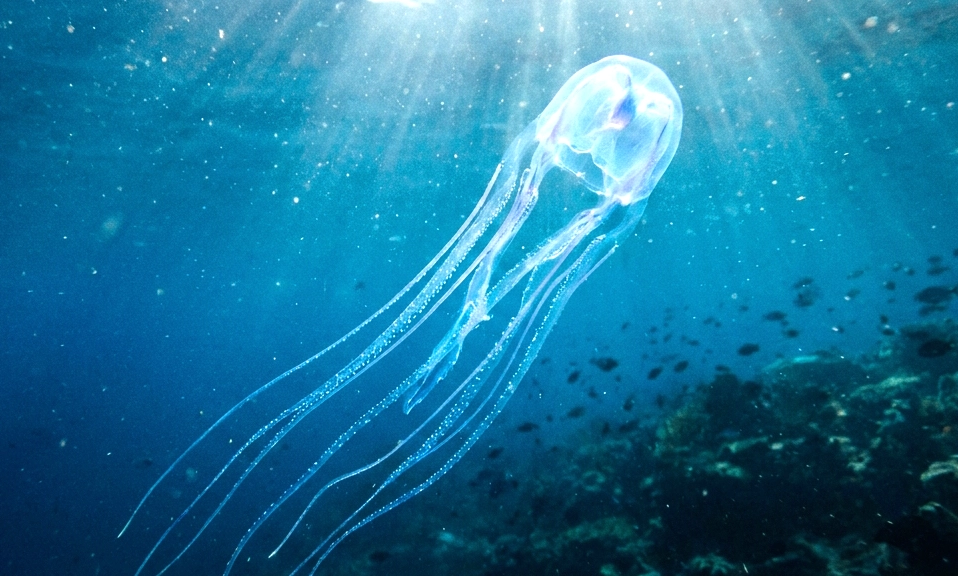
The Australian Box Jellyfish (Chironex fleckeri) is a ghost in the water. Its bell can grow to the size of a basketball, and its tentacles can stretch up to 10 feet long, but it is almost entirely transparent, making it nearly impossible to see until it’s too late.
The Science: Its tentacles are lined with millions of microscopic, harpoon-like cells called nematocysts. Upon contact, these fire venom directly into the victim’s skin. The venom is a terrifying cocktail of toxins that simultaneously attacks the heart, nervous system, and skin cells. It causes excruciating pain, cardiac arrest, and can be fatal to humans in under five minutes.
🐙 2. The Beautiful Killer: The Blue-Ringed Octopus
The Danger: A golf-ball-sized cephalopod carrying enough venom to kill 26 adult humans.
The Habitat: Tide pools and coral reefs in the Pacific and Indian Oceans.
The Habitat: Tide pools and coral reefs in the Pacific and Indian Oceans.
Don’t let its adorable size and stunning, iridescent blue rings fool you. The Blue-Ringed Octopus is one of the most venomous animals on the planet. It is generally docile and will only bite if severely provoked or handled.
The Science: Its saliva contains tetrodotoxin (TTX), a potent neurotoxin also found in pufferfish. TTX works by blocking the sodium channels in your nervous system, effectively shutting down the signals between your brain and your muscles. There is no antivenom. A bite is painless, but within minutes, the victim experiences total muscle paralysis. The most terrifying part? The victim remains fully conscious and aware, unable to move or breathe, requiring immediate artificial respiration until the toxin wears off (which can take 24 hours).
🪨 3. The Master of Camouflage: The Stonefish
The Danger: The world’s most venomous fish, disguised as a harmless rock.
The Habitat: Shallow coastal waters, estuaries, and coral reefs of the Indo-Pacific.
The Habitat: Shallow coastal waters, estuaries, and coral reefs of the Indo-Pacific.
The Stonefish is the ultimate ambush predator. It doesn’t chase its prey; it waits. Its mottled, warty skin perfectly mimics a encrusted rock or a piece of coral, making it virtually invisible on the seafloor.
The Science: Running along its dorsal fin are 13 razor-sharp spines connected to venom glands. If a human accidentally steps on it, the pressure forces the spines to erect, injecting a highly potent neurotoxin and cytotoxin into the foot. Survivors of a stonefish sting universally describe the pain as the most excruciating they have ever experienced, often comparing it to “walking on white-hot coals” or having a limb amputated without anesthetic. While rarely fatal to healthy adults (thanks to the availability of an antivenom), the shock and pain can easily cause secondary accidents, like drowning.
🐚 4. The Deceptive Beauty: The Geographic Cone Snail
The Danger: A slow-moving sea snail with a harpoon that strikes faster than you can react.
The Habitat: Sandy areas near coral reefs in the Indo-Pacific.
The Habitat: Sandy areas near coral reefs in the Indo-Pacific.
The Geographic Cone Snail (Conus geographus) has a beautifully patterned, intricate shell that makes it a highly sought-after prize for beachcombers and shell collectors. Picking one up is a potentially fatal mistake.
The Science: Unlike most snails, this creature is a highly specialized carnivore. It hunts by modifying its radula (a tongue-like organ) into a hollow, harpoon-like tooth loaded with a complex venom called conotoxin. It fires this harpoon with muscular force, injecting a paralytic toxin that immobilizes fish almost instantly. In humans, the sting is often initially painless, earning it the grim nickname the “cigarette snail”—the morbid myth being that you only have enough time to smoke one cigarette before the paralysis sets in. Like the blue-ringed octopus, there is no antivenom, and respiratory failure is the primary cause of death.
🦈 5. The Unpredictable Apex: The Bull Shark
The Danger: High aggression, powerful bite, and the ability to hunt in your local river.
The Habitat: Warm, shallow coastal waters, estuaries, and freshwater rivers worldwide.
The Habitat: Warm, shallow coastal waters, estuaries, and freshwater rivers worldwide.
While the Great White gets all the cinematic glory, many shark experts consider the Bull Shark to be the most dangerous to humans. Why? Because of where it hunts and how it behaves.
The Science: Bull sharks possess a unique biological adaptation that allows them to regulate the salt in their bodies, enabling them to swim far inland up freshwater rivers (they’ve been found thousands of miles up the Amazon and Mississippi rivers). This brings them into direct, frequent contact with humans in murky, shallow waters where visibility is near zero. Combined with a naturally high level of testosterone (which correlates with aggressive behavior) and a powerful, blunt-force bite designed to tear through tough prey, the Bull Shark is responsible for a disproportionately high number of unprovoked attacks worldwide.
🐊 6. The Aquatic Ambush King: The Saltwater Crocodile
The Danger: The largest living reptile, with the most powerful bite force on Earth.
The Habitat: Brackish mangrove swamps, estuaries, and coastal waters of Southeast Asia and Northern Australia.
The Habitat: Brackish mangrove swamps, estuaries, and coastal waters of Southeast Asia and Northern Australia.
While technically semi-aquatic, the Saltwater Crocodile (“Salty”) is the undisputed ruler of the water’s edge. They are ancient, calculating, and view almost anything that enters their territory as a potential meal.
The Science: A large male can reach over 20 feet in length and weigh over 2,000 pounds. Their hunting strategy is pure stealth: they float just below the surface, with only their eyes and nostrils exposed, waiting for prey to come to the water’s edge. When they strike, they do so with explosive speed. Their bite force is measured at nearly 3,700 pounds per square inch (PSI), capable of crushing turtle shells and bone instantly. Once they latch on, they perform the infamous “death roll,” spinning their massive bodies to tear off chunks of flesh or drag the victim underwater to drown.
🛡️ How to Respect the Water (And Stay Safe)
It’s easy to read this list and develop a fear of the ocean, but the reality is that millions of people swim, dive, and surf every day without incident. These animals are not “evil”; they are simply perfectly adapted to their environments, and we are the ones entering their home.
To stay safe:
- The “Stingray Shuffle”: When wading in shallow, sandy waters, shuffle your feet. This vibrates the sand and warns creatures like stonefish or stingrays to move away, preventing accidental steps.
- Look, Don’t Touch: Never pick up a beautiful shell, a small octopus, or a seemingly dead jellyfish on the beach. If you don’t know what it is, leave it alone.
- Heed the Signs: If a beach has stinger nets or warning signs about crocodiles or sharks, respect them. Local authorities put those up for a reason.
- Avoid Murky Water at Dawn/Dusk: This is peak feeding time for many predatory fish and sharks, and low visibility increases the chance of mistaken identity.
Fear is the Wrong Emotion; Respect is the Right One
The ocean covers 71% of our planet, and we have only explored about 5% of it. The creatures that live beneath the waves are not monsters; they are marvels of evolutionary engineering.
The box jellyfish’s invisible defense, the stonefish’s perfect disguise, and the crocodile’s ancient hunting strategy are testaments to the incredible diversity of life on Earth.
The best way to interact with these dangerous creatures is to admire them from a safe distance, educate ourselves on their behaviors, and remember that when we slip beneath the waves, we are guests in their world.