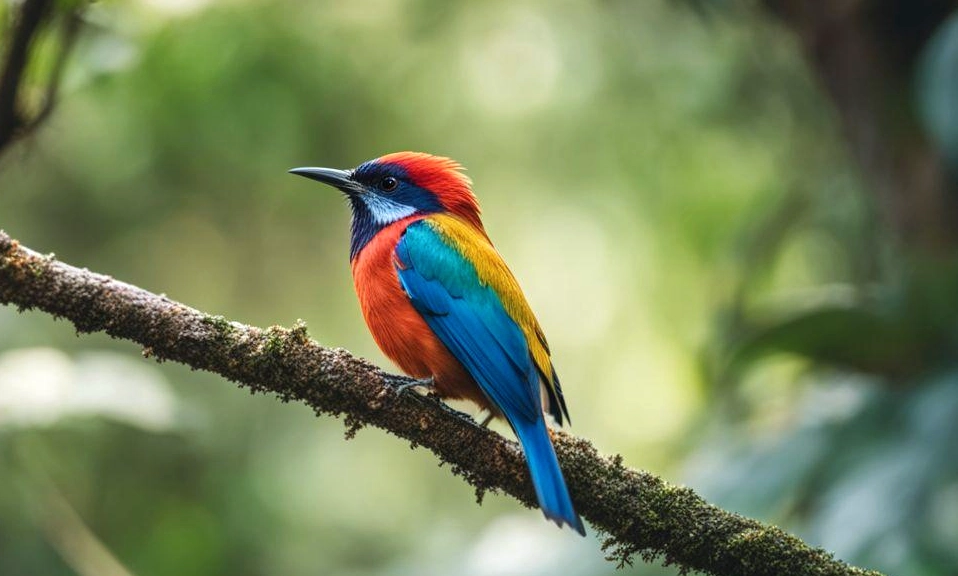
A bird that had slipped from the scientific record for 13 years has just been filmed for the first time in history. Perched high in the canopy of West Africa’s lowland forests, the Ghana cuckooshrike is a creature of almost mythic elusiveness. Its rediscovery is not just a triumph of patience—it is a quiet, hopeful signal that one of the world’s “lost” species might still have a future.
The Sighting: A Flash of Colour in the Canopy
The encounter happened in June 2026, deep inside Taï National Park in Côte d’Ivoire. Two researchers from the International Bird Conservation Partnership (IBCP), Stephanie Bartlett and Paulo Ditzel, were finishing a months-long expedition through West Africa when they noticed movement in the trees.
They recognised the colours immediately: a striking combination of yellow, orange, and black. Ditzel followed the bird with binoculars while Bartlett readied her camera. The bird vanished as quickly as it appeared, but the footage they captured was enough to confirm the impossible. It was the first-ever video recording of the Ghana cuckooshrike, and the first confirmed sighting since 2013, when the species was last photographed in Ghana’s Atewa Forest.
“This rediscovery proves that the bird is not extinct,” said Yendoubouam, IBCP’s West Africa project manager.
The Bird: A Ghost of the Upper Guinea Forests
The Ghana cuckooshrike (Lobotos lobatus), also known as the Western Wattled Cuckooshrike, is a small, canopy-dwelling bird measuring just 17 to 21 centimetres. It resembles an oriole, with a yellow-green back, wings, and tail, a glossy blue-black head and throat, and—most distinctively—large, fleshy orange wattles under its eyes.
It is a master of concealment. Despite its bright plumage, it spends its life high in the forest canopy, moving quietly and often remaining silent. Its flight call is a soft, thrush-like “tsik“—a sound so understated that it is easily lost amid the ambient noise of the rainforest. This combination of brilliant colour and near-invisibility is what allowed it to slip through the scientific record for over a decade.
The species is found only in the Upper Guinea forests of West Africa, spanning Sierra Leone, Liberia, Ghana, and Côte d’Ivoire. Its range is restricted to these lowland rainforests, which have been heavily fragmented by deforestation and the expansion of agricultural land, particularly for cocoa plantations.
The Conservation Story: Vulnerable, Declining, But Not Gone
The Ghana cuckooshrike is classified as Vulnerable on the IUCN Red List, a status last assessed in 2018. Its population is thought to be declining throughout its range, even within well-preserved forests like Gola Forest. The primary threats are habitat loss and degradation, driven by agricultural expansion and logging.
In 2024, the species was included on a list of 126 birds “lost” to science—species that had gone undetected for over a decade—compiled by the Search for Lost Birds initiative, a collaboration between the American Bird Conservancy, Re:wild, and BirdLife International. The Ghana cuckooshrike was one of 126 species on that list, alongside birds like the Jamaican pauraque and the New Caledonian lorikeet, which had been unseen for over a century.
But the rediscovery changes that status. It confirms that the bird is not extinct, and it provides researchers with fresh material to study its appearance, behaviour, and habitat needs. More importantly, it offers a renewed case for protecting the forests it depends on.
“This rediscovery proves that the bird is not extinct,” IBCP’s Yendoubouam said. The hope now is that it might be making a comeback, supported by local conservation efforts to restore its population.
The Bigger Picture: The 126 “Lost” Birds
The Ghana cuckooshrike is one of 126 bird species that science had effectively given up on. The Search for Lost Birds initiative was launched to find them—to confirm whether they still exist, and to mobilise conservation action before it is too late.
Some of these birds have been rediscovered in recent years. The Santa Marta sabrewing, a hummingbird from Colombia, was documented in 1946, then again in 2010, and most recently in 2022. The Bismarck kingfisher was photographed in Papua New Guinea in 2025 after 13 years without records. Each rediscovery is a small victory—a species pulled back from the brink of being written off as extinct.
But rediscovery is not the same as recovery. A bird that has been lost for 13 years is, by definition, rare. It may have survived in small, isolated populations, clinging to fragments of habitat that are themselves under threat. Finding it again is the first step. Protecting it is the harder, longer work.
A Signal in the Canopy
The Ghana cuckooshrike was never truly lost. It was simply hidden—in the canopy, in the silence, in the vastness of a forest that science had stopped watching closely enough. The fact that it was found again is a testament to the persistence of the researchers who kept looking, and to the resilience of a species that has survived despite the odds.
Its rediscovery is a signal—a reminder that “extinct” is sometimes a provisional label, and that the natural world still holds secrets we have not yet given up on. It is also a warning: the forests where the cuckooshrike lives are still being cleared, and the next 13 years may not be as kind as the last.
For now, the bird is back in the record. It has been seen, filmed, and confirmed. And that, for a species that had slipped into the shadow of extinction, is a kind of comeback—small, fragile, but real.