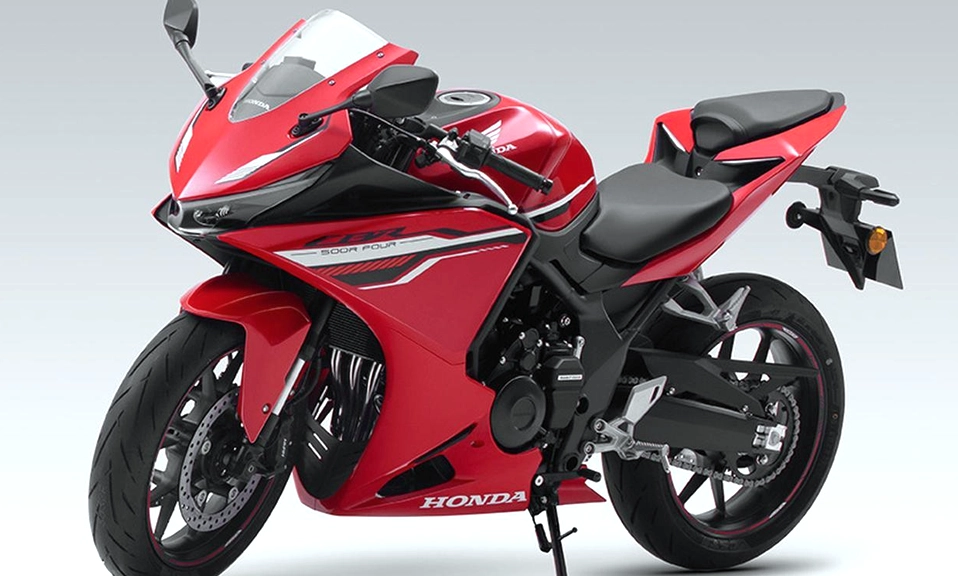
Honda has done something genuinely unexpected. In a market that has spent the last decade downsizing, turbocharging, and simplifying, the Japanese giant has just dropped a brand-new 500cc inline-four sportbike—a machine that revs to 12,500 rpm, comes standard with an automatic clutch, and costs barely more than the parallel-twin CBR500R it will sit alongside. But the CBR500R FOUR is not a replacement. It is a different animal entirely, and the “FOUR” in its name is the key to understanding why.
The new bike, unveiled in October 2026 and arriving in European showrooms in January 2027, is Honda’s attempt to recapture the spirit of the small-capacity four-cylinder sportbike—a genre that has been dormant for years. It draws on the lineage of the CB400 SUPER FOUR, a machine sold in Japan for more than three decades, and positions itself as a miniature superbike in the vein of the Kawasaki ZX-4RR. But what exactly makes it different from the CBR500R that has been a staple of Honda’s lineup? Quite a lot.
The Engine: A New Heart, A New Character
The most fundamental difference is under the fairing. The existing CBR500R uses a 471cc parallel-twin engine, a dependable and accessible unit that produces around 47 horsepower and makes its peak power at a relatively low 8,500 rpm. It is a sensible, friendly engine—the kind that welcomes new riders and commutes without complaint.
The CBR500R FOUR throws that formula out the window. It is powered by an all-new 502cc DOHC 16-valve inline-four, a completely different architecture that produces around 71–72 horsepower at 11,000 rpm and 47.4 Nm of torque at 9,750 rpm, with a redline stretching to 12,500 rpm. Where the twin is about accessible mid-range, the FOUR is about the crescendo—the soaring, high-revving power delivery that only four cylinders can deliver.
Honda has not simply bolted two extra cylinders onto an existing design. The engine features nickel-silicon carbide cylinder plating to reduce weight, diamond-like carbon-coated valve lifters to minimise friction, and a downdraft intake system with dual ram-air ducts to sharpen throttle response and produce what Honda describes as a “multi-frequency resonance” sound. The 4-2-1 exhaust is inspired by the 1975 CB400 FOUR, a nod to Honda’s own history of small four-cylinder road bikes.
The result is an engine that feels fundamentally different from the twin. It is peakier, more theatrical, and more demanding of the gearbox. But Honda insists it still offers a “broad spread of usable performance” rather than relying solely on high revs—a claim that will be tested by riders accustomed to the twin’s low-down flexibility.
The Clutch: E-Clutch Comes as Standard
One of the most significant practical differences is the fitment of Honda’s E-Clutch as standard equipment. The system automatically operates the clutch during take-offs, gear changes, and stops, allowing riders to ride without ever touching the clutch lever. The lever remains in place for those who want manual control, and the system can be switched off entirely.
This is a bigger deal than it might sound. E-Clutch democratises the four-cylinder experience. A high-revving inline-four can be intimidating for newer riders, particularly in stop-start traffic where clutch control is essential. By removing that barrier, Honda is making the CBR500R FOUR approachable in a way that a traditional small-capacity four-cylinder sportbike has rarely been. It also works with the bike’s throttle-by-wire system to manage rev-matched downshifts, smoothing out the kind of aggressive engine braking that can unsettle a less experienced rider.
The Electronics: Modern Kit, Sensible Priorities
The CBR500R FOUR is not a stripped-out homologation special. It comes with a full suite of rider aids designed for the road as much as the track.
There are five riding modes—Standard, Sport, Urban, and two user-configurable modes—that allow riders to adjust power delivery, engine braking, and traction control. Honda Selectable Torque Control and wheelie control are both included, and the bike features a 5-inch TFT display with Honda RoadSync smartphone connectivity for calls, messages, music, and navigation. LED lighting and a USB-C socket round out the practical package.
This is a notably more comprehensive electronics package than the parallel-twin CBR500R offers, and it reflects the FOUR’s positioning as a premium, tech-rich machine rather than a budget commuter.
The Chassis: Simple but Purposeful
Honda has not overcomplicated the chassis. The CBR500R FOUR uses a steel diamond-type frame with the engine as a stressed member, paired with a cast-aluminium swingarm. Suspension is handled by 41mm KYB upside-down forks up front and a Pro-Link monoshock with preload adjustment at the rear. Braking comes from twin 296mm front discs with radially mounted Nissin two-piston calipers, backed by two-channel ABS.
The numbers are equally sensible. Claimed kerb weight is 189 kg, seat height is an accessible 780mm, and the fuel tank holds 14 litres. This is not a featherweight track weapon, but it is manageable and unintimidating—exactly what you want from a bike that is trying to make four-cylinder performance accessible to a wider audience.
The Positioning: Between the Twin and the Supersport
The CBR500R FOUR does not replace the CBR500R twin. Honda will continue to sell both, and the naming is deliberately differentiated by the “FOUR” suffix. The twin remains the entry point—affordable, accessible, and focused on everyday usability. The FOUR sits above it, offering more power, more technology, and a more focused riding experience, but without stepping into the territory of the CBR600RR, which is a true supersport machine with a racing pedigree.
Honda describes the FOUR as “all-new” and built on a platform distinct from the long-running twin, and it is priced accordingly: £6,999 in the UK, just £100 more than the parallel-twin CBR500R. That is a remarkably small premium for a completely different engine and a more comprehensive electronics package. An A2-licence-friendly 35kW version will also be available for riders in Europe who are still restricted by licence category.
The main rivals are the Kawasaki ZX-4RR and the BMW F 450 RR, both of which occupy the same “mini superbike” niche. The Honda’s advantage is its standard E-Clutch, its accessible seat height, and its aggressive pricing relative to the specification.
What Makes It Different?
The CBR500R FOUR is different because it refuses to accept the conventional wisdom that small-capacity sportbikes should be simple, affordable twins. It brings a high-revving inline-four back to the 500cc class, wraps it in modern electronics, and makes it approachable through E-Clutch—all without pricing it out of reach of the riders who are most likely to want it.
It is not a replacement for the CBR500R twin, and it is not a shrunken CBR600RR. It is a third path: a premium, technology-rich, four-cylinder sportbike for riders who want the sound, the sensation, and the character of a multi-cylinder engine without the cost, complexity, or intimidation factor of a full-size supersport. Honda has not just revived a dormant category. It has redefined what a 500cc sportbike can be. And for riders who have been waiting for something genuinely different in the middleweight class, that is worth paying attention to.