🎬 Introduction: A New Era of Filmmaking
Avatar, directed by James Cameron, is more than just a movie—it’s a cultural phenomenon that revolutionized 3D filmmaking and redefined the sci-fi genre. Released in 2009, it became the highest-grossing film of all time (until Avengers: Endgame briefly surpassed it in 2019), earning over $2.9 billion worldwide and 3 Oscars (including Best Cinematography and Best Visual Effects). But beyond its box office success, Avatar is a visually stunning, emotionally resonant story about colonialism, environmentalism, and the power of connection.
Let’s dive into why Avatar remains a landmark in cinema history.
📖 Plot Summary: A Journey to Pandora
Act 1: Jake Sully’s Arrival
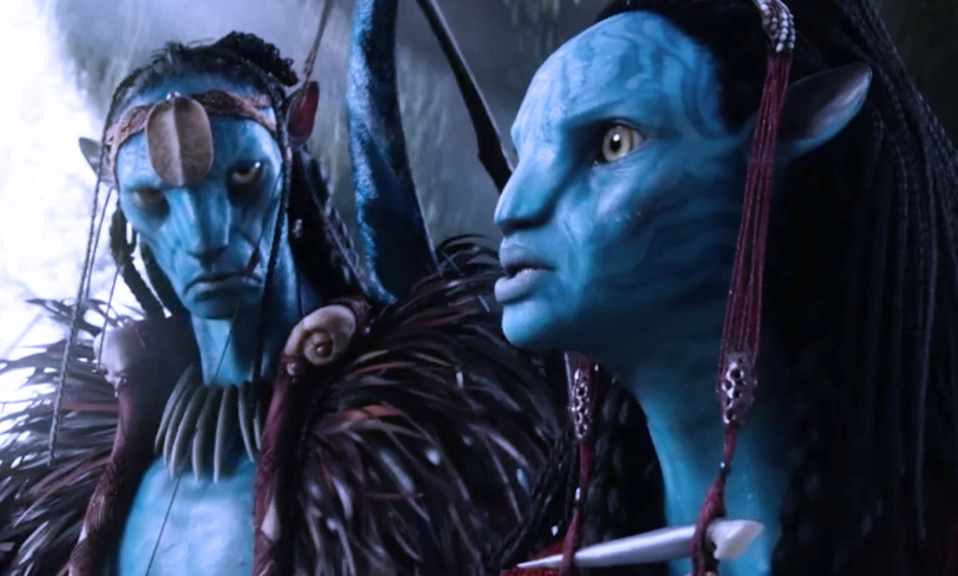
- Setting: The year 2154. Humans have depleted Earth’s resources and are now mining Pandora, a lush, habitable moon of a gas giant in the Alpha Centauri system. Pandora is home to the Na’vi, a 10-foot-tall, blue-skinned, humanoid species with a deep spiritual connection to their planet and its ecosystem.
- Protagonist: Jake Sully (Sam Worthington), a paraplegic Marine, is recruited to join the Avatar Program—a project where humans control genetically engineered Na’vi bodies (Avatars) to infiltrate and study the Na’vi.
- Conflict: The Resources Development Administration (RDA), led by Parker Selfridge (Giovanni Ribisi), wants to mine Pandora’s valuable mineral, Unobtanium, while Colonel Miles Quaritch (Stephen Lang) leads the military forces to secure the operation by any means necessary.
Act 2: Jake’s Transformation
- Undercover Mission: Jake, in his Avatar form, is sent to infiltrate the Na’vi and gather intelligence. He meets Neytiri (Zoe Saldaña), a Na’vi princess, who initially distrusts him but eventually teaches him the ways of her people.
- Cultural Immersion: Jake learns the Na’vi language, customs, and spiritual beliefs, including their connection to Eywa, the planet’s deity, and the sacred Tree of Souls.
- Falling in Love: Jake and Neytiri develop a deep romantic bond, and he begins to question his loyalty to the humans.
- Betrayal: When the Na’vi discover Jake’s true mission, they banish him. However, he proves his loyalty by saving Neytiri from a Thanator (a deadly Pandoran predator).
Act 3: The Battle for Pandora
- War Erupts: The RDA, impatient with Jake’s lack of progress, launches a full-scale assault on the Na’vi’s Hometree. Jake, now fully aligned with the Na’vi, warnings them of the impending attack, but they refuse to abandon their home.
- Destruction of Hometree: The humans destroy the Hometree, killing many Na’vi, including Neytiri’s father, the tribal chief.
- Jake’s Redemption: Jake unites the Na’vi tribes and leads them in a counterattack against the humans. With the help of Pandora’s wildlife (including the Thanators and Direhorses), the Na’vi overwhelm the human forces.
- Final Showdown: Jake duels Colonel Quaritch in a mech suit (AMP suit) and kills him. The remaining humans are expelled from Pandora, and Jake permanently transfers his consciousness into his Avatar body, fully becoming one of the Na’vi.
🎭 Characters & Performances
| Character | Actor/Actress | Role |
|---|---|---|
| Jake Sully | Sam Worthington | Protagonist, a paraplegic Marine who finds redemption on Pandora. |
| Neytiri | Zoe Saldaña | Na’vi princess, Jake’s love interest, and a fierce warrior. |
| Colonel Miles Quaritch | Stephen Lang | Primary antagonist, a ruthless military leader obsessed with power. |
| Dr. Grace Augustine | Sigourney Weaver | Scientist, leader of the Avatar Program, and advocate for the Na’vi. |
| Parker Selfridge | Giovanni Ribisi | Corporate villain, head of the RDA, prioritizes profit over ethics. |
| Norm Spellman | Joel David Moore | Scientist, Jake’s friend, and comic relief. |
| Trudy Chacon | Michelle Rodriguez | Pilot, a sympathetic human who helps Jake. |
🌍 Themes & Social Commentary
Avatar is more than just a sci-fi adventure—it’s a powerful allegory for real-world issues:
Colonialism & Exploitation:
- The RDA’s actions on Pandora mirror historical colonialism, where powerful nations exploited indigenous peoples and their lands for resources.
- The Na’vi’s resistance reflects real-world struggles of Native American tribes, Indigenous peoples in the Amazon, and other marginalized groups.
Environmentalism:
- Pandora’s lush, interconnected ecosystem represents Earth’s fragile environment.
- The destruction of Hometree symbolizes deforestation and ecological devastation caused by human greed.
- The film advocates for respecting nature and the consequences of exploiting it.
Disability & Transformation:
- Jake’s paraplegia and his transformation into an Avatar explore themes of identity, healing, and rebirth.
- His journey from a broken man to a hero resonates with audiences facing physical or emotional struggles.
Love & Connection:
- Jake and Neytiri’s cross-cultural romance highlights the power of love to bridge divides.
- The Na’vi’s communal lifestyle contrasts with the individualism and greed of the humans.
Spirituality vs. Materialism:
- The Na’vi’s deep spiritual connection to Pandora (through Eywa) contrasts with the humans’ materialistic, destructive approach.
- The film questions whether humanity has lost its connection to the natural world.
🎨 Visuals & Technical Innovations
Avatar was a pioneer in filmmaking technology, pushing the boundaries of 3D and motion-capture (performance capture):
1. Groundbreaking 3D Technology
- Cameron waited over a decade to make Avatar until 3D technology was advanced enough to bring his vision to life.
- The film used stereoscopic 3D cameras to create a fully immersive experience, making Pandora feel real and tangible.
- First major film to use 3D as a storytelling tool (not just a gimmick).
2. Performance Capture (Mo-Cap)
- Actors performed in motion-capture suits, allowing their facial expressions and body movements to be digitally transferred to their CGI Avatars and Na’vi characters.
- Zoe Saldaña’s performance as Neytiri was groundbreaking—her emotional depth shined through the CGI.
- Sam Worthington’s Jake Sully was one of the first fully CGI protagonists in a live-action film.
3. World-Building: Pandora
- Pandora’s Design: Inspired by real-world ecosystems, including bioluminescent forests (like those in Vietnam’s Hang Son Doong Cave).
- Flora & Fauna: The film’s alien creatures (Thanators, Direhorses, Mountain Banshees) were meticulously designed to feel real and believable.
- Na’vi Culture: The language, customs, and spirituality of the Na’vi were developed with linguistic and anthropological experts.
4. Cinematography
- DP: Mauro Fiore (won Oscar for Best Cinematography).
- **Use of virtual cameras allowed Cameron to film in a 3D virtual environment before the CGI was fully rendered.
- Night scenes on Pandora were shot with infrared cameras to capture the bioluminescent glow of the forest.
🏆 Winner: Avatar – A technical masterpiece that redefined modern filmmaking.
🎵 Music & Soundtrack
- Composer: James Horner (legendary composer of Titanic, Braveheart).
- Soundtrack Highlights:
- “I See You” (by Leona Lewis) – The emotional theme song that plays during Jake and Neytiri’s first flight on a Mountain Banshee.
- “Pandora’s Box” – A haunting, ethereal track that captures the mystery of Pandora.
- “Becoming One of the People” – A powerful, cultural piece that plays as Jake earns his place among the Na’vi.
- Legacy: The soundtrack complements the film’s emotional and visual grandeur, enhancing the immersive experience.
📊 Reception & Critical Response
Avatar received mixed-to-positive reviews from critics but was a massive commercial and cultural success:
✅ Praise:
✔ Groundbreaking Visuals: Critics unanimously praised the film’s 3D technology, CGI, and world-building.
✔ Immersive Experience: Many called it a “game-changer” for cinema, redefining how movies could be made and watched.
✔ Environmental Message: The film’s themes of colonialism and environmentalism resonated with audiences.
✔ Box Office Success: It became the highest-grossing film of all time (until Endgame in 2019) and revived 3D cinema.
❌ Criticism:
✖ Thin Plot: Some critics argued the story was predictable and lacked depth compared to its visual spectacle.
✖ Derivative: The plot was compared to Dances with Wolves and Pocahontas (a white savior narrative).
✖ Dialogue: Some lines were clunky or cheesy (e.g., “I see you”).
📊 Ratings & Box Office
| Metric | Avatar (2009) |
|---|---|
| IMDb | 7.9/10 |
| Rotten Tomatoes | 82% (Critics) / 88% (Audience) |
| Metacritic | 67/100 |
| Box Office (Worldwide) | $2.92 billion (original release) |
| Budget | $237 million |
| Oscars | 3 Wins (Best Cinematography, Best Visual Effects, Best Art Direction) |
🏆 Verdict: A visual triumph that transcended its narrative limitations.
🌍 Cultural Impact & Legacy
Avatar didn’t just break box office records—it changed the film industry and pop culture:
1. Revival of 3D Cinema
- Before Avatar, 3D movies were a niche gimmick.
- After Avatar, every major studio rushed to release 3D films (some successfully, many poorly).
- IMAX and premium 3D ticket sales skyrocketed, proving that audiences would pay extra for an immersive experience.
2. Influence on Sci-Fi & Filmmaking
- Paved the way for high-budget sci-fi epics like Dune (2021), The Martian (2015), and Interstellar (2014).
- Proved that CGI could carry a film—inspiring more investment in motion-capture technology (e.g., Planet of the Apes reboot).
- James Cameron’s perfectionism set a new standard for blockbuster filmmaking.
3. Environmental & Social Awareness
- The film’s anti-colonialism and pro-environmentalism themes sparked global discussions about climate change and indigenous rights.
- Real-world activism was inspired by the movie, including protests against deforestation in places like the Amazon rainforest.
4. Merchandising & Franchise
- Video Games: Avatar: The Game (2009) was a commercial success.
- Theme Park Attractions: Pandora – The World of Avatar at Disney’s Animal Kingdom (opened in 2017) is one of the most popular theme park lands in the world.
- Sequels: Cameron announced four sequels, with Avatar: The Way of Water (2022) breaking box office records and proving the franchise’s staying power.
5. Memes & Pop Culture
- “I see you” became a popular meme and catchphrase.
- Pandora’s bioluminescent forests inspired real-world light installations and art.
- Na’vi language (created by linguist Paul Frommer) became a subject of study for some fans.
🏆 Winner: Avatar – A cultural phenomenon that extended far beyond the screen.
🎬 Behind the Scenes & Fun Facts
- Development Hell: Cameron first conceived Avatar in 1994 but waited 15 years for technology to catch up.
- Budget: The film’s $237 million budget made it the most expensive movie ever at the time (until Pirates of the Caribbean: On Stranger Tides in 2011).
- Filming: 70% of the movie was CGI, with actors performing in motion-capture suits on a virtual set.
- Language: The Na’vi language has over 1,000 words and its own grammar and syntax.
- Re-Release: Avatar was re-released in theaters in 2010, 2011, and 2022 to boost box office numbers before its sequels.
- James Cameron’s Obsession: Cameron wrote an 80-page treatment for the film in 1994 and personally oversaw every detail of Pandora’s design.
🎯 Why Avatar Still Matters Today
Avatar wasn’t just a box office hit—it was a cultural reset for cinema. It proved that:
✅ 3D wasn’t a gimmick—it could be a storytelling tool.
✅ CGI could carry emotional weight—not just action.
✅ Sci-fi could be more than just spaceships and lasers—it could be deeply human.
✅ Audiences would pay premium prices for an immersive experience.
Even 15+ years later, Avatar remains a benchmark for blockbuster filmmaking, and its sequels continue to push the boundaries of what’s possible in cinema.
🏆 Final Verdict: Is Avatar Worth Watching in 2026?
✅ Watch It If You:
- Love groundbreaking visuals and immersive world-building.
- Enjoy sci-fi epics with deep themes (colonialism, environmentalism, spirituality).
- Appreciate James Cameron’s perfectionism and attention to detail.
- Want to experience a film that changed cinema forever.
❌ Skip It If You:
- Prefer fast-paced, dialogue-driven stories (the plot is slow and predictable).
- Dislike long runtime (162 minutes).
- Are not a fan of 3D (though the 2D version still looks stunning).
🎤 I see you” (Oel ngati kameie)
Avatar (2009) is a flawed but revolutionary film. While its story may not be its strongest suit, its visuals, world-building, and cultural impact are unmatched. It redefined what a blockbuster could be and inspired a generation of filmmakers.
Final Rating: ⭐⭐⭐⭐½ (4.5/5) – A must-watch for its historical significance and visual spectacle.
Have you seen Avatar? What did you think of its themes and visuals?