What the 66-Million-Year-Old Footprints Reveal
Kent Hups was nursing a bad knee when he accidentally stepped into paleontology history. He looked down, saw three splayed toes carved into the rock, and started hooting and hollering.
For more than a century, scientists have known Tyrannosaurus rex as a collection of bones. Mighty bones, to be sure — jaws that could crush bone, legs like tree trunks, a skull the size of a bathtub. But bones tell you what a dinosaur was. They don’t tell you what it did.
Now, for the first time, we know what one of them did on a single afternoon 66.5 million years ago. It walked.
A high school science teacher from Colorado has discovered the first-ever trackway made by an adult T. rex — four connected footprints stretching 23 feet across the badlands of southwestern North Dakota. The discovery, published September 8 in the Journal of Vertebrate Paleontology, offers something no skeleton ever could: a moment of behavior frozen in stone.
A Lucky Knee
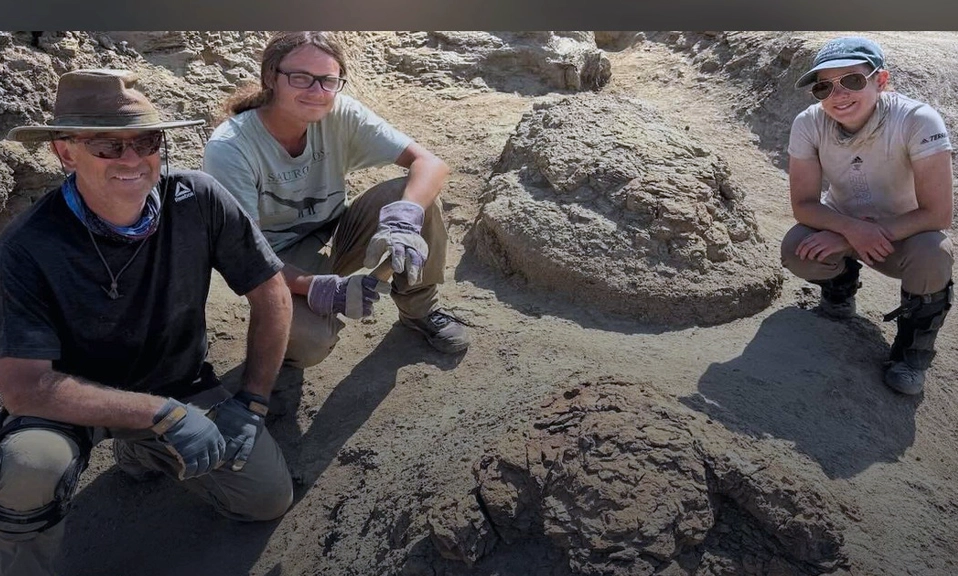
Kent Hups wasn’t supposed to be there. A teacher at Northglenn High School and a research associate at the Denver Museum of Nature & Science, Hups was volunteering on a dig led by his friend Tyler Lyson, the museum’s senior curator of vertebrate paleontology, near Marmarth, North Dakota.
He had recently had knee replacement surgery. The rugged terrain of the Hell Creek Formation was not kind to him. So while the rest of the team worked the main quarry, Hups did what he called “prospecting” — wandering the outcrops, looking for anything interesting that might have eroded out of the hillside.
He had descended into a remote area when he saw it: a lumpy, wedge-shaped protrusion sticking out of the ground, with three distinct toes splayed outward.
“I immediately started jumping up and down and hooting and hollering,” Hups told ABC News.
He knew what it looked like. He also knew how unlikely it was to be real.
The Skeptic and the Trackway
When Hups showed Lyson what he’d found, the paleontologist was skeptical. And with good reason. Only two isolated adult T. rex footprints had ever been confirmed anywhere in the world — one in New Mexico, one in Montana. Neither showed how the animal was moving. Neither was part of a sequence. A single T. rex track was a rare curiosity. A trackway was something else entirely.
But the team returned to the site the next day anyway. And what they found stopped them cold.
Four footprints. Two left, two right. Each one roughly three feet long. Together they formed a trackway 23 feet long, with a stride of about 13 feet between successive steps.
The tracks were unmistakably tyrannosaur. The size, the narrow shape of the toes, the three-toed arrangement — all pointed to one animal. And the surrounding rock sealed the case: the Hell Creek Formation in that area has produced an abundance of T. rex fossils, including a juvenile specimen nicknamed “Teen Rex,” discovered by three boys on a family hike in 2022.
The researchers had their trackmaker. What they didn’t yet have was the full story the tracks could tell.
How Fast Does a Seven-Ton Predator Walk?
The spacing between the footprints gave the team their answer. By measuring the stride length and the size of the feet, researchers estimated the T. rex was moving at about 3.5 to 4.5 miles per hour — roughly the pace of a brisk human walk.
That might sound underwhelming. A seven-ton apex predator, the most fearsome land animal in Earth’s history, was strolling along at the speed of a commuter heading to the train station.
But that’s precisely what makes the discovery valuable. “Bones tell us an enormous amount about these animals, but footprints capture a moment of behavior,” Lyson said. “With a trackway, we can actually follow an animal as it moved across the landscape. That is incredibly rare for T. rex“.
The tracks date to about 66.5 million years ago — near the very end of the Cretaceous period, just before the asteroid impact that wiped out the dinosaurs. This wasn’t a dinosaur from the distant past of its own era. It was one of the last walks any T. rex is known to have taken.
How a Teacher in Colorado Analyzed Tracks in VR
The discovery required a collaboration that spanned an ocean and a pandemic-era comfort: virtual reality.
Peter Falkingham, a professor of palaeobiology at Liverpool John Moores University and a leading expert on dinosaur tracks, was the lead author of the study. He never visited North Dakota. He never saw the tracks in person.
Instead, Denver Museum researchers used high-resolution 3D surface scanning to document each footprint and the full trackway. They sent the digital models to Falkingham, who examined them on his computer and in virtual reality.
“The technology we’re able to apply in the digital age means my colleagues could scan the tracks in the field and then send the 3D information over to me to visualize on my computer and in VR, enabling me to take as close a look as they did in person,” Falkingham said.
The digital models also allow the team to create physical 3D reproductions of the tracks — and three of the four footprints are expected to be airlifted out by helicopter this fall and transported to the Denver Museum of Nature & Science.
Why This Discovery Matters
T. rex is the most famous dinosaur in the world. It’s also one of the most studied. And yet, until now, we knew almost nothing about how it actually moved through its environment. We had bones. We had biomechanical models. We had footprints so rare that they were treated as curiosities rather than data.
The trackway changes that. It gives researchers a direct record of locomotion — not a reconstruction, not a simulation, but the actual physical trace of an animal walking across a landscape that is now the badlands of North Dakota.
It also underscores something that’s easy to forget in a field dominated by museum skeletons: paleontology isn’t just about bones. It’s about behavior. And behavior is almost never preserved.
“It’s going to be one of those days that I’ll never forget,” Hups said.
What Hups Told His Students
Hups has been sharing the discovery with his geology classes and paleontology club. His students, he said, are “loving it”.
But the lesson he wants them to take away is bigger than a single set of footprints.
“As a teacher, I’m always telling my students that science starts with curiosity, passion, and careful observation,” he said. “I never imagined that could lead me to a discovery like this”.
He also had a simpler piece of advice for anyone who might follow in his footsteps: “You got to go out and look for stuff”.
That’s the thing about the T. rex trackway. It wasn’t found by a team of specialists with a grant and a research plan. It was found by a high school teacher with a bad knee, wandering a hillside, paying attention.
The footprints had been there for 66.5 million years. They were waiting for someone to look down.