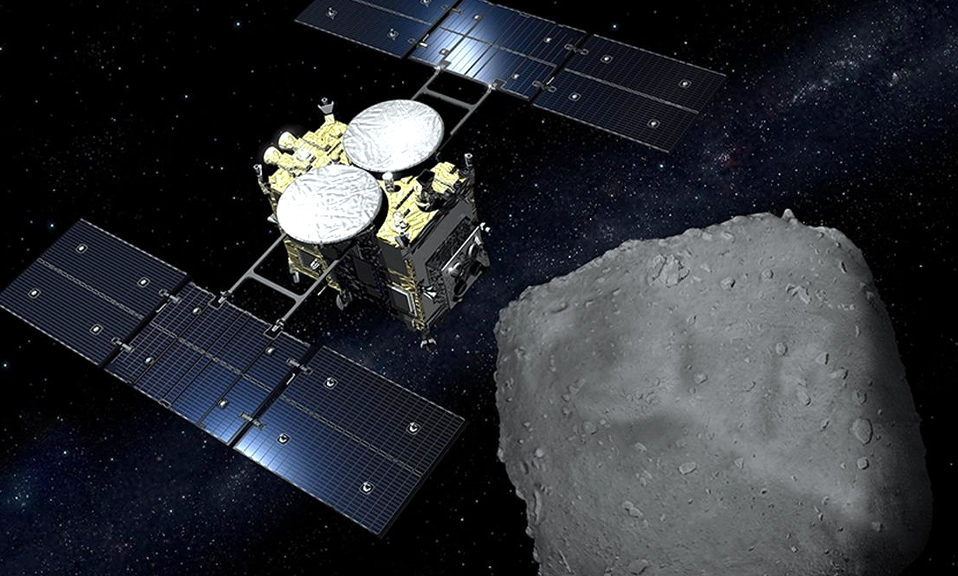
In a discovery that fundamentally reshapes our understanding of life’s cosmic origins, scientists have found all five building blocks of DNA and RNA in pristine samples from a 4.5-billion-year-old asteroid. The finding suggests that the essential ingredients for life were not only present in space, but were likely widespread throughout the early Solar System—delivered to Earth by the very rocks that bombarded it in its youth.
The asteroid is Ryugu, a primitive carbonaceous rock that orbits the Sun between Earth and Mars. Samples were collected by the Japanese Space Agency’s (JAXA) Hayabusa2 mission, which rendezvoused with the asteroid in 2018 and returned a capsule of material to the Australian outback in December 2020. Since then, scientists have been studying the grains with ever-increasing precision, and the latest analysis has confirmed the presence of the complete set of canonical nucleobases: adenine, guanine, cytosine, thymine, and uracil.
The research, led by Toshiki Koga of the Japan Agency for Marine-Earth Science and Technology (JAMSTEC), was published on March 16, 2026, in the journal Nature Astronomy.
The Discovery: A Complete Set of Genetic Letters
Nucleobases are the nitrogen-containing molecules that form the “rungs” of the DNA double helix and the building blocks of RNA. They come in two classes: purines (adenine and guanine) and pyrimidines (cytosine, thymine, and uracil). The detection of all five in a single extraterrestrial sample is a landmark moment.
Previous analyses of Ryugu had already reported the presence of uracil in 2023. But the amount of material available was too small for a comprehensive analysis. In 2023, Koga’s team applied for and received a new allocation of just 20 milligrams of sample—one from the asteroid’s surface and another from its subsurface—and developed a refined extraction process that allowed them to “eke out every single particle and every piece of data” from the minuscule grains. Using high-resolution mass spectrometry, they identified not only the five nucleobases but also several of their structural isomers.
The presence of these isomers is crucial. It is strong evidence that the nucleobases are not contamination from Earth, but rather formed abiotically in space. The finding confirms that the chemistry that produces the building blocks of life can occur in the absence of life itself.
Why Ryugu’s Ratios Matter
The discovery is not just about which molecules were found, but how much of each. Koga’s team compared the nucleobase abundances in Ryugu with those from the Murchison and Orgueil meteorites and with samples from the asteroid Bennu. They found significant differences.
Ryugu contains roughly comparable amounts of purine and pyrimidine nucleobases, while Murchison is richer in purines, and Bennu and Orgeuil are richer in pyrimidines. These ratios reflect the different chemical, environmental, and evolutionary histories of their respective parent bodies. The fact that all five nucleobases have now been found in two different carbonaceous asteroids—Ryugu and Bennu—suggests that these fundamental components of genetic material were likely produced universally during the formation of the Solar System.
The Implications: Life’s Ingredients Were Everywhere
The implications of this discovery extend far beyond a single asteroid. If the building blocks of DNA and RNA were present in the early Solar System, and if they were widespread across different carbonaceous asteroids, then the raw materials for life were not a rare or localized phenomenon. They were part of the cosmic inventory from which planets formed.
The findings also strengthen the case that carbonaceous asteroids may have contributed to the chemical inventory of early Earth. As the young Earth was bombarded by asteroids and meteorites during its formation, it would have been seeded with these prebiotic molecules—a delivery service from the heavens that may have helped kickstart the chemistry that eventually led to life.
Astrobiologists are careful to note, however, that finding the building blocks is not the same as finding life. As César Menor Salvan, an astrobiologist at the University of Alcalá, put it: “Finding nucleobases does not answer the question of life’s origins, just as finding sand, clay, and rocks in a field doesn’t explain the origin and evolution of architecture or ceramics”. The molecules are necessary but not sufficient. The mystery of how these ingredients assembled into the first self-replicating organisms remains one of the deepest unanswered questions in science.
Ryugu is a milestone
in the search for life’s origins. It confirms that the genetic alphabet was written in the chemistry of space, billions of years before the first organisms appeared on Earth. It suggests that the ingredients for life were not unique to our planet, but were sown throughout the Solar System by the very processes that formed it.
The samples returned by Hayabusa2 are a time capsule from the birth of the Solar System. They tell us that the molecules that make life possible were already present in the dust and ice from which the planets assembled. Whether those ingredients ever assembled into something alive on another world is a question that remains open. But the evidence is mounting that the universe is not hostile to the chemistry of life. It may be, in a very real sense, built for it.