You take your car in for a routine windshield replacement after a rock chip. The technician does a great job, the glass looks perfect, and you drive away feeling good.
Two weeks later, you’re on the highway when your car suddenly slams on the brakes for no reason. Or worse, it doesn’t brake when the car in front of you stops.
Welcome to the hidden world of ADAS calibration—a critical service that most drivers have never heard of, but that could literally save your life.
Advanced Driver Assistance Systems (ADAS) have become standard on most modern vehicles. Lane departure warning, automatic emergency braking, adaptive cruise control, blind spot monitoring—these features rely on a network of cameras, radar, and sensors that must be precisely aligned. When that alignment is off by even a fraction of a degree, these life-saving systems can malfunction in dangerous ways.
Here’s what every modern car owner needs to know about ADAS calibration, why it matters, and when your car needs it.
🎯 What Is ADAS (And Why Should You Care)?
ADAS stands for Advanced Driver Assistance Systems. These are the semi-autonomous features that help you drive safer:
- Automatic Emergency Braking (AEB): Detects obstacles and brakes automatically
- Lane Keeping Assist: Gently steers you back if you drift out of your lane
- Adaptive Cruise Control: Maintains a set distance from the car ahead
- Blind Spot Monitoring: Alerts you to vehicles in your blind spots
- Traffic Sign Recognition: Reads speed limits and other signs
- Parking Assist: Helps you parallel park or detect obstacles
These systems work using a combination of:
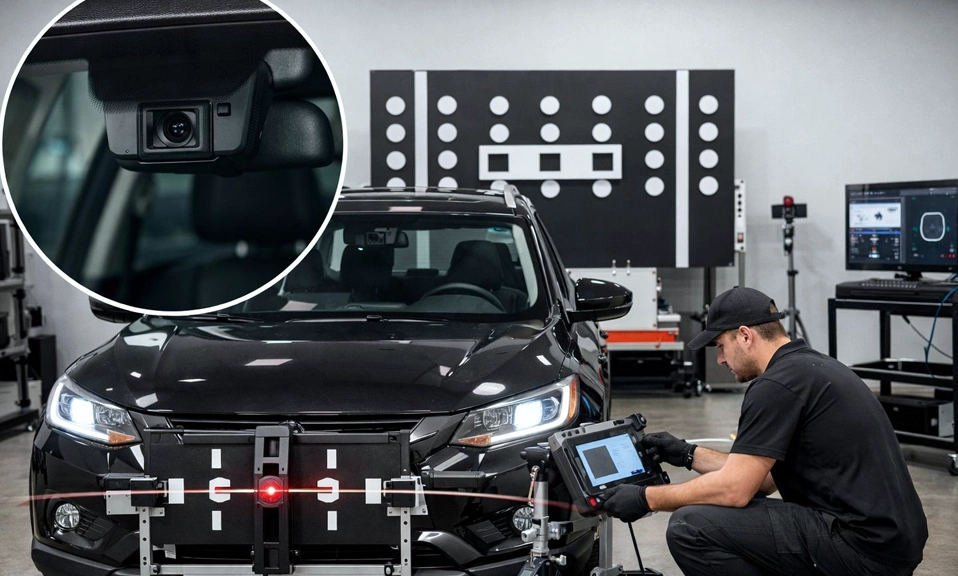
- Cameras (usually mounted behind the windshield, near the rearview mirror)
- Radar sensors (often behind the front grille or bumper)
- Ultrasonic sensors (in the bumpers for parking assistance)
- LiDAR (on some newer, more advanced vehicles)
All of these sensors must be perfectly calibrated to work correctly. And that’s where most drivers—and even some mechanics—get caught off guard.
🔧 When Does Your Car Need ADAS Calibration?
Most people assume ADAS calibration is only needed after a major accident. That’s not true. Here are the most common situations that require recalibration:
1. Windshield Replacement
Why it matters: The forward-facing camera is typically mounted directly behind the windshield, right in front of the rearview mirror. Even a millimeter shift in the camera’s angle can throw off the entire system. The reality: If your windshield is replaced and the camera isn’t recalibrated, your lane keeping assist might drift, your automatic emergency braking might trigger falsely, or it might not trigger at all when you need it.
2. After a Collision (Even a Minor One)
Why it matters: A fender bender can knock sensors out of alignment. Even if the damage looks cosmetic, the radar sensors in the bumper or the cameras might be slightly misaligned. The reality: Many repair shops now include ADAS calibration as a standard part of collision repair, but not all do. Always confirm this is being done.
3. Suspension Work or Alignment
Why it matters: Changing the ride height or wheel alignment alters the vehicle’s geometry. Since ADAS sensors are calibrated to the vehicle’s specific angles, suspension changes can throw them off. The reality: If you get new shocks, struts, or even a wheel alignment, ask if ADAS recalibration is needed.
4. Front Bumper Removal or Replacement
Why it matters: Many radar sensors are mounted behind the front emblem or in the lower bumper. Removing or replacing the bumper can shift these sensors. The reality: Even something as simple as replacing a cracked bumper cover after a minor scrape can require recalibration.
5. Steering or Suspension Component Replacement
Why it matters: Tie rods, control arms, and other steering components affect wheel angles, which in turn affect how the ADAS systems interpret the vehicle’s position on the road.
6. After Certain Software Updates
Why it matters: Occasionally, a software update can reset or alter sensor calibration parameters. This is rare but worth checking if you notice system behavior changes after an update.
⚙️ Static vs. Dynamic Calibration: What’s the Difference?
There are two main types of ADAS calibration, and the method depends on your vehicle:
Static Calibration
How it works: The vehicle is parked in a specialized bay with precise targets, patterns, and laser levels placed at exact distances and angles around the car. A computer then aligns the sensors to these targets. When it’s used: For camera-based systems (like lane keeping) and some radar systems. Requirements: Requires specialized equipment and a controlled environment (specific lighting, floor flatness, etc.). Cost: Typically $200-$600 depending on the vehicle and systems.
Dynamic Calibration
How it works: A technician drives the vehicle on a specific route (usually a highway with clear lane markings) while a diagnostic tool monitors the sensors in real-time. The system self-calibrates as it “learns” the road. When it’s used: For some radar-based systems (like adaptive cruise control) and certain camera systems. Requirements: Requires specific road conditions (clear markings, good weather, minimal traffic). Cost: Typically $150-$400.
Some Vehicles Require Both
Many modern cars need both static and dynamic calibration to fully align all systems. This can push costs to $500-$1,000 or more for luxury vehicles with complex ADAS setups.
🚨 What Happens If You Skip ADAS Calibration?
This isn’t just about convenience or features working “a little off.” Improperly calibrated ADAS can be genuinely dangerous:
1. False Activations Your car might slam on the brakes for no reason, thinking there’s an obstacle when there isn’t. This can cause rear-end collisions or loss of control.
2. Failure to Activate The system might not detect a stopped car, a pedestrian, or a lane departure when it should. You’re relying on a safety feature that isn’t working.
3. Erratic Behavior Lane keeping might pull you toward the shoulder instead of keeping you centered. Adaptive cruise might follow the wrong vehicle or fail to maintain proper distance.
4. Voided Warranty or Insurance Issues If you’re in an accident and it’s discovered that ADAS systems weren’t properly calibrated after a repair, your insurance claim could be denied, or the repair shop could be liable.
5. Legal Liability In some jurisdictions, driving a vehicle with known safety system malfunctions could expose you to legal liability if you’re in an accident.
💰 The Cost Reality: Why ADAS Calibration Is Expensive
Let’s be honest: ADAS calibration isn’t cheap. Here’s why:
1. Specialized Equipment The calibration tools cost $20,000-$100,000+ for shops to purchase. This investment has to be recouped through service charges.
2. Training and Certification Technicians need specific training and often manufacturer certification to perform calibrations correctly.
3. Time-Intensive A full calibration can take 1-3 hours of skilled labor, plus setup time.
4. Liability and Precision This is safety-critical work. If done incorrectly, people can be hurt. Shops carry higher insurance costs and must follow strict procedures.
5. Vehicle Complexity Luxury vehicles with multiple radar units, cameras, and LiDAR require more complex calibration processes.
Typical costs by vehicle type:
- Economy cars (basic ADAS): $150-$400
- Mid-range vehicles: $300-$600
- Luxury vehicles (Mercedes, BMW, Audi, etc.): $500-$1,200+
- High-end vehicles with LiDAR (some new EVs): $1,000-$2,000+
The hard truth: This cost is now part of owning a modern car. It’s like the cost of replacing tires or brakes—unavoidable maintenance for safety systems.
🔍 How to Know If Your Car Needs Calibration
Here are the warning signs that your ADAS might be out of calibration:
1. Dashboard Warning Lights
- “Lane Keeping Assist Unavailable”
- “Forward Collision Warning Off”
- “Camera Obstructed” (when the camera is clearly clean)
- Generic ADAS warning icons
2. Erratic System Behavior
- Lane keeping pulls you off-center
- Adaptive cruise follows the wrong car or cuts in and out
- Automatic braking triggers for no reason
- Blind spot monitoring shows vehicles that aren’t there
3. After Any of the Situations Listed Above If you’ve had a windshield replaced, collision repair, suspension work, or bumper replacement, assume calibration is needed unless the shop explicitly confirms it was done.
4. The “Check with Your Shop” Rule After any repair, ask: “Was ADAS recalibration performed as part of this service?” If they look at you blankly, that’s a red flag.
🛠️ Finding a Qualified Calibration Shop
Not all mechanics can perform ADAS calibration. Here’s what to look for:
1. Specialized Equipment Ask what calibration tools they use. Reputable shops will have brand-specific or universal systems from companies like Hunter, Autel, or Bosch.
2. Certification Look for ASE certification in ADAS systems, or manufacturer-specific training (especially for luxury brands).
3. Facility Requirements Static calibration requires a level floor, specific lighting conditions, and enough space for targets. If a shop says they can do it in a cramped bay with uneven floors, be skeptical.
4. Documentation A proper calibration should come with a printout or digital report showing before/after measurements and confirmation that all systems are within spec.
5. Windshield Replacement Shops Many glass replacement chains now offer ADAS calibration, but quality varies wildly. Ask about their equipment, technician training, and whether they provide calibration documentation.
Red flags:
- “We’ll just reset the system and it should be fine”
- “Calibration isn’t really necessary”
- No specialized equipment visible
- Can’t provide documentation
🚗 The Future: Why This Will Only Get More Important
ADAS calibration isn’t a trend—it’s the future of automotive service. Here’s why:
1. Increasing System Complexity New vehicles have more sensors, higher resolution cameras, and more sophisticated algorithms. Calibration requirements are becoming more stringent.
2. Autonomous Driving Features As vehicles move toward higher levels of autonomy (Level 2+, Level 3), sensor precision becomes even more critical. A miscalibrated system in a semi-autonomous vehicle is a major safety risk.
3. Insurance and Liability Insurance companies are increasingly requiring proof of proper calibration after repairs. This will become standard practice.
4. Regulatory Pressure Governments are beginning to establish standards for ADAS maintenance and calibration. This will likely become a regulated service area.
5. Consumer Awareness As more people experience ADAS malfunctions after repairs, awareness is growing. Shops that can’t provide proper calibration will lose business.
📋 Your ADAS Calibration Checklist
Use this checklist to protect yourself:
Before Any Repair:
- Know what ADAS features your vehicle has
- Ask the repair shop if calibration will be needed
- Get a quote that includes calibration if applicable
After Windshield Replacement:
- Confirm calibration was performed
- Request documentation
- Test all ADAS features on your first drive
After Collision Repair:
- Ensure the repair plan includes ADAS calibration
- Verify calibration was done before picking up the vehicle
- Test all systems thoroughly
After Suspension/Alignment Work:
- Ask if ADAS recalibration is recommended
- Monitor system behavior closely after the repair
Ongoing:
- If you notice erratic ADAS behavior, get it checked immediately
- Keep calibration documentation with your vehicle records
- Factor calibration costs into your vehicle maintenance budget
ADAS Calibration Is Non-Negotiable
We’ve entered an era where cars are essentially computers on wheels, and their safety systems depend on precise sensor alignment. ADAS calibration isn’t optional—it’s as critical as brake service or tire rotation.
The next time you need a windshield replaced, have collision repair done, or even just get new suspension components, ask about ADAS calibration. If the shop doesn’t bring it up, bring it up yourself. If they can’t perform the calibration, find a shop that can.
Your car’s safety systems are designed to protect you and your passengers. But they only work if they’re properly calibrated. Don’t let a fraction-of-a-degree misalignment turn a life-saving feature into a liability.
Modern cars require modern maintenance. Make sure your mechanic is equipped for the job.