The creative software industry has spent decades building tools that respond to the user’s hand—brushes that paint, sliders that adjust, timelines that assemble. Adobe’s Creative Agent, expanded across Firefly and Creative Cloud at Adobe MAX on November 10, 2026, proposes something fundamentally different: tools that respond to a goal. Instead of painting the stroke, you describe the picture. Instead of adjusting every clip in a sequence, you describe the look you want across the whole edit, and the agent executes it. It is a shift from manual control to directed autonomy, and it is the most significant change to how creative work gets done since the layer was invented.
The question is not whether this changes photo and video editing. It already has. The question is what it changes for, and whether the trade-off—speed and scale in exchange for a different kind of creative relationship—is one that artists should embrace or resist.
What the Creative Agent Actually Is
The Creative Agent is not a single feature or a chatbot bolted onto Photoshop. It is an orchestration layer that sits across Adobe’s tools and a growing roster of third-party AI models, executing multi-step tasks based on plain-English instructions. It powers the Firefly AI Assistant (in beta) and is now embedded in Photoshop, Illustrator, Premiere, InDesign, After Effects, and Frame.io, as well as inside Firefly’s own video, design, and image editors.
The most important thing to understand about the agent is that it is not a replacement for the tools. It is a director that uses the tools. When you ask it to apply a specific look to every clip in a Premiere sequence, it is not generating new footage. It is operating the color and exposure controls you already know, across the entire timeline, at once. When you ask it to edit one part of an image without disturbing the rest, it is using Firefly’s Edit Object, Edit Text, Relight, and Retouch features—tools that already exist—with a natural-language interface on top.
This distinction matters. The agent is not magic. It is automation with judgment—a system that can plan, sequence, and execute the kind of repetitive, multi-step work that consumes hours without requiring creative decisions at every step.
How It Works: Plan Mode, Model Selector, and the Shift to Direction
The most consequential design decision in the Creative Agent is that it does not simply act. It shows its plan first.
Plan Mode is the mechanism. Before the agent begins working, it presents a proposed sequence of steps. The creator can review, edit, and approve the plan—or let the agent run on its own if the task is straightforward and the stakes are low. This is the difference between an agent that takes over and an agent that collaborates. As one analysis put it, “you stay in the director’s chair”.
The second key mechanism is the Model Selector. The Creative Agent is not locked into a single AI model. It can route tasks to models from Adobe, Google, OpenAI, ByteDance, Kling, ElevenLabs, and others, depending on what the job requires. A video task might use Kling 4.0; an image edit might use GPT Image 2.6 or Nano Banana 2.1; an audio element might use ElevenLabs. The creator can choose the model manually, or let the agent auto-select based on the task.
This is a quiet but important shift. The agent is not a single intelligence. It is a conductor of many intelligences, and the creator is the one who decides which instruments play.
The Photo Editing Shift: Precision Without the Grind
In photo editing, the Creative Agent’s impact is less about generating new images and more about removing the friction of precise, local adjustments.
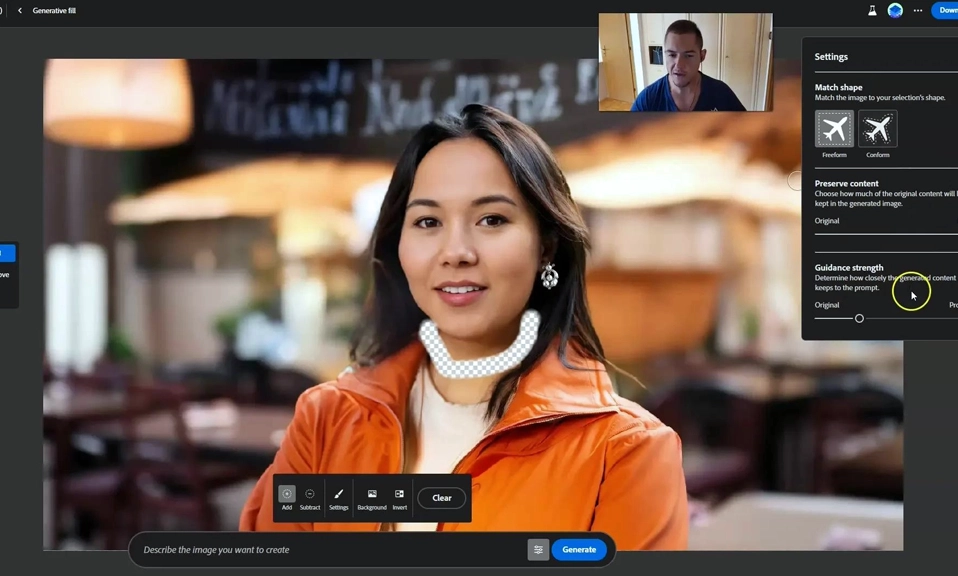
The Firefly Image editor now includes Edit Object, Edit Text, Relight, and Retouch—tools that let you change one part of an image and leave the rest untouched. The agent can execute these adjustments across a batch of images, applying a consistent look or correction without requiring the user to repeat the same sequence of clicks for every file. For photographers processing hundreds of shots from a shoot, or social media teams producing dozens of variations for different platforms, this is a genuine time-saver.
The deeper shift is in who is doing the precise work. Traditional photo editing requires the user to make every adjustment—every mask, every curve, every localized correction. The Creative Agent allows the user to describe the outcome and let the agent handle the mechanics. The creative decisions—what the image should feel like, what story it should tell, which version is the right one—remain with the human. The execution is delegated.
The Video Editing Shift: From Timeline Grind to Narrative Direction
In video editing, the Creative Agent addresses one of the most tedious realities of post-production: the same adjustment, repeated across dozens or hundreds of clips.
In Premiere, the agent can apply effects across every clip in a sequence or adjust color and exposure throughout an entire edit with a single instruction. It can track masked subjects across frames and apply corrections consistently. It can, according to Adobe, “transform a video storyboard into a finished cut” within Firefly Video, planning scenes and shots, arranging clips on a timeline, adding captions, and generating transitions and b-roll.
This is not the agent deciding what the story is. It is the agent handling the assembly—the part of editing that is mechanical rather than creative. The editor still decides which take is best, what the pacing should be, and how the narrative should flow. But the hours spent repeating the same color correction across a hundred clips can now be spent on the decisions that actually shape the film.
The more ambitious preview is always-on agents, which will work in the background on recurring tasks: organizing new footage, identifying duplicate clips, flagging shaky shots or audio problems, and preparing content for different channels. Adobe says these will reach beta in early 2027. The vision is a workflow where the editor sets a goal, reviews the plan, and returns to find the grunt work done—not the creative work, but the preparation for it.
The Philosophical Divide: Empowerment or Displacement?
The Creative Agent has provoked a genuine debate about what AI should and should not do in creative work, and both sides have a point.
The case for empowerment is straightforward. A 78 percent of creators say creative AI has accelerated the growth of their business or following, according to Adobe’s Creators’ Toolkit Report. The agent removes the repetitive, unfulfilling work that consumes time without requiring creative judgment. It lets a solo creator produce work at a scale that was previously only possible for a team. It democratizes access to professional-grade tools, putting the power of Creative Cloud within reach of creators at every experience level. For anyone who has spent an afternoon resizing the same graphic six ways, the appeal is obvious.
The case against is equally serious. Critics argue that the Creative Agent crosses a line that the earlier generation of AI tools did not. The most pointed critique focuses on Firefly Boards, where the agent can create mood boards—the visual and conceptual foundation of a project. “That sure sounds like an attempt to replace the creative spark that professional artists bring to the table,” one critic wrote, warning of the “McDonaldization of Art” : work that is cheap, scalable, and fundamentally less unique than something handcrafted. The concern is not that the agent will paint the picture. It is that it will decide what the picture should be—and that over time, AI-driven creative concepts will coalesce into a homogenous mainstream, crowding out the idiosyncratic and the strange.
There is also the ecosystem lock-in concern. The more your workflow depends on Adobe’s agents, models, and apps, the harder it becomes to leave. The Creative Agent is not an open protocol. It is an orchestration layer inside Adobe’s walled garden, and the convenience it offers comes with a dependence that some creators are right to resist.
The most honest framing is that both things are true. The Creative Agent genuinely removes the grind. It also genuinely changes the creative relationship, shifting the human from maker to director. Whether that is empowerment or displacement depends on what kind of creative work you do—and whether the part of the process you are handing over is the part you were happy to lose.
The Director’s Chair Is Still Occupied
Adobe’s Creative Agent is not the end of human creativity in photo and video editing. It is the automation of the mechanical layer—the repetitive, multi-step, judgment-light work that no one went into editing to do. The agent handles the assembly. The human handles the intent.
The tools are real, the time savings are real, and the shift toward agentic workflows is irreversible. But the most important design choice Adobe made is Plan Mode—the insistence that the agent shows its work before it acts. That is a recognition that creative work requires judgment, and judgment is not something an agent can own. It is something a person exercises.
The editor who embraces the Creative Agent is not giving up the director’s chair. They are getting a better crew. The question is whether they will use the time they reclaim to make something only they could make—or whether they will let the agent’s efficiency quietly become the point. That choice, for now, is still ours.