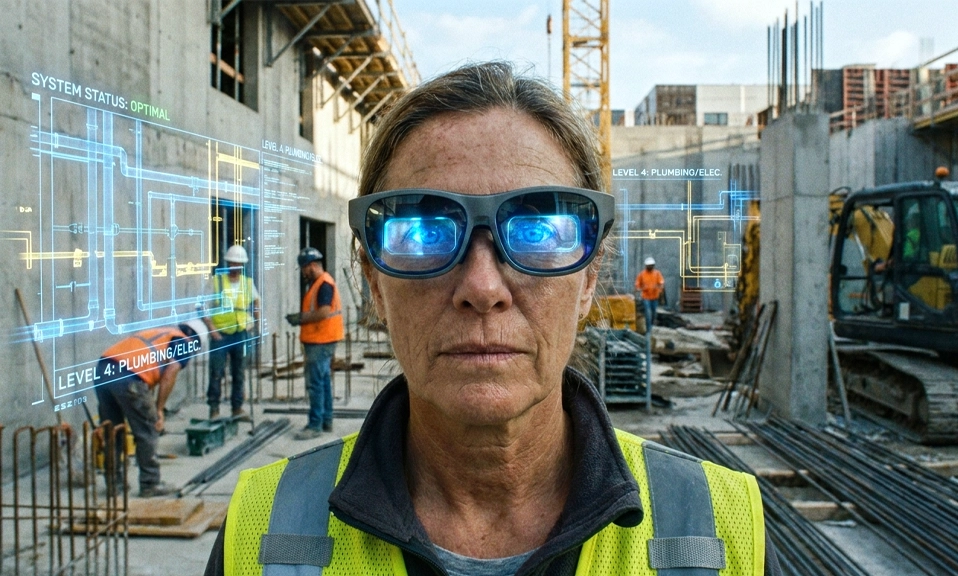
Construction is one of the least digitised industries in the world. It’s also one of the most important — accounting for 13% of global GDP and employing over 200 million people. But for decades, productivity has stagnated. Projects run over budget and behind schedule with depressing regularity. Skilled labour is scarce. Safety remains a persistent concern.
Artificial intelligence is changing that. From the design studio to the construction site, AI is being deployed to solve some of the industry’s oldest and most stubborn problems. The result isn’t just marginal improvement — it’s a fundamental shift in how buildings and infrastructure get built.
Here’s how AI is making construction more efficient, and what it means for the future of the industry.
1. Design and Planning: Generative Design and AI-Powered BIM
The efficiency gains start before a single shovel hits the ground.
Generative design uses AI algorithms to explore thousands of design options against a set of constraints — budget, materials, site conditions, energy performance, structural requirements. Instead of a human designer iterating through a handful of concepts, the AI generates hundreds of viable alternatives and ranks them by how well they meet the brief.
Autodesk’s generative design tools, for example, have been used to optimise everything from office layouts to bridge structures. The result is designs that use less material, cost less to build, and perform better — often in ways a human designer wouldn’t have considered.
AI-enhanced Building Information Modelling (BIM) takes this further. BIM creates a digital twin of a building — a 3D model packed with data about every component, material, and system. AI can analyse that model to detect clashes (e.g., a duct running through a structural beam), predict construction sequencing, and simulate how the building will perform over its lifetime.
The efficiency gains are substantial. Clash detection alone can reduce rework by up to 10% of contract value. On a $100 million project, that’s $10 million saved before construction even begins.
2. Scheduling and Resource Management: Predicting the Unpredictable
Construction schedules are fragile. One delayed delivery, one absent subcontractor, one unexpected site condition — and the entire critical path shifts.
AI-powered scheduling tools use predictive analytics to anticipate delays before they happen. They ingest data from past projects, weather forecasts, supplier lead times, and real-time site reports to forecast which activities are at risk and recommend corrective action.
ALICE Technologies, for example, uses AI to optimise construction schedules. It can simulate millions of scheduling scenarios and identify the most efficient sequence of tasks given the available resources. Contractors using ALICE have reported schedule compression of 10–20% on complex projects.
Resource allocation is another area where AI excels. Instead of manually assigning crews, equipment, and materials across multiple sites, AI can optimise the allocation in real time — balancing cost, availability, and project priorities. This reduces idle time, minimises overtime, and ensures that critical resources are where they’re needed most.
3. Safety: Computer Vision and Wearable Tech
Construction is one of the most dangerous industries in the world. In the US alone, nearly 1,000 workers die on construction sites every year, and tens of thousands more are injured.
AI is being used to prevent accidents before they happen.
Computer vision systems installed on site cameras can detect unsafe behaviour in real time — workers without hard hats, people entering restricted zones, equipment operating too close to personnel. When a violation is detected, an alert is sent to site supervisors. Companies using these systems have reported reductions in safety incidents of 20–40%.
Wearable technology takes this further. Smart hard hats and vests equipped with sensors can monitor worker fatigue, detect falls, and even alert workers to nearby hazards. Some systems use AI to analyse gait and posture, identifying signs of strain or exhaustion before they lead to injury.
Predictive safety analytics can also identify patterns that precede accidents. By analysing historical incident data, site conditions, and worker behaviour, AI can flag high-risk periods or activities and recommend preventative measures.
4. Quality Control and Inspection: Drones, Robots, and AI Vision
Inspecting a construction site is time-consuming, labour-intensive, and often dangerous. AI is automating it.
Drones equipped with high-resolution cameras and LiDAR scanners can survey a site in hours instead of days. AI algorithms then analyse the captured data to compare as-built conditions against the BIM model, detecting deviations, missing components, or quality issues.
Robotic inspection is emerging for specific tasks. Robots can crawl through pipes, climb scaffolding, or inspect confined spaces that are hazardous for humans. AI processes the sensor data to identify cracks, corrosion, or other defects.
AI-powered quality control is also being used in off-site manufacturing. Precast concrete components, structural steel, and modular units can be scanned and analysed by AI to ensure they meet specifications before they leave the factory. Catching defects early avoids costly rework on site.
5. Supply Chain and Logistics: Anticipating Disruptions
Construction supply chains are complex and vulnerable. A single missing component can halt an entire project.
AI is making supply chains more resilient by predicting disruptions before they occur. By analysing data from suppliers, shipping records, weather patterns, and geopolitical events, AI can flag potential delays and recommend alternative sourcing options.
Just-in-time delivery is another area where AI excels. Instead of stockpiling materials on site (which ties up capital and creates congestion), AI can coordinate deliveries to arrive exactly when they’re needed. This reduces waste, lowers storage costs, and keeps the site organised.
Autonomous logistics — including self-driving trucks and automated material handling — is still in its early stages, but pilot projects are underway. Rio Tinto, for example, has been operating autonomous haul trucks in its mines for years, and the technology is gradually migrating to construction.
6. Equipment Management: Predictive Maintenance
Construction equipment is expensive. A single day of downtime on a tower crane or excavator can cost tens of thousands of dollars.
Predictive maintenance uses AI to monitor equipment health in real time. Sensors track vibration, temperature, oil quality, and other parameters. AI analyses the data to predict when a component is likely to fail, allowing maintenance to be scheduled before a breakdown occurs.
The benefits are significant. Predictive maintenance can reduce equipment downtime by 30–50%, extend asset life, and lower maintenance costs. It also improves safety by preventing catastrophic failures.
Telematics systems take this further by tracking how equipment is used — utilisation rates, idle time, operator behaviour. AI can identify underused assets that could be redeployed to other projects, or operators who need additional training.
7. On-Site Automation: Robots and Autonomous Machinery
The construction site of the future is increasingly automated.
Bricklaying robots like Hadrian X can lay bricks faster and more accurately than human masons. Concrete-pouring robots can screed floors with millimetre precision. Rebar-tying robots can assemble reinforcement cages in a fraction of the time it takes a human crew.
Autonomous excavators and self-driving bulldozers are being deployed on earthmoving projects. They can operate 24/7, follow precise grading plans, and work in conditions that would be unsafe for humans.
Drones are not just for inspection — they’re also being used for site surveying, progress monitoring, and even material delivery.
The efficiency gains from automation are substantial. Robots don’t get tired, don’t take breaks, and don’t make the same mistakes repeatedly. But the technology is still maturing, and adoption is uneven. Large infrastructure projects are leading the way; smaller residential projects are slower to adopt.
The Challenges: What’s Holding AI Back in Construction?
AI is transforming construction, but it’s not a magic bullet. Several barriers remain.
Fragmentation. The construction industry is highly fragmented, with thousands of small contractors and subcontractors. Many lack the resources or expertise to adopt AI.
Data quality. AI needs data to learn. Construction data is often siloed, inconsistent, or simply not collected. Without good data, AI can’t deliver good results.
Resistance to change. Construction is a traditional industry. Many workers and managers are sceptical of new technology, particularly when it threatens jobs or changes established workflows.
Cost. While AI can save money in the long run, the upfront investment in sensors, software, and training can be prohibitive for smaller firms.
Skills gap. Building and maintaining AI systems requires skills that many construction companies don’t have in-house. Hiring data scientists and AI engineers is expensive and competitive.
AI is not going to
replace construction workers. It’s going to make them more productive, safer, and more effective. The companies that embrace AI will build faster, cheaper, and better. The ones that don’t will struggle to compete.
The technology is already here. Generative design, predictive scheduling, computer vision safety systems, autonomous equipment — these aren’t futuristic concepts. They’re being deployed on job sites today.
The construction industry has been slow to digitise. But the pressure to improve productivity, address labour shortages, and meet sustainability targets is mounting. AI is the tool that can finally unlock the industry’s potential.
The builders of tomorrow won’t just use AI. They’ll wonder how they ever built without it.