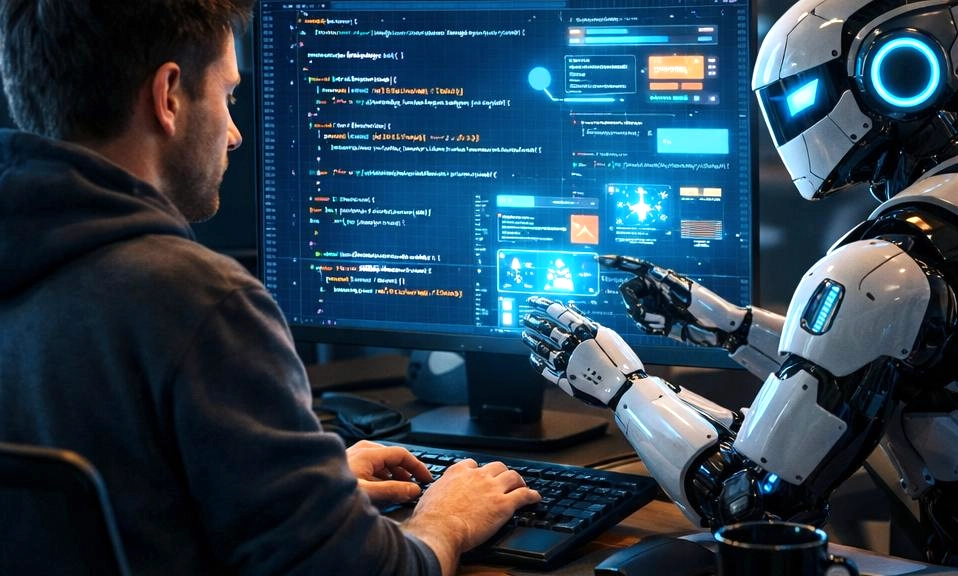
If you had asked a software engineer in 2023 whether AI would replace them, the answer was likely a mix of anxiety and defiant optimism. Fast forward to 2026, and the landscape has fundamentally shifted. AI coding assistants, autonomous agents, and context-aware development environments are no longer novelties—they are the baseline.
But this rapid integration has sparked a fierce, ongoing debate in the tech world: Can Artificial Intelligence write better software than a human programmer?
The short answer is: It depends entirely on how you define “better.”
If “better” means generating 500 lines of boilerplate code in three seconds, AI wins without breaking a sweat. But if “better” means building a secure, scalable, and deeply intuitive system that solves a complex, ambiguous human problem? The human programmer is still very much the captain of the ship.
Let’s break down the true strengths and weaknesses of both, and explore what the future of software development actually looks like.
🤖 The AI Advantage: Where Machines Excel
To understand AI’s role, we have to acknowledge what it does phenomenally well. Modern AI coding tools are not just glorified autocomplete; they are pattern-matching engines trained on virtually every public repository in existence.
1. Blazing Speed and Boilerplate Elimination Writing CRUD (Create, Read, Update, Delete) endpoints, setting up database schemas, or writing repetitive unit tests is tedious. AI can generate this foundational code instantly, freeing up developers to focus on the actual business logic.
2. Instantaneous Debugging and Refactoring Stuck on an obscure error message? An AI can analyze the stack trace, cross-reference it with your codebase, and suggest a fix in milliseconds. It can also instantly refactor a messy, 200-line function into clean, modular, and well-documented code.
3. Language Agnosticism A human developer might be a Python expert but struggle with Rust or Go. An AI is equally fluent in dozens of languages, making it an incredible tool for translating legacy codebases or bridging gaps between different tech stacks.
4. Exhaustive Test Generation Humans are notoriously bad at writing comprehensive edge-case tests. AI can instantly generate hundreds of unit and integration tests, covering scenarios a human might never think to check.
🧠 The Human Edge: Where Developers Reign Supreme
Despite these superpowers, AI has a fundamental limitation: It doesn’t actually understand what it’s building. It predicts the next most likely token based on statistical probability. This leads to several critical areas where humans are irreplaceable.
1. Understanding the “Why” (Ambiguity Resolution) Software development is rarely about writing code; it’s about solving human problems. A stakeholder will ask for a “button that does X.” A human developer knows to ask: “Why do we need this? Who is the user? What happens if they click it twice? Does this align with our Q3 goals?” AI will just build the button, even if it’s the wrong solution to the real problem.
in meetings, reading body language, and negotiating trade-offs between engineering, design, and product teams. AI cannot navigate office politics or advocate for a better architectural decision.
3. System Architecture and Big-Picture Thinking AI is excellent at writing a single function or class. It is currently terrible at designing a microservices architecture that needs to scale to 10 million users, handle regional compliance laws (like GDPR), and integrate with three legacy third-party APIs. Humans hold the mental model of the entire system.
4. Security and the “Hallucination” Trap AI is confident, but it is not always correct. It can confidently suggest a deprecated library, introduce a subtle security vulnerability (like a SQL injection flaw), or “hallucinate” an API that doesn’t exist. A human must review, audit, and take ultimate responsibility for the code that goes into production.
⚖️ The “Better” Fallacy: Speed vs. Maintainability
The biggest danger in the AI vs. Human debate is the assumption that more code = better software.
In fact, the opposite is often true. The best code is the code you don’t have to write.
When developers rely too heavily on AI to generate code without fully understanding it, they accumulate invisible technical debt. The code might work today, but when a bug emerges six months later, the original developer (or their successor) has to untangle a complex web of AI-generated logic they never truly internalized.
“Better” software is maintainable, readable, and aligned with business goals. AI writes code fast; humans ensure that code is worth writing.
🚀 The Future Paradigm: From “Coder” to “Orchestrator”
The narrative that “AI will replace programmers” is fundamentally flawed. A more accurate statement is: AI will replace programmers who refuse to use AI.
The role of the software engineer is not dying; it is evolving. We are moving from an era of typing to an era of orchestrating.
In 2026 and beyond, the most valuable developers are not the ones who can memorize syntax or type the fastest. They are the ones who possess:
- Strong System Design Skills: Knowing how to piece together AI-generated modules into a cohesive, secure architecture.
- Advanced Prompt Engineering: Knowing how to ask the AI the right questions, provide the right context, and iteratively refine its output.
- Ruthless Code Review: The ability to look at AI-generated code and instantly spot logical flaws, security risks, or inefficiencies.
- Domain Expertise: Deep knowledge of the specific industry (finance, healthcare, gaming) to ensure the software actually solves the right problem.
The developer of the future is less like a bricklayer and more like a film director. The AI is the camera crew, the special effects team, and the script assistant. But the human provides the vision, the creative direction, and the final cut.
It’s Not a Competition, It’s a Symbiosis
Can AI write better software than a human?
On its own, no. AI is a brilliant, tireless, but ultimately mindless junior developer. It needs guidance, oversight, and a clear vision.
But a human programmer armed with AI can write better software, faster, and with fewer bugs than a human programmer working alone. The synergy between human creativity and machine efficiency is the most powerful force in modern software development.
The question is no longer whether AI will take your job. The question is: Are you ready to stop being just a coder, and start becoming an architect?