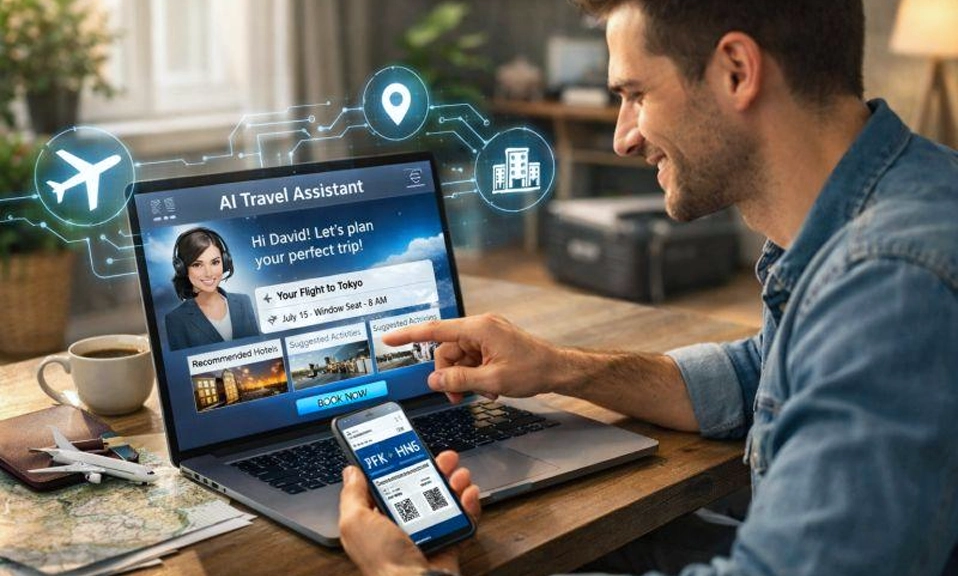
United Airlines just drew a line in the sand that every traveler—and every AI company—needs to understand. On November 11, 2026, the airline announced it is banning third-party AI agents from booking, changing, or managing flights on its platforms. Your AI assistant can still search for flights and compare fares. It just can’t click “buy.”
The move makes United the first major U.S. carrier to formally prohibit autonomous AI agents from completing transactions. It is a decision that pits the airline against the very technology its rivals are racing to integrate. And it raises a question that goes far beyond travel: when an AI agent acts on your behalf, who is responsible when something goes wrong?
What United Actually Did
The ban is not a vague policy suggestion. It is written into United’s Contract of Carriage—the legal agreement that governs every ticket.
Rule 6.J.6 adds “the use of AI Agents to make, modify or service a Ticket, and/or to purchase any service or product” to the airline’s list of prohibited ticketing practices. The definition of an AI agent is deliberately broad: it covers AI assistants, standalone agents, and even AI-enabled browsers.
Rule 5.H gives United the right to cancel reservations made or managed by AI agents without notice. This applies even if a passenger personally instructed the agent and oversaw its actions.
The prohibition covers direct bookings through United’s website and app, as well as indirect bookings through travel agencies and aggregators. Travel agencies are prohibited from using third-party AI agents to search for, book, or manage United travel. They can only deploy their own internal AI tools with explicit permission from the airline.
United said it will honor bookings made by AI agents before November 11, 2026, but recommended that travelers review recent bookings to ensure they are correct.
Why United Did It: Three Reasons, One Motive
United cited three official reasons for the ban. But there is a fourth, commercial motive that the airline’s CEO made no effort to hide.
1. Data security. Sharing account credentials with third-party AI assistants “can expose sensitive information,” United said, and actions taken by these tools “may result in unintended purchases, account changes, or use of MileagePlus miles”. An AI agent needs access to your login, payment details, and frequent flyer account to book a flight. That is a significant concentration of sensitive data in a third-party tool that United does not control.
2. Regulatory compliance. United argues that automated AI actions could violate FAA and Department of Transportation rules. The most concrete example: flight check-in requires a human acknowledgment that bags do not contain banned substances like explosives. An AI agent cannot legally provide that acknowledgment. If it clicks through the check-in process on your behalf, it may be creating a regulatory violation that United is liable for.
3. Operational risk. AI agents can make mistakes. If an agent books a non-refundable seat by accident, changes a reservation without authorization, or drains a MileagePlus account, United faces customer service backlash without clear attribution for the fault.
4. The commercial motive. United CEO Scott Kirby was blunt: “To be honest, I don’t want to create another middleman” . Airlines have spent two decades fighting online travel agencies over ticketing, customer relationships, and fees. Kirby sees AI agents as the next intermediary layer—one that could insert itself between United and its customers, potentially charge for directing bookings, and strip away high-margin ancillary revenue like priority boarding and co-branded credit card promotions.
“Flight searches cost airlines money,” aviation analyst Henry Harteveldt told CBS News, “and undoubtedly United wants to avoid the expense associated with the surge of AI bot flight searches”.
The Industry Is Split
United’s decision has exposed a genuine divide in how the travel industry views AI agents. There is no consensus. There is no unified strategy.
| Airline | Approach to AI Agents |
|---|---|
| United | Hard block on booking transactions; updates to Digital Trust Center |
| Delta | Permits authenticated agent bookings; deploys proprietary in-app Delta Concierge |
| Southwest | Explores conversational discovery; launched direct ChatGPT plug-in for flight search |
| American | Restricts unauthorized bots; permits bookings via approved partners |
Source: TechRepublic, November 2026
Delta reportedly allows properly authenticated AI assistants to make reservations, with additional safeguards for sensitive bookings. Southwest has made its flight inventory viewable to ChatGPT users, who can access the airline’s website through the AI app. American restricts unauthorized bots but permits bookings through approved partners.
The split is not just about technology. It is about control. Delta and Southwest are betting that embracing AI agents—with safeguards—keeps them closer to the customer. United is betting that the only way to protect the customer relationship is to keep the agents out.
The broader business world is watching. Amazon has also blocked bots like Meta’s Muse from completing purchases. JPMorgan Chase has prohibited outside AI agents from logging in with customer credentials, sending money, or paying bills. “You don’t want rogue agents,” CEO Jamie Dimon said, “and there could be thousands of them”.
The Middleman Paradox
There is an irony at the heart of United’s decision.
The airline says it is protecting customers from unintended purchases, data exposure, and regulatory violations. That is a legitimate concern. An AI agent that books the wrong flight or drains your miles is a real risk, and the legal chain of consent when an autonomous system clicks “buy” is genuinely unclear.
But United is also protecting its own position. Airlines already pay intermediaries—Google, Kayak, online travel agencies—for flight searches and bookings. An AI agent could become another layer of intermediation, one that United cannot control and does not profit from. Kirby’s “another middleman” comment is a candid admission that the ban is as much about commercial leverage as it is about consumer protection.
The paradox is that the ban may not make life easier for travelers. As Harteveldt noted, “by blocking the AI bots, United won’t make it any easier to find its fares, either”. Travelers can still use AI to research flights and compare prices. They just have to complete the booking themselves. The convenience that AI agents promised—the seamless, end-to-end transaction—is being deliberately fractured.
What This Means for AI Travel Assistants
United’s ban is a warning shot for the entire AI agent ecosystem. It signals that the final step—the transaction—is the hardest to automate, not because the technology cannot do it, but because the institutions that own the transaction have reasons to resist.
The future may not be a total ban. TechRepublic’s analysis predicts that carriers will eventually erect authenticated, paid enterprise APIs—gateways that let AI agents book flights, but only with the airline’s permission, under the airline’s terms, and with the airline retaining its direct revenue channels. That is a compromise that preserves control while allowing automation. But it is not the open, frictionless future that AI companies have promised.
For travelers, the immediate reality is a disjointed workflow: browse with AI, purchase with humans. You can use your assistant to find the flight. You cannot use it to book the flight. The convenience is partial. The control remains with the airline.
For AI companies, the lesson is that access is not guaranteed. Meta, OpenAI, and Anthropic can build the most capable agents in the world, but if the companies that own the inventory refuse to let them complete a transaction, the agents are limited to research. The battle over AI agents is not just a battle over technology. It is a battle over who controls the point of sale.
Control, Not Capability
United Airlines’ ban on AI agents is not a rejection of AI. The airline still invests heavily in AI for its own operations and ticket sales. It is a rejection of unauthorized intermediaries—of AI agents that operate outside the airline’s systems, without its permission, and without its ability to control the transaction.
The decision is defensible on security and regulatory grounds. It is also commercially self-interested. And it exposes a tension that will define the next phase of the AI agent revolution: the technology is ready to act, but the institutions are not ready to let it.
For now, the age of the fully autonomous AI travel assistant is on hold. Your AI can plan the trip. It just can’t pay for it. United has made sure of that.