Andrew Garfield is trading the neon lights of Silicon Valley for the mud and blood of 14th-century England in The Uprising. With Paul Greengrass at the helm, this isn’t just another sword-and-sandals epic—it’s a gritty, modern-minded retelling of the Peasants’ Revolt. But does it succeed as history, as drama, or as both?
The Uprising, which hit theaters on September 11, 2026, and made its streaming debut on Peacock on November 6, 2026, has arrived with a strange cloud of confusion hanging over it. Is it a historical drama? A Robin Hood origin story? A commentary on modern inequality? The answer, as with the film itself, is complicated.
🔥 The Story: The Peasants’ Revolt, Reimagined
The Uprising is set in England in 1381, during the aftermath of the Black Death. The plague has wiped out half the population, leaving a weakened peasantry and a ruling class determined to maintain its power through crushing taxation and brutal enforcement.
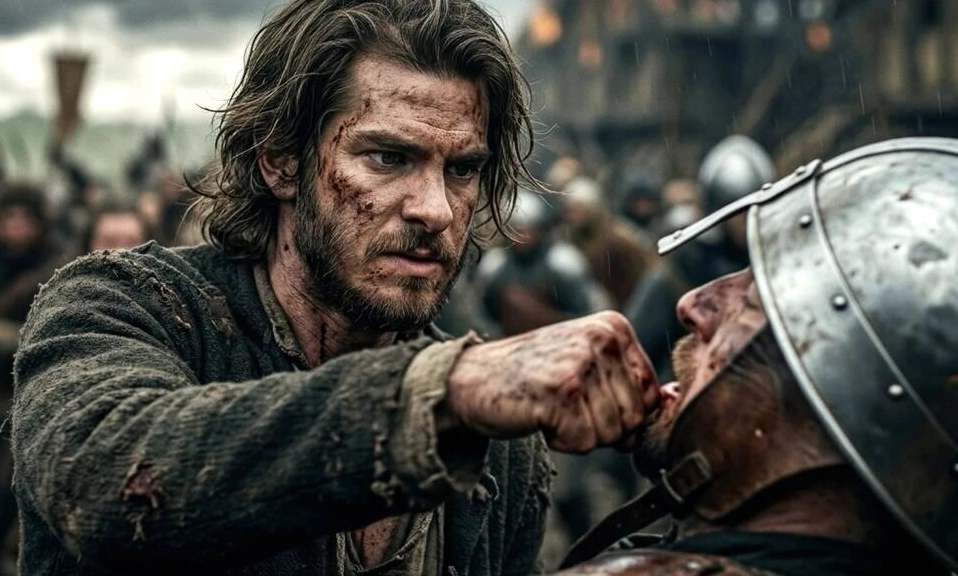
At the center of the story is Ploughman (Andrew Garfield), a grieving farmer who has lost his wife and children to the plague. When tax collectors arrive demanding even more—including a death tax for his deceased loved ones—Ploughman snaps, violently fighting back and sparking a rebellion that spreads across the countryside. He joins forces with the radical priest John Ball (Jamie Bell) and the rebel leader Wat Tyler (Cosmo Jarvis), as thousands of commoners march on London to confront the young King Richard II (Woody Norman) and his corrupt council.
🎭 Andrew Garfield: A Reluctant, Rageful Leader
Garfield’s performance has been the film’s most consistently praised element. He plays Ploughman not as a charismatic revolutionary, but as a man hollowed out by grief, filled with a “righteous and rageful awakening”. As USA Today notes, Garfield described the role as a “palate cleanser” after playing Sam Altman, allowing him to express “a lot of rage”.
The Telegraph India observed that Garfield “does not play Ploughman as a charismatic revolutionary or a larger-than-life hero,” instead bringing a “weariness to him, as though grief has drained away most of his personality but left behind a stubborn sense of justice”. It’s a performance of soulful sadness and fierce fury, anchoring the film’s visceral, grounded approach.
🎬 Paul Greengrass: The Bourne Aesthetic Meets the Middle Ages
Director Paul Greengrass is best known for his kinetic, handheld “shaky cam” style in the Bourne franchise and films like Captain Phillips. Applying that aesthetic to a medieval setting might seem like an odd choice, but the LA Times argues it’s a “brilliant creative choice”. The jittery camera work is intended to jolt the audience into recognizing that while the film is about 1381, it’s really about “right now”.
The result is a historical epic that feels more like a news documentary than a “stuffy period piece”. It’s a stripped-down, brutal film that focuses on “the muddy grimness that likely defined England at the time” rather than spectacle. This approach has divided critics, with some finding it effective and others finding it exhausting.
⚔️ A Brilliant Cast, Underused
The supporting cast is uniformly strong, even when the material doesn’t give them enough to do. Jamie Bell is excellent as the vengeful priest John Ball, and Cosmo Jarvis brings a hardened intensity to Wat Tyler. Thomasin McKenzie delivers strong work as a former nun who joins the rebellion, and Katherine Waterston is compelling as Richard II’s scheming mother, Joan of Kent.
However, JoBlo notes a structural problem: in the film’s middle section, Garfield’s Ploughman becomes “mostly an observer” while Tyler and Ball take on more dominant roles, and the momentum sags. The cast is top-notch, but the script doesn’t always give them the material they deserve.
🏹 The Robin Hood Problem: A Marketing Mess
One of the most significant issues surrounding The Uprising is its confusing marketing. The film was initially presented as a straightforward historical drama about the Peasants’ Revolt. Then, late in the campaign, a new subtitle appeared: The Uprising: The Rise of Robin Hood. Promotional materials showed Garfield carrying a bow and wearing a hood, encouraging audiences to “Witness the Rise of Robin Hood”.
This was met with widespread ridicule, and the marketing quickly reverted. The truth is more nuanced. Greengrass has explained that the ending, where Ploughman becomes a “green-hooded outlaw,” naturally invites comparisons to Robin Hood. However, the director stresses that this is rooted in historical reality: the name “Robin Hood” was a generic term for outlaws before the Peasants’ Revolt, and the legend likely emerged after the revolt, inspired by rebels like Ploughman.
So, The Uprising is not a Robin Hood movie. It is a film about the conditions that gave rise to the Robin Hood legend. But the marketing confusion left many viewers uncertain about what they were watching.
📉 Critical Reception and Box Office: A Muddled Epic
The film’s reception has been decidedly mixed. It currently holds a 54% critic score on Rotten Tomatoes and a Metacritic score in the 50s (indicating mixed or average reviews). The Guardian called it a “disjointed slog through the mud with the emotional depth of a History Channel rerun,” arguing that Garfield’s charisma can’t save a “grim and depressingly generic period piece”. SlashFilm was even harsher, calling it a “dull and disappointing attempt at a Robin Hood origin story”.
There were defenders, however. ScreenRant praised it as “harrowing, heartbreaking, and a great modern epic,” anchored by a “terrific” Garfield and strong thematic weight. The LA Times found it “explosive” and “jittery,” a film that speaks directly to contemporary anxieties.
Commercially, the film struggled. It grossed just $7.7 million worldwide against a $20 million budget—a historic box office low for Garfield. This poor performance led to a rapid digital release, less than three weeks after its theatrical debut.
💎Ambitious, Flawed, and Worth a Watch
The Uprising is not the historical epic it could have been. Its pacing is uneven, its middle act sags, and its marketing did it no favors. But it is also a film with a genuine vision, a committed central performance, and a message that resonates far beyond 14th-century England.
It is a story about the rage of the overlooked, the cruelty of unchecked power, and the inevitable explosion when a people are pushed too far. Greengrass’s decision to tell it with the visceral, handheld urgency of a modern thriller is a bold one, even if it doesn’t always work. And Garfield’s Ploughman—a man who is “an antenna for a collective rage”—is a character worth spending time with, even in a flawed film.
If you’re looking for a rousing, Robin Hood-style adventure, you’ll be disappointed. But if you’re interested in a grim, thoughtful, and uncomfortably timely meditation on class, power, and rebellion, The Uprising is worth a watch—now streaming on Peacock.