Awkwafina has never been a cook. She says so herself, repeatedly, in the opening minutes of her new Apple TV docuseries. And yet, the entire premise of Awkwafina: The Unlikely Cook rests on her attempting to do something she has spent her whole life believing she cannot do: run a restaurant. Not just any restaurant—her family’s restaurant, a Cantonese institution in Flushing, Queens, that her great-grandfather opened in 1952, before she was born, before her father’s family had any idea she would one day become famous for being funny, not for being a chef.
The eight-episode series, which premieres globally on November 6, 2026, is not a cooking competition. It is not a travelogue, though it travels. It is not a celebrity vanity project, though it features plenty of famous faces. It is something rarer: a food show about what happens when the food you are supposed to inherit is the one thing you never learned to make.
The Premise: A Legacy She Never Tasted
Awkwafina’s family ran Lum’s, a Cantonese restaurant in Flushing that became a local legend. Her great-grandfather, Jimmy Lum, opened it in 1952, one of the first Chinese restaurants in the neighborhood at the time. People who lived in New York during a certain era remember it—the pupu platter, the lobster egg rolls, the neon-lit decor. For Awkwafina, it is a story she has heard her whole life, a family member she never met.
“I can’t cook. Like, at all,” she admits in the trailer. The show does not shy away from that. It opens with her in her pristine Los Angeles kitchen, losing a fight with two burners at once, ramen boiling on one, Spam sizzling violently on the other. Her nonagenarian grandmother, Powah, watches over FaceTime and tells her, lovingly, that it looks like shit.
That is the tone of the series: warm, self-deprecating, and deeply personal. Awkwafina is not pretending to be a chef. She is a 38-year-old woman trying to understand what it means to be Asian when, as she puts it, “food is so important to being Asian. You can’t talk about being Asian without food being the thread that pulls it all together”—and she cannot even steam an egg.
The Journey: From Spam to a Pop-Up Restaurant
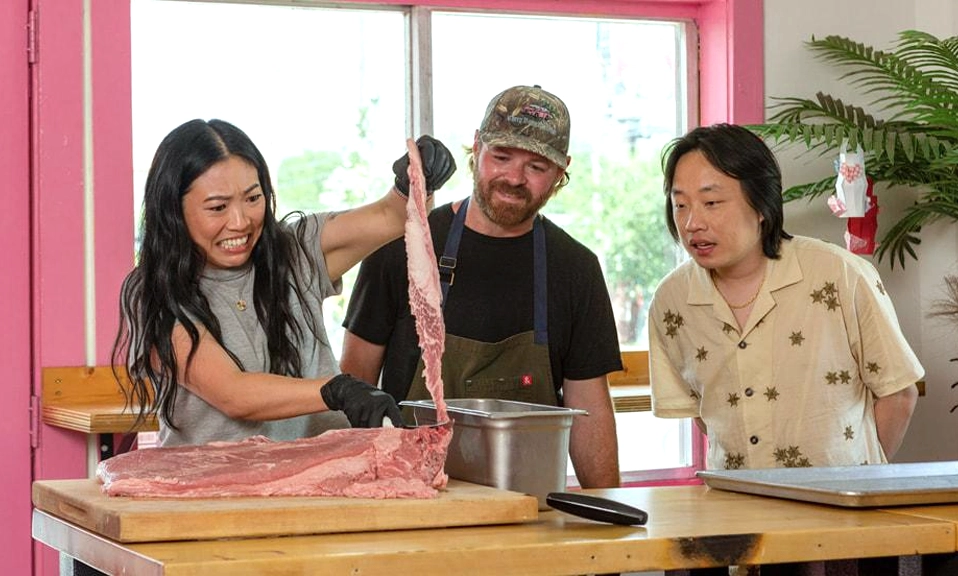
The show is structured as a cross-country culinary education. Awkwafina takes a crash course at the Culinary Institute of America, learns from chefs and restaurateurs including Roy Choi, Martin Yan, and Jimmy O. Yang, and explores food traditions across the country. She tours Texas barbecue joints with Yang, including Curry Boys BBQ in San Antonio and Eaker Barbecue in Fredericksburg, where traditional brisket is served atop green Thai curry and bulgogi sausage. She explores the tiki culture in Hawai’i that inspired her grandmother’s restaurant. She serves at a restaurant in Los Angeles’ Chinatown. She films at House of Nanking, a landmark Shanghainese restaurant in San Francisco’s Chinatown, where chef Kathy Fang welcomed her on camera.
Along the way, she meets Asian American chefs and restaurateurs who are, in many ways, like her: restaurant kids who left the industry and eventually found their way back on their own terms. “A lot of their families did not want them to go into the industry,” Awkwafina says. “They’re subverting the stereotype in a way”.
All of it builds toward a single, high-stakes event: a one-night pop-up to resurrect Lum’s, with Awkwafina in the kitchen. The toughest VIP diner of all will be sitting at one of the tables: her grandmother.
The Stakes: “They Didn’t Trust Me With It”
The emotional core of the show is not the cooking. It is the inheritance—or rather, the absence of one.
Awkwafina grew up hearing about Lum’s as if it were a long-lost family member. She knew the stories, but she never tasted the food, never worked the line, never learned the recipes. “Whether it was dishes or cooking, no one trusted me with it,” she says. “I convinced myself that I’m just not a cook”.
The Unlikely Cook is her attempt to un-convince herself. It is a show about learning a skill, yes, but it is also a show about claiming a heritage that felt out of reach. As the SF Chronicle put it, she embarks on this journey “in honor of her great-grandfather,” who opened one of New York City’s first Chinese American restaurants. The show is not just about reviving a restaurant. It is about reviving a connection.
The Production: A Proven Pedigree
The series is produced by Twofour, the same company behind Apple TV’s Emmy-nominated The Reluctant Traveler with Eugene Levy. That show succeeded because it understood that the appeal was not the destinations but the host’s discomfort—Levy, a man who does not like to travel, forced to travel. The Unlikely Cook operates on a similar principle: Awkwafina, a woman who cannot cook, forced to cook. The executive producers include Awkwafina herself, alongside David Brindley, Itay Reiss, and Caroline Davies.
The format is well-established, but the subject is not. Most food shows celebrate expertise. This one celebrates the attempt—the messy, uncertain, sometimes disastrous process of learning something new in public, with the people you love watching.
A Food Show About More Than Food
Awkwafina: The Unlikely Cook arrives at a moment when food television is saturated with competition, perfection, and performance. It offers something quieter: a story about a woman who missed out on a family legacy and is trying, late and imperfectly, to claim it.
The show does not promise that Awkwafina will become a great chef. It promises that she will try, that she will fail, that she will learn, and that her grandmother will be there to tell her the truth. That is enough. It is more than enough.
Awkwafina: The Unlikely Cook premieres globally on Apple TV on Friday, November 6, 2026.