What Happened at This Ancient Grave?
In southern Russia, archaeologists have unearthed something extraordinary—and deeply unsettling. A 2,000-year-old grave belonging to an elite warrior contains not just weapons, a horse, and gold coins bearing the face of Alexander the Great, but also the fragmentary remains of what appears to be a human sacrifice. The discovery offers a rare window into the funerary beliefs of an ancient people who lived on the edges of the classical world, and raises haunting questions about what they believed awaited them after death.
The Discovery: An Elite Warrior’s Grave in the Kuban Region
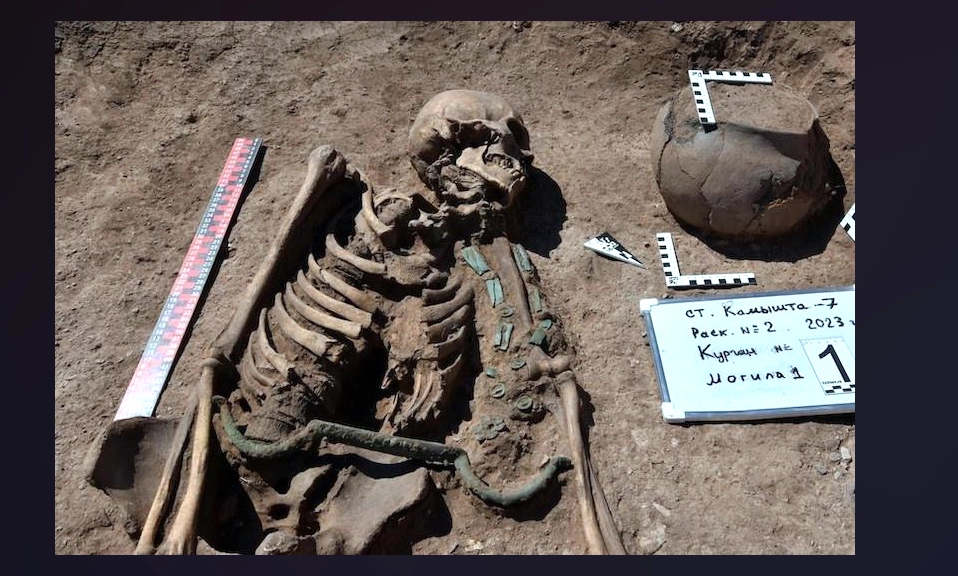
The grave was found in Russia’s Kuban region, east of the Crimean Peninsula, within a necropolis containing more than 150 ancient graves. The warrior’s burial occupied the central position in the cemetery—a placement that indicates he was a member of the social elite. The study, published in September in the journal Russian Archaeology, describes a burial rich with grave goods befitting a man of high status.
Two gold coins were found: one placed on the warrior’s skeleton, and another nearby. Both are gold “staters” in the Greek style adopted by Alexander the Great, showing portraits of the legendary conqueror. Experts determined they were minted during the reign of Mithridates Eupator, also known as Mithridates the Great, who claimed descent from both Alexander and Persian nobility. Interestingly, the Alexander portraits on the coins are designed to also resemble Mithridates himself.
One coin was found in a ritual shaft near the burial, likely placed there as an offering to the gods. The second was found beneath the jaw of the warrior’s skeleton—evidence of “Charon’s obol,” the traditional ancient Greek payment for the mythical ferryman of the dead. As study first author Mikhail Abramzon told Live Science, the coins were “likely not money in the conventional sense, but rather a means of storing wealth, akin to a cryptocurrency”.
The Human Sacrifice: A Fragment of a Pelvis
The evidence of human sacrifice comes not from the warrior’s grave itself, but from a neighboring burial assemblage. This adjacent burial contained the remains of three horses, two cattle, a pig, a dog—and a fragment of a human pelvis that researchers believe came from a sacrificed person.
The role of the human sacrifice is unknown, but researchers suggest it may have been to act as a servant for the warrior in the afterlife. The animals each had their own symbolic purpose: the cattle may have been offerings in the style of an ancient hecatomb, a mass slaughter meant to please a god; the horses were for riding in the afterlife; the pig was for eating; and the dog may have been intended to guide the dead warrior’s spirit.
A Window Into the Maeotian People
The warrior was a noble of the Indigenous Maeotian people, who lived in the region at a time when they were allied with the neighboring Mithridatic Empire—a Hellenistic-Persian kingdom and enemy of the expanding Roman Republic. According to the Greek geographer Strabo, writing in the first century A.D., the Maeotians were an Indigenous people integrated into the nearby Bosporan kingdom, a Greek and Scythian state founded on the north side of the Black Sea.
The grave goods reveal a culture deeply influenced by Greek traditions. The warrior was buried with two iron spearheads and an iron arrowhead, as well as his riding gear and his horse, which had been sacrificed. The grave also held luxury items, including a rare glass alabastron—a small vessel for oil or perfumes, probably imported from Cyprus or the Levant.
Perhaps most intriguingly, a two-handled clay cup called a kantharos was found in the grave. Its surface was engraved with a pentagram, a symbol of the sun, which researchers believe was considered spiritual protection against magical threats. The cup, the coins, and the grave goods together illustrate both the beliefs of the Maeotian people and the extent to which they had absorbed ancient Greek traditions.
A Broader Pattern: Human Sacrifice Across the Ancient World
The Russian discovery is not an isolated case. Across the ancient world, archaeologists are increasingly uncovering evidence of human sacrifice using modern forensic techniques.
In Egypt, a new study published in October 2026 confirmed that servants buried around the funerary complexes of First Dynasty kings at Abydos were sacrificed after their rulers died. Modern forensic analysis of 46 skulls preserved from excavations in the 1920s found that 18 of them—39%—showed evidence of lethal blunt-force trauma. The injuries were linear fractures, likely caused by a flat, wide weapon, and would have caused rapid unconsciousness and death. “In many cultures, retainer sacrifice is practiced because of beliefs that the sacrificed individuals will continue to serve the ruler in some kind of afterlife,” explained study author Roselyn Campbell. “But retainer sacrifice can also be a visceral display of the ruler’s power”.
In England, archaeologists excavating an Iron Age Celtic settlement in Dorset discovered the remains of a teenage girl, face down in a pit with her hands likely tied, showing no sign of a proper burial. Lead archaeologist Miles Russell said the scene “has the sense of a body thrown into a pit”. She was one of three women found at the site who had suffered violent deaths—one with her throat cut—suggesting a pattern of ritual killing rather than isolated tragedies.
And in Guatemala, researchers studying bones from a Maya cave called Cueva de Sangre—”Blood Cave”—concluded that the remains of more than 100 individuals were the result of acts of human sacrifice some 2,000 years ago. The bones bore marks of dismemberment and were ritually deposited between 400 B.C. and A.D. 250, likely to appease the rain god Chaac.
What This Grave Tells Us
The Russian warrior’s grave is more than just an archaeological curiosity. It’s a snapshot of a society at a crossroads—an Indigenous people absorbing Greek customs, adopting Greek coins, and burying their elite with Greek-inspired rituals, even as they maintained their own traditions of sacrifice and belief in an afterlife that required servants, horses, and provisions.
The human sacrifice found beside the warrior is a stark reminder that the ancient world was not a gentle place. Status, power, and belief in what awaited after death could determine who lived and who was killed to accompany the dead. As archaeologists continue to analyze the remains from the Kuban necropolis, they may yet uncover more about the person whose pelvis was found among the animals—who they were, where they came from, and what role they were meant to play in the warrior’s journey to the afterlife.
For now, the grave stands as a testament to a complex and sometimes brutal past, and to the enduring human impulse to prepare for what lies beyond. The study, published in Russian Archaeology, adds a new chapter to our understanding of the Maeotian people and their place in the ancient world—a world where the boundary between this life and the next was guarded by gold coins, pentagrams, and, sometimes, human sacrifice.