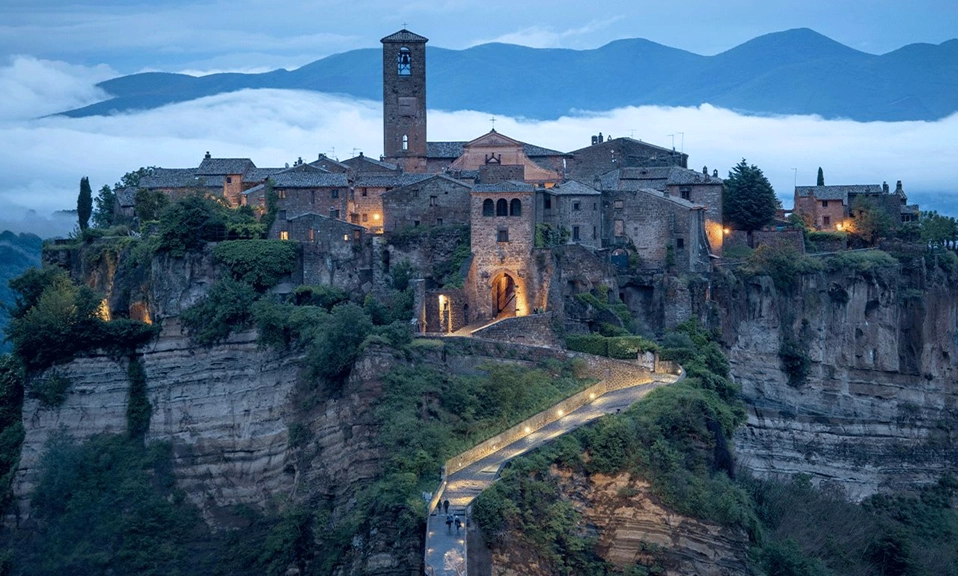
There is a different kind of travel that has nothing to do with beaches or bucket lists. It is travel for the story—the strange, the unexplained, the legend that clings to a place like fog. Call it lore-tripping: the deliberate pursuit of destinations where history and myth are so tangled that you cannot tell where one ends and the other begins. These are not haunted house attractions or theme-park scares. They are real places with real pasts, where the locals will tell you stories that they half-believe themselves. Here are six places to visit if you want to step into a legend.
1. The Hellfire Club, Dublin, Ireland: The Devil’s Dining Room
On the summit of Montpelier Hill in the Dublin Mountains sits a ruined building with a reputation that has survived for nearly three centuries. The Hellfire Club was built in 1725 as a hunting lodge for William Conolly, the Speaker of the Irish House of Commons. But it is not Conolly’s name that echoes through the hills. It is the name of the club that met there after his death—a group of wealthy, aristocratic men who, according to legend, gathered to drink, gamble, and engage in acts of debauchery that included, allegedly, summoning the devil himself.
The stories are lurid and persistent. A black cat was said to be the devil in disguise. A priest was supposedly murdered on the premises. A young woman was said to have been locked in a wardrobe and burned to death. The lodge’s original roof was allegedly removed by the devil himself, who flew into a rage after losing a game of cards. None of these stories can be verified. But the building is genuinely eerie: roofless, blackened, and surrounded by a forest that seems to swallow the light. Visitors report a heavy, oppressive atmosphere and a sense of being watched.
Why go: The Hellfire Club is a short hike from the car park at the foot of Montpelier Hill. The walk takes about 30 minutes and the views over Dublin are spectacular. Go at dusk, when the light is fading and the stories feel closer. The nearby Hellfire Club pub in the village of Killakee is a good place to warm up afterwards.
2. The Oak Island Money Pit, Nova Scotia, Canada: The World’s Most Perplexing Hole
Oak Island is a small island off the coast of Nova Scotia with a mystery that has consumed treasure hunters for more than two centuries. In 1795, a young man named Daniel McGinnis discovered a circular depression in the ground on the island’s eastern side. He and his friends began digging and found a shaft lined with oak platforms every ten feet. They kept digging. They never reached the bottom.
Since then, the “Money Pit” has drawn generations of treasure hunters, including Franklin D. Roosevelt and the actor John Wayne. The pit has been flooded by a system of booby traps, collapsed repeatedly, and swallowed millions of dollars in exploration costs. Six people have died in the search. Theories about what lies at the bottom range from Captain Kidd’s pirate treasure to the Holy Grail to Shakespeare’s lost manuscripts. No one has found anything definitive.
The island is now the subject of a long-running reality television series, The Curse of Oak Island, which has brought new attention to the mystery. But the lore is older than television, and it has a hold on the imagination that is difficult to explain. It is the story of a hole that refuses to give up its secret—and the people who cannot stop digging.
Why go: Oak Island is not a tourist attraction in the conventional sense. It is a working site with ongoing excavations. Visitors can book tours through the island’s official website, but the real experience is the landscape itself: the wild Atlantic coast, the dense forest, and the sense of standing on ground where people have been searching for something for over 200 years.
3. The Village of Pluckley, Kent, England: The Most Haunted Village in Britain
Pluckley is a small village in the Kent countryside that holds a Guinness World Record for being the most haunted village in Britain. It is a quiet, pretty place—half-timbered houses, a medieval church, winding lanes—but it is said to be home to more than a dozen ghosts.
The stories are part of the village’s identity. The Screaming Woods are said to be haunted by the screams of those who died there. Elvey Farm is haunted by a farmer who died in the 18th century. The Black Horse Inn is home to a ghost known as “the Miller,” who was smothered in flour. The Watercress Woman haunts a bridge over the River Stour. The Highwayman haunts a crossroads. The Dering family are said to appear in the churchyard, and a hanging ghost swings from a tree near the church.
Most of these stories have no documentary evidence. They are local legends, passed down through generations, shaped by the landscape and the imagination. But Pluckley’s reputation is so strong that it has attracted ghost hunters and television crews for decades. The village itself is beautiful—the kind of English countryside that seems designed for a ghost story.
Why go: Pluckley is best visited on foot. The village is small and the surrounding countryside is crisscrossed with footpaths. The Black Horse Inn is a good place for lunch. Go in autumn, when the leaves are falling and the light is low.
4. The Pine Barrens, New Jersey, USA: The Legend of the Jersey Devil
The Pine Barrens is a vast, sparsely populated forest region in southern New Jersey—a landscape of pitch pine, cedar swamps, and sandy soil that feels remote despite its proximity to Philadelphia and New York. It is also the home of the Jersey Devil, one of America’s most enduring cryptids.
The legend dates back to the 18th century. According to the most common version, a woman named Mother Leeds gave birth to her thirteenth child in 1735. Exhausted and resentful, she cursed the child, saying, “Let this one be a devil.” The child was born normal, but then transformed—growing horns, wings, hooves, and a forked tail—and flew up the chimney into the Pine Barrens. Sightings have been reported ever since. In 1909, a wave of sightings across New Jersey caused a brief panic, with schools closing and crowds gathering to hunt the creature.
The Jersey Devil has become a cultural icon. It is the namesake of New Jersey’s NHL team, the subject of countless books and documentaries, and the centerpiece of local lore. The Pine Barrens themselves are genuinely strange: a vast, quiet forest with a history of isolated communities, abandoned settlements, and the ruins of forgotten industries. It is easy to believe in monsters in a place like this.
Why go: The Pine Barrens are crisscrossed with hiking trails, including the Batona Trail, a 52-mile path through the heart of the region. The town of Chatsworth is a good base. The Pine Barrens Visitor Center in Shamong offers maps and information. Go in October, when the forest is at its most atmospheric.
5. Bhangarh Fort, Rajasthan, India: The Cursed City
Bhangarh Fort is a ruined city in the Rajasthan desert, about 80 kilometres from Jaipur. It is a place of extraordinary beauty—crumbling palaces, temples, and marketplaces spread across a hillside—and extraordinary danger, if the signs at the entrance are to be believed. The Archaeological Survey of India has placed a notice at the site prohibiting visitors from entering between sunset and sunrise. The reason, according to local legend, is a curse.
The story goes that a sorcerer named Singhiya fell in love with the princess of Bhangarh and used black magic to try to win her. The princess discovered his plan and had him killed. Before he died, Singhiya cursed the city, declaring that it would be destroyed and that no one would ever live there again. Soon after, the city was attacked by the Mughal emperor Babur, and Bhangarh was abandoned. It has been deserted ever since.
Visitors report strange phenomena: whispers in the ruins, apparitions, and a feeling of being watched. The ASI signs are real, and they have given Bhangarh a reputation as one of the most haunted places in India. Whether the curse is real or not, the fort is a remarkable place—a lost city frozen in time, with the desert slowly reclaiming its walls.
Why go: Bhangarh is a day trip from Jaipur. The fort is open from sunrise to sunset. The nearby town of Sariska is home to a tiger reserve. Go in winter, when the desert heat is manageable and the light is golden.
6. The Catacombs of Paris, France: The Empire of the Dead
Beneath the streets of Paris lies a labyrinth of tunnels and ossuaries containing the remains of more than six million people. The Catacombs were created in the late 18th century when the city’s overcrowded cemeteries were cleared, and the bones were moved underground. What began as a practical solution to a public health crisis became something else entirely: a vast, subterranean monument to mortality.
The official tour takes visitors through a small section of the catacombs, where femurs and skulls are arranged in patterns and inscriptions remind the living of their inevitable end. But the catacombs are far larger than the public route. The network of tunnels extends for hundreds of kilometres beneath Paris, and it has been explored by urban explorers, artists, and adventurers for centuries. The lore of the catacombs includes stories of secret societies, hidden chambers, and the ghosts of the dead who were moved there.
The most famous story is that of Philibert Aspairt, a doorkeeper at the Val-de-Grâce hospital who entered the catacombs in 1793 and never came out. His body was found 11 years later, and he was buried where he died. His tomb is a stop on the official tour.
Why go: The official catacombs tour is one of the most popular attractions in Paris, and tickets should be booked in advance. The entrance is in the 14th arrondissement. The tour is not for the claustrophobic—the tunnels are narrow and dimly lit. Go early in the morning or late in the afternoon to avoid the crowds.
Lore-tripping is not about
believing every story you hear. It is about appreciating the stories themselves—the way they attach to places, the way they shape local identity, and the way they allow us to see the world as a little more mysterious than it usually seems. These six destinations are not haunted in any way that can be proven. But they are places where the past feels close, where the imagination has room to roam, and where a walk through a ruin or a forest can feel like stepping into a story.
That is the appeal of lore-tripping. It is travel for the curious, the romantic, and the slightly brave. It is a reminder that the world is still full of places that have not been fully explained—and that sometimes, the best reason to go somewhere is simply to hear the story.