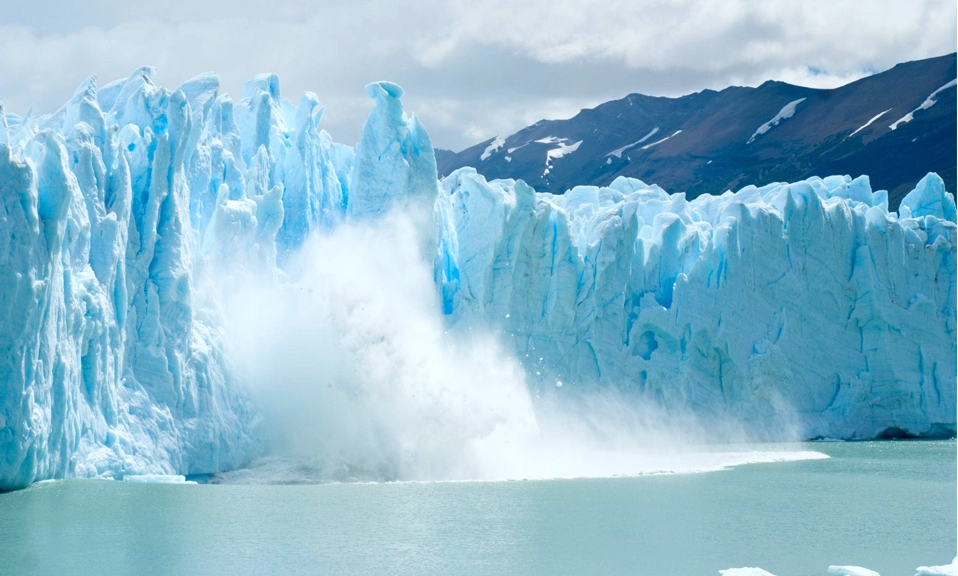
For 50 years, guides in El Calafate told the same story: while every other glacier in the world was retreating, Perito Moreno was defying climate change. It was stable. It advanced 2 meters a day. It dammed Lake Argentino and then dramatically ruptured.
That story is officially over.
In the last 100 days, Argentina’s most famous glacier lost almost a kilometer.
The Numbers That Shocked Glaciologists
On October 1, researchers confirmed what drone footage had been screaming for months:
Perito Moreno Glacier recorded a retreat of 910 metres from the Magallanes Peninsula between 24 February and 4 June — just 100 days.
This figure officially breaks the previous record of 750 meters of shrinkage, which was recorded in 1899 by explorer Rudolf Hauthal.
But the 100-day sprint is just the headline. The full picture from the Glaciarium and Los Glaciares National Park is worse:
- 1.46 km² lost in 197 days — Between November 2025 and June 2026, the glacier lost 1.46 km² of surface. That equals 44% of all the ice it has lost since 2018.
- 3.27 km² lost since 2018 — Total loss since May 2018, according to Copernicus Sentinel-2 satellite images captured on June 30, 2026.
- 0.8 km² in 97 days of summer + 0.65 km² in 100 days of autumn — documented by drone mosaics from 19-11-2025 to 04-06-2026.
To put it in local terms, LM Neuquén calculated that loss since 2018 is equivalent to 458 professional football fields, with 204 fields lost in just the last summer-autumn season.
As the graphic that went viral from Intriper put it: “EL PERITO MORENO RETROCEDIÓ CASI UN KILÓMETRO EN SOLO 100 DÍAS” — and the comment section exploded with people posting their own before-and-after photos from the walkways.
Why It Was Stable — And Why It’s Not Anymore
For decades, Perito Moreno was an anomaly. Its stability was due to geography: high-altitude location, heavy replenishment of ice, and a ridge of bedrock beneath it. That submarine moraine acted like a brace, keeping the front anchored in the Canal de los Témpanos and Brazo Rico.
That brace is now gone.
Scientists cite three linked causes:
1. Moraine decoupling: The front lost anchoring on the submarine moraine. Once it started floating in the Canal de los Témpanos, where bathymetry now shows depths up to 180m, it became vulnerable.
2. Accelerated thinning: From 0.34 m/year between 2000-2019 to 5.5 m/year between 2019-2024, and now up to 8 meters per year, according to Greenpeace Argentina‘s review of glaciologist data. Dr. Lucas Ruiz noted the glacier’s size no longer matches the current climate.
3. Warmer Patagonia: A 1.2°C rise in Patagonia’s summer temperature has tipped the balance where melting now exceeds accumulation.
The result is a feedback loop: thinner ice floats more, floating ice breaks faster, and the ice loss equates to large blocks continuously collapsing into the Rico Arm and the Témpanos Channel, altering the glacier’s balance which had remained stable over the last century.
What Tourists Are Seeing Right Now
The comparison that is blowing up on Threads right now says it all: a photo labeled “2015” shows the massive blue ice wall right up against the wooden walkways, packed with tourists. The same spot labeled “2026” shows the glacier as a distant white line — “now you need a boat to see it,” the caption says.
Greenpeace Argentina posted a carousel calling it out: while the glacier maintained equilibrium for decades, that scenario is now changing, and “protecting glaciers protects water, biodiversity and future.”
At Glaciarium in El Calafate, the scientific center that has flown drones since May 2025, the mood in comments is pure grief: “Dios mio que triste,” “en 2016 fui y estaba el hielo sobre la peninsula, es tremendo ver como retrocedió en 10 años.”
Even the World Meteorological Organization weighed in, naming a photo of Perito Moreno’s countless calving events as a winner of the 2026 WMO Calendar Photo Competition, noting the glacier has been undergoing dramatic changes and is now retreating.
Is It Irreversible?
Glaciarium’s latest research concludes the glacier entered an irreversible retreat since 2018, with 44% of surface loss since then occurring in just 197 days of 2026.
Perito Moreno was once the exception that climate skeptics pointed to — “Look, one glacier is still growing!” That exception has now become the warning.
If you are going to Los Glaciares National Park this season, go. Hear the thunder of calving that sounds like cannon fire. Stand on the walkway where 85 years ago Hauthal measured 750 meters of retreat and thought it was a record that would never be broken.
And understand that what you are watching is not just ice falling into a lake. It’s Patagonia losing its fortress, almost a kilometer at a time.