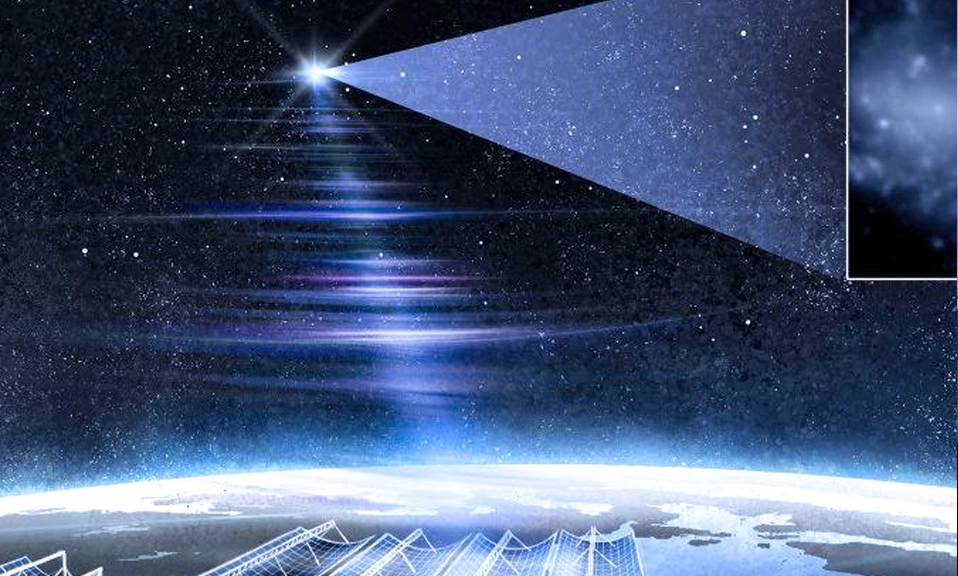
It lasted just a few milliseconds. It carried as much energy as the Sun releases in days. And when it finally arrived at Earth in March 2024, it had been travelling through the cosmos for more than 10 billion years — since a time when the Sun didn’t exist, the Earth didn’t exist, and no human had ever looked up at the sky.
Astronomers have now traced that signal to its source: a small, young galaxy in the early universe, located 10.6 billion light-years away. It is the most distant fast radio burst (FRB) ever detected and precisely localised — more than doubling the previous distance record.
The discovery, published October 8, 2026, in the journal Science, was led by researchers from the University of Sydney using South Africa’s MeerKAT radio telescope and NASA’s James Webb Space Telescope.
“This is an extraordinary glimpse into the distant Universe,” said Dr Manisha Caleb, the study’s lead author. “We have caught a fast radio burst from a time when the Universe was only about three billion years old, and we have used that brief flash of radio light to learn about the matter it has travelled through over billions of years.”
What Is FRB 20240304B?
The signal, designated FRB 20240304B, was detected on March 4, 2024, by the MeerTRAP system on the MeerKAT radio telescope in South Africa. The name follows a simple convention: the date of detection, and the fact that it was the second FRB found that day.
Fast radio bursts are among the most mysterious objects in astronomy. They are intense, millisecond-long pulses of radio waves that can emit as much energy in a fraction of a second as the Sun releases over several days. First discovered in 2007, thousands have been detected since — but their origins remain uncertain. Some theories point to magnetars, highly magnetised neutron stars formed when massive stars explode as supernovae. Others suggest different mechanisms may be at work.
What made FRB 20240304B immediately special was its dispersion measure — a metric that tells astronomers how much material the radio waves passed through on their journey to Earth. The signal had a dispersion measure of approximately 2,400 units, far higher than the typical few hundred. “With about 2,400 units of DM we figured it had to be coming from really far away,” Caleb said.
The dispersion arises because radio waves of different frequencies travel at slightly different speeds through the electrically charged matter that fills the space between galaxies. The more matter the signal passes through, the greater the dispersion. A measurement that high meant the burst had crossed a vast distance.
The Host Galaxy: A Surprise Waiting at the End
Pinpointing where the burst came from required a two-step process.
First, MeerKAT localised the signal to a precise position on the sky. Then, the team turned to ground-based telescopes like Keck — and found nothing. The host galaxy was simply too faint to see. It was only when they used the James Webb Space Telescope’s infrared instruments that a tiny galaxy appeared, right at the FRB’s position.
Webb’s NIRSpec instrument measured the galaxy’s redshift at 2.148 — a value that places the burst at a time when the universe was just 3 billion years old, roughly a quarter of its current age. The light had travelled 10.6 billion years to reach Earth.
But the real surprise was the galaxy itself.
Most FRB host galaxies are massive, star-forming systems. This one was not. It contains only about 10 million times the mass of our Sun — a thousand times less massive than typical FRB hosts, and a tiny fraction of the mass of our own Milky Way. It is a small dwarf galaxy, actively forming stars, with very low metal content.
“The galaxy hosting this burst is surprisingly small, metal-poor and undergoing a very active episode of star formation,” said Dr Laura Driessen, a co-author of the study. “That gives us an important clue about the environments in which FRBs are born and shows that these brief radio flashes can tell us not only about the distant Universe, but also about how galaxies and their stellar populations evolve.”
What This Tells Us About the Origin of FRBs
The host galaxy’s characteristics — low mass, low metallicity, active star formation — are a strong clue about what produced the burst.
The leading theory for FRB origins is that they come from magnetars — young, highly magnetised neutron stars left behind when massive stars explode as supernovae. The conditions in FRB 20240304B’s host galaxy are exactly what you’d expect for magnetar formation: a young, vigorously star-forming environment where massive stars are being born and dying.
“This provides fresh evidence that at least some FRBs may originate from young magnetars,” the researchers wrote. The alternative explanation — the merger of older neutron stars — would require a much older stellar population, which the host galaxy does not have.
But the team is careful not to overstate the case. “Whatever the mechanism that causes this radio burst has to account for the fact that it can be produced in very young galaxies with very low amount of metals,” said Dr Themiya Nanayakkara, another lead researcher. “I wouldn’t rule out having more than one way to produce an FRB.”
The Bigger Picture: Mapping the Invisible Universe
The scientific value of distant FRBs extends far beyond understanding what creates them.
When an FRB travels through space, its radio waves interact with the intergalactic medium — the thin, diffuse plasma that fills the vast spaces between galaxies. This matter is otherwise nearly impossible to observe directly. It doesn’t emit light. It doesn’t absorb light in any easily detectable way. But it does slow down radio waves, and the amount of slowdown tells astronomers exactly how much matter the signal passed through.
This makes FRBs powerful tools for probing what cosmologists call the cosmic web — the vast, invisible scaffolding of matter that forms the backbone of the universe. “The fun thing about FRBs is that we don’t need to know what is causing them to do some of the science we are doing now,” Nanayakkara said.
By studying FRBs at different distances, astronomers can build a three-dimensional map of the matter between galaxies — including the “missing matter” that is predicted by cosmological models but has proven extraordinarily difficult to find.
“This particular burst has been travelling for 80% of the age of the universe,” Nanayakkara added. Further detections of distant FRBs, he said, “would enable scientists to map unseen matter in the distant universe”.
The Human Perspective: A Signal Older Than the Sun
There is something almost vertiginous about the timescale involved.
Dr Caleb put it in human terms: “If you put this in human perspective, when the light left the source, the Sun didn’t exist, the solar system didn’t exist, no humans existed. Civilisation formed and we built radio telescopes and then we just happened to look at the right patch of sky at the right time.”
The burst was emitted 10.6 billion years ago. It travelled across the expanding universe, through galaxy clusters and cosmic voids, past stars that were born and died, through regions of space that would one day become the Milky Way, the solar system, and Earth. It arrived at a planet that didn’t exist when it began its journey.
And a radio telescope in South Africa caught it.
What Comes Next
The discovery of FRB 20240304B represents a milestone in the study of fast radio bursts — the most distant burst ever localised, and the first from a time when the universe was less than a quarter of its current age.
The researchers are already looking further. “In principle, sufficiently powerful bursts could be detectable from the very early Universe,” said Kavya Shaji, a PhD student and co-author of the study.
The next generation of radio telescopes — including the Square Kilometre Array (SKA), currently under construction in South Africa and Australia — will be far more sensitive than MeerKAT. If FRB 20240304B was detectable at this distance, even more distant bursts may be waiting to be found.
“The next step is to push this frontier,” said Professor Ben Stappers of the University of Manchester, a co-author and principal investigator of the MeerTRAP project. “What is particularly exciting about our result is that we’ve now demonstrated that we can identify and study an FRB from when the Universe was young.”
The signal travelled for 10 billion years. The next one might have been travelling even longer. And if the telescopes are ready, we might finally hear it.
The study, “A fast radio burst at redshift 2.148,” was published October 8, 2026, in Science.