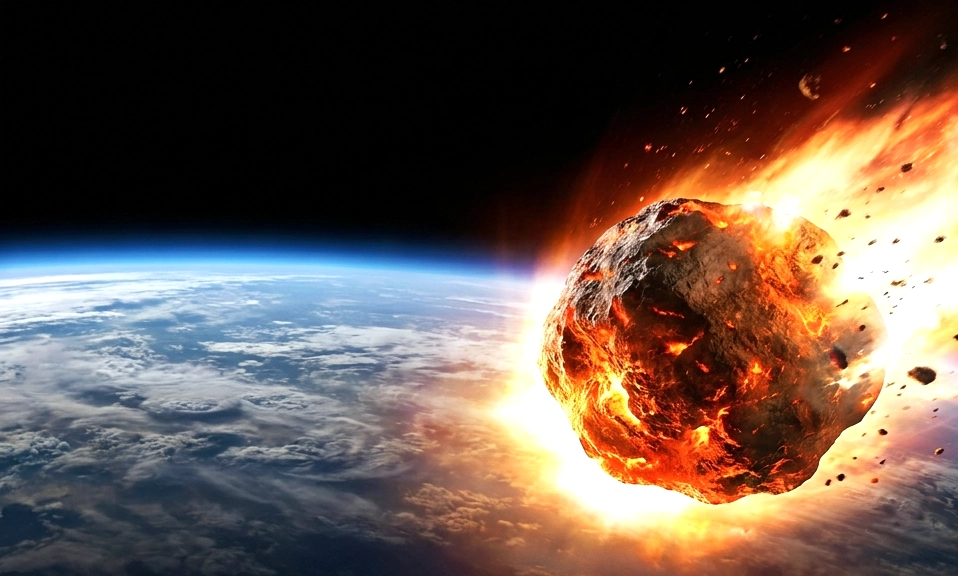
We’ve all seen the movies.
Astronauts drill into a space rock, plant a nuclear warhead, and blow it to smithereens just in time to save humanity. It’s a thrilling Hollywood trope. But if a truly massive, “unstoppable” asteroid were ever on a collision course with Earth, the reality would be far less cinematic, and far more terrifying.
When astronomers talk about an “unstoppable” asteroid, they aren’t talking about a shooting star or a small meteor that burns up in the atmosphere. They are talking about a Planet-Killer or Civilization-Ender: a rocky or metallic behemoth, often over 1 kilometer (0.6 miles) wide, traveling at cosmic speeds of 15 to 20 kilometers per second (roughly 33,000 to 45,000 mph).
If an object of that size and speed were to strike Earth, no amount of last-minute heroics could stop it.
Here is the cold, hard, scientifically grounded timeline of what would actually happen if an unstoppable asteroid ended up hitting Earth.
💥 1. The Impact: A Kinetic Bomb Beyond Comprehension
The danger of an asteroid isn’t explosives; it’s kinetic energy. The formula for kinetic energy is E=12mv2E=21mv2. Because velocity is squared, an asteroid’s speed makes it exponentially more destructive than its mass.
A 1-kilometer-wide asteroid hitting at 20 km/s would release energy equivalent to roughly 100,000 megatons of TNT. To put that in perspective, that is about 2,000 times more powerful than the largest nuclear weapon ever detonated (the Tsar Bomba).
The moment it hits the atmosphere, it wouldn’t just be a “rock.” It would be a blinding column of superheated plasma, outshining the sun.
🌪️ 2. The First Hour: The Blast Wave and Firestorms
If the asteroid strikes land, the immediate aftermath is apocalyptic.
- The Crater: A crater up to 15 miles wide and 3 miles deep would be excavated in seconds.
- The Shockwave: A wall of compressed air would radiate outward at supersonic speeds. Within a 100-mile radius, every building, forest, and human would be instantly flattened and vaporized.
- Thermal Radiation: The impact would superheat the atmosphere, igniting a ring of firestorms hundreds of miles wide. Anything flammable within line of sight of the impact would spontaneously combust.
If it strikes the ocean (which is statistically more likely, since oceans cover 71% of the Earth), the immediate blast is somewhat contained, but it triggers something else: megatsunamis. Waves hundreds of feet tall would radiate outward, devastating coastal cities across entire ocean basins within hours.
🌋 3. The First Week: The Sky Turns to Fire
The impact doesn’t just destroy the impact zone; it weaponizes the Earth’s crust.
Millions of tons of vaporized rock, dust, and debris would be blasted into the upper atmosphere and even into space. As this ejecta falls back to Earth, friction with the atmosphere would heat it to thousands of degrees. The entire sky would literally glow red-hot, raining down a global shower of molten glass and rock. This “re-entry heating” would ignite wildfires across entire continents, burning away forests and releasing massive amounts of carbon into the air.
❄️ 4. The First Year: The Impact Winter (The Real Killer)
The blast and the fires would be horrific, but they wouldn’t be what ends civilization. The true extinction mechanism is what happens next: The Impact Winter.
The combination of pulverized rock, sulfur aerosols, and soot from global firestorms would be injected into the stratosphere. Unlike normal clouds, this debris doesn’t wash away with rain. It would form a thick, global blanket, blocking out up to 90% of sunlight for months, or even years.
- Photosynthesis stops: Plants die. The base of the food chain collapses.
- Global freezing: Average global temperatures would plummet by 15°C to 20°C (27°F to 36°F), plunging the planet into a sudden, brutal ice age.
- Acid rain: The sulfur in the atmosphere would mix with water vapor, creating highly acidic rain that poisons remaining freshwater sources and strips the soil of nutrients.
This is exactly what wiped out the non-avian dinosaurs 66 million years ago. It wasn’t the initial blast that killed them; it was the starvation and freezing that followed.
🛡️ 5. Why Would It Be “Unstoppable”?
You might be asking: Don’t we have space programs to stop this?
Yes, we do. NASA’s DART mission (2022) proved we can alter the trajectory of a small asteroid. We also have concepts for nuclear deflection and “gravity tractors.”
But an asteroid becomes “unstoppable” under two conditions:
- It’s too big: Current deflection technology is only viable for asteroids under ~500 meters. A 1-kilometer+ object has too much momentum. Blowing it up with nukes might just turn one bullet into a shotgun blast of radioactive city-killers.
- We see it too late: If a large asteroid approaches Earth from the direction of the Sun, our ground-based telescopes are blinded by the glare. We might only get weeks, or even days, of warning. At that point, evacuation is the only (highly inadequate) option.
🌟 6. The Silver Lining: We Are Actually Looking Up
Despite the terrifying physics, there is a massive reason for optimism: We know where the big ones are.
Thanks to decades of dedicated sky surveys (like NASA’s Planetary Defense Coordination Office), astronomers have discovered and tracked over 95% of all Near-Earth Objects (NEOs) larger than 1 kilometer.
The verdict? None of them are on a collision course with Earth for at least the next 100 years.
The era of being caught completely off guard by a dinosaur-killing asteroid is largely over. Our focus has now shifted to finding the smaller, “city-killer” asteroids (140 meters and above), and we are getting better at that every year with upcoming missions like the NEO Surveyor space telescope.
A Cosmic Reality Check
The concept of an unstoppable asteroid is a sobering reminder of our place in the universe. We live on a fragile, thin layer of rock, sailing through a cosmic shooting gallery at 67,000 mph.
But it is also a testament to human ingenuity. We are the first species in the 4.5-billion-year history of this planet to look up, understand the threat, and actively build the technology to defend ourselves.
The dinosaurs didn’t have a space program. We do. And as long as we keep our eyes on the sky, the ultimate “unstoppable” force might just be human determination.