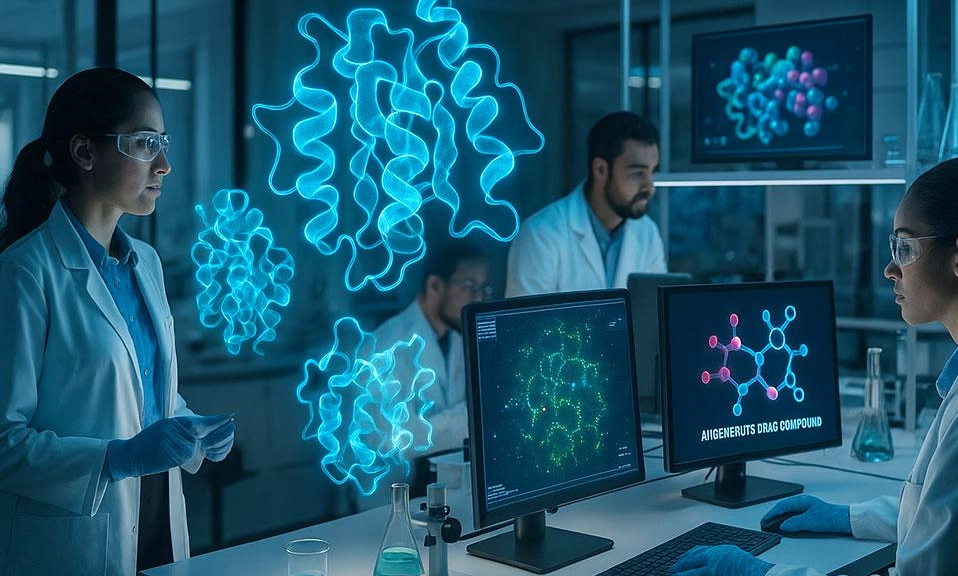
The traditional path of drug discovery is famously brutal: a decade of work, billions of dollars, and a failure rate that would deter anyone outside the pharmaceutical industry. A new British startup, however, is betting that the laboratory can be skipped entirely—or at least, dramatically bypassed. Potential Sciences, which launched on November 5, 2026, is building an AI model not on experimental data, but on computer-generated simulations of how molecules behave, derived from the fundamental laws of physics.
Backed by the UK government’s sovereign AI fund and Twin Path Ventures, the company has raised tens of millions in seed funding to pursue a radical idea: that the best training data for drug discovery isn’t the messy, incomplete record of past experiments, but a clean, physics-based simulation of reality itself. It is a bold, high-stakes gamble that could reshape how medicines are made—or become a cautionary tale about the limits of simulation.
🧬 The Problem: The Data Bottleneck
The core issue Potential Sciences is trying to solve is one of data scarcity. As the company’s founder and CEO, Hatem Helal, explained to WIRED, the models currently used in AI drug discovery have “already learned everything the existing record can teach”. That record—the accumulated results of decades of laboratory experiments—is finite, biased toward molecules that were easy to test, and woefully incomplete when it comes to the vast space of possible chemical compounds.
Potential Sciences’ solution is to generate its own data. The company plans to use physics-based simulations to model interactions first between individual atoms, then between small molecules, and eventually between complex amino acids and proteins. The goal is to create training datasets of unprecedented size and accuracy—datasets that, in theory, are not limited by what has been physically tested, but by the computational power available to simulate what could be.
🎯 The Goal: Fail Fast, Succeed Faster
The immediate objective is not to design a perfect drug, but to identify the ones that will fail before they ever reach a lab. “We want molecules that are never going to work in the clinic to fail fast,” Helal told WIRED. “That means having better predictors of how they will behave as they interact with human biology”.
If successful, the implications would be enormous. Early-stage drug discovery is a process of elimination, and the cost of each eliminated candidate is measured in months and millions. An AI that can reliably predict which compounds are dead ends would allow researchers to focus their resources on the candidates with the highest chance of success. Helal also argues that reducing the cost of experimentation could make it economically viable for pharmaceutical companies to pursue drugs for rare conditions that have previously gone untreated—moving medicine toward a future of “bespoke treatments” tailored to an individual’s unique biology.
⚠️ The Skeptic’s Case: The Accuracy Gap
The ambition is immense, but so is the scientific challenge. The central question, as WIRED notes, is whether Potential Sciences can predict how well drug candidates bind to disease-related proteins “as accurately as it hopes, which would require a marked leap forward”.
Peter Wolynes, a professor of chemistry at Rice University, offered a sobering assessment. While he expects the approach to yield “an improvement,” he cautioned that the current state of protein engineering is “at the level of the Romans, not of the Renaissance”. In other words, the computational methods required to simulate molecular interactions with the fidelity of a laboratory experiment are still in their infancy. The physics is understood, but the engineering of systems capable of applying that physics at the scale and accuracy required is an open problem.
This is not a reason to dismiss the effort—it is the reason the effort matters. If the technology works, it solves one of the most persistent bottlenecks in biomedical research. If it doesn’t, the company will have produced valuable tools and insights along the way.
🌐 A Growing Field, Not a Lone Bet
Potential Sciences is not operating in a vacuum. The broader field of “in silico” drug discovery is rapidly maturing, with several other startups pursuing complementary approaches.
Helical, a Luxembourg-based startup, raised $10 million in April 2026 for a “virtual AI lab” that turns biological foundation models into reproducible workflows for pharmaceutical companies, allowing scientists to test hypotheses computationally before committing to the wet lab. **Rivercell**, a Paris-based company, launched in October 2026 with $25 million to build a “world model of the cell” that predicts how human cells respond to drugs, reducing the need for physical experiments. Ten63 Therapeutics has raised over $45 million for its BEYOND platform, which uses quantum-chemistry simulations to pursue “undruggable” targets with an accuracy it claims is “nearing laboratory experiments”.
These companies are attacking the problem from different angles—some with physics, some with biological foundation models, some with proprietary data generation—but they share a common premise: that computational prediction can and should replace a significant portion of physical experimentation. The question is not whether this will happen, but how much of the lab it will replace, and how soon.
💎 Can AI discover new medicines
without traditional laboratory experiments? The honest answer is: not entirely, not yet, and perhaps never completely. The laboratory remains the ultimate arbiter of biological reality. But the work of Potential Sciences and its peers suggests that the laboratory’s role is shifting—from the primary site of discovery to the final stage of verification.
The bet is that a sufficiently accurate simulation can do the work of a thousand failed experiments, allowing researchers to arrive at the lab with candidates that are far more likely to succeed. If that bet pays off, the decade-long, billion-dollar journey of drug discovery could become faster, cheaper, and more equitable. If it doesn’t, the effort will still have pushed the boundaries of what computational chemistry can achieve.
Helal and his team are not trying to eliminate the laboratory. They are trying to make it the last step instead of the first. Whether that vision becomes reality will depend on physics, engineering, and the stubborn complexity of human biology. The simulation is running. The results are pending.