Be honest. How long is your Duolingo streak?
47 days? 200 days? 1,247 days and you would rather delete Instagram than break it?
If you have ever felt personally attacked by a green owl, you are not alone. In the second quarter of 2026 it reported 58.7 million people using it every single day, with 40+ languages and 280+ courses.
Duolingo is the biggest language app that has ever existed. It turned learning a language into a game. It made millions of people do five minutes of Spanish while waiting for coffee.
But here is the question nobody wants to ask after a 300-day streak:
Can you actually learn a language with it? Like, really speak it? Order food, make a joke, have a real conversation, survive a trip?
I have used it on and off for years, in Spanish and French. I have also watched people use it for 2 years and still freeze when a native speaker says “hola.” Here is the honest answer for 2026.
The Quick Verdict
Yes, Duolingo can teach you a language. No, Duolingo alone cannot make you fluent.
Duolingo remains the most effective piece of software ever built for getting someone to study a language for five minutes a day, and the free tier alone does that job.
That is its superpower. And its limit.
If you want to build a daily habit, learn vocabulary, and get to a solid beginner or intermediate level, it is brilliant.
If you want to hold an unscripted conversation, understand fast native speech, or live in another country, you need more than the owl.
What Duolingo Does Brilliantly
1. It Makes You Show Up
This is the part everyone underestimates.
Learning a language is not hard because it is complicated. It is hard because you quit after two weeks.
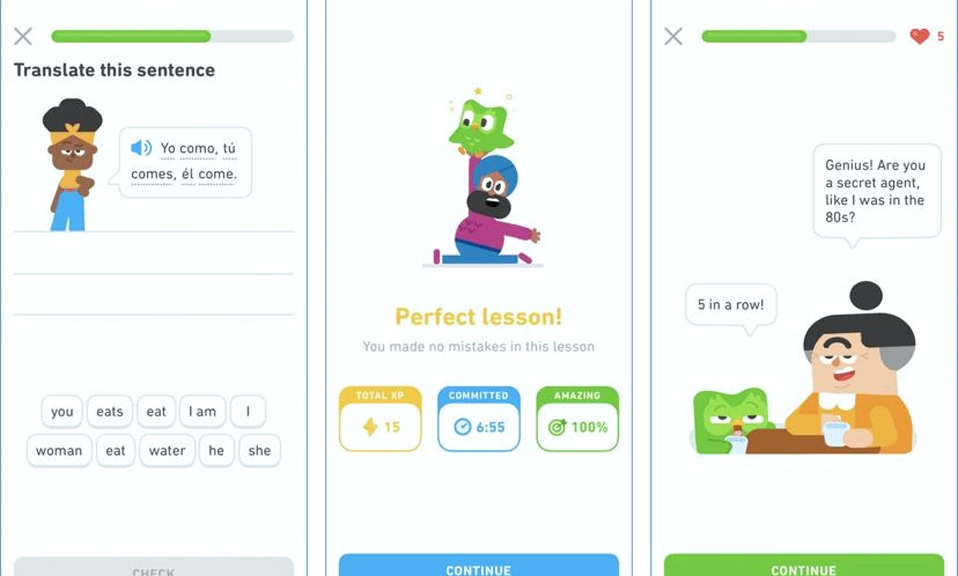
Duolingo solved quitting with gamification: streaks, XP, leagues, hearts, animations, and that slightly passive-aggressive owl who guilts you at 9pm. It is annoying. It works.
Duolingo invests meaningfully in learning science. Spaced repetition, interleaving, and retrieval practice are all baked into lesson design. You do not just see a word once. You see it, forget it, see it again, get it wrong, see it again. That is how memory actually works.
For a beginner, that structure is gold. You do not have to decide what to study. You just open the app and do the next lesson.
2. It Actually Works For Reading and Listening
The research is better than most people think, but with a big caveat.
A 2022 study in Foreign Language Annals found that adults who finished Duolingo’s Spanish or French material reached reading and listening levels comparable with university students after four semesters.
That is real. That is not “I learned 10 words.” That is four semesters of university reading and listening.
Since April 2026, Duolingo’s nine most popular courses teach content through B2, the CEFR’s “independent user” level. B2 means you can understand the main ideas of complex text, interact with a degree of fluency, and produce clear, detailed text on a wide range of subjects.
That is a huge upgrade from the old Duolingo that stopped at tourist phrases.
3. Max Finally Fixes Speaking, A Little
For years, Duolingo had one massive hole: speaking.
You could read “El gato bebe leche” 500 times, but you had never actually talked to anyone.
Duolingo Max, the premium tier that unlocks AI-powered Video Calls with characters like Lily and Falstaff, plus Roleplay conversations, is trying to fix that.
Max has the best AI conversation features in language learning, the Video Call with Lily genuinely feels like practicing with a patient native speaker, but it is a hard sell at $29.99 a month.
Is it perfect? No. Is it the first time Duolingo has actually let you practice a real conversation without embarrassment? Yes. For shy learners, that matters a lot.
What Duolingo Does NOT Do Well
1. It Will Not Make You Fluent Alone
Let’s say it clearly: Duolingo is excellent at getting you to practise every day. It is weaker at teaching the grammar and real-time speaking you need to hold a conversation.
An independent 2023 review concluded that “8 years after the start of research on Duolingo, we still have very little conclusive evidence about its effectiveness.”
And Duolingo’s own studies tested reading and listening, not open-ended speaking. That is why you can finish a whole course and still freeze when someone speaks fast.
Fluency also needs lots of listening to real speech and speaking with people. Duolingo can give you the foundation. It cannot give you the real-life reps.
2. The Energy System Made Free Way Worse
This is the controversy that blew up in 2025 and is still hurting Duolingo in 2026.
Through 2025 Duolingo began replacing the old Hearts system on mobile with a new one called Energy. The Energy system replaced the old hearts system. Every exercise drains energy, even if you answer perfectly. Free users can run out after just a few lessons and face waits of up to 18 hours to recharge.
One community poll of more than 11,000 learners found that nearly half disliked the change. Forum posts described people running out of energy before finishing two full lessons, even when they got everything right.
In other words, the better you do, the faster you get locked out. Unless you pay.
That is why the free experience in 2026 feels more frustrating than it did in 2023. It is still usable, but it is designed to nudge you toward paying.
3. It Teaches You To Translate, Not To Think
Duolingo loves translation exercises. “Translate: The dog is eating an apple.”
Real life does not work like that. Real life is messy, fast, and full of slang, mumbling, and interruptions. Duolingo’s sentences are clean. Real conversations are not.
If you only use Duolingo, you will be great at Duolingo. You will be less great at a real cafe in Madrid.
Pricing in 2026: Free, Super, or Max?
Here is the real breakdown:
Free – $0: The full course, with ads, and Energy limits. You can study any of the 40-plus languages without paying anything. Good for testing if you actually like the language. Bad if you want to binge study.
Super Duolingo – $13.99/month or $95.99/year: No ads, unlimited energy, offline mode, Legendary levels. Super Duolingo removes energy limits but adds no new curriculum. You are paying to remove friction, not to learn more.
Duolingo Max – $29.99/month: All Super features plus Video Call and Roleplay AI. Currently supports Spanish, French, German, Italian, Portuguese, Japanese, Korean, and Chinese.
My honest take:
Stay Free if you are just starting and not sure you will stick with it. Do 1-2 lessons a day. See if you still care in 30 days.
Get Super if you already have a 30+ day streak and the Energy system is killing your momentum. It is worth it for daily learners.
Get Max only if you will actually use the AI Video Call 3-4 times a week. Max is priced higher and is only worth it if you will use the AI speaking practice regularly; otherwise the money is better spent on a few sessions with a human tutor.
How To Actually Learn A Language With Duolingo
If you want to go from “I do Duolingo” to “I speak Spanish,” do this. This is the formula that actually works:
1. Duolingo for 15 minutes a day, max. Use it for vocabulary and habit. Do not make it your whole study plan.
2. Add real listening. Watch a show in your target language with subtitles in that language. Listen to a podcast. Even 10 minutes a day will train your ear for speed, which Duolingo cannot.
3. Speak to a human, even badly. Use Max’s Video Call, or use iTalki, Tandem, or a language exchange. One 30-minute conversation a week will do more for fluency than 100 Duolingo lessons.
4. Read something real. Not Duolingo sentences. A children’s book. Instagram captions. A menu. Real language is messy, and you need to get used to messy.
5. Learn grammar outside the app. Duolingo teaches grammar by example, not by explanation. If you do not understand why something works, look it up on YouTube or in a grammar book for 5 minutes. That 5 minutes will save you 5 weeks of confusion.
Duolingo is the gym membership. You still have to do the workout in the real world.
Duolingo vs The Alternatives
Duolingo vs Babbel: Babbel is better for grammar explanations and structured conversation lessons, especially for adults. Duolingo is better for habit and fun. If you hate Duolingo’s game style, try Babbel.
Duolingo vs Rosetta Stone: Rosetta Stone is immersion-only, no translation. It is slower and more expensive, but it forces you to think in the language. Duolingo is faster and free.
Duolingo vs Anki / Flashcards: Anki is better for pure vocabulary memorization if you are disciplined. Duolingo is better if you need someone to tell you what to do next.
None of them will make you fluent alone. All of them work if you combine them with real speaking.
So, Can You Really Learn A Language With It?
Here is my final answer, after all the research and all the streaks:
Duolingo can take you from zero to “I can read, I can understand the basics, I can survive a trip.” It can take you to B2 in reading and listening if you finish a course. That is a massive achievement.
It cannot take you to “I can have a deep conversation, make friends, work, and joke in this language” by itself.
But that is not Duolingo’s fault. No app can do that. Fluency is not an app. Fluency is a life.
What Duolingo can do, better than any app ever made, is get you to start. And keep starting, every day, for 100 days, for 500 days, until starting is no longer the hard part.
And if you are reading this because you are thinking about learning a language, that start is the hardest part of all.
So download it. Pick a language. Do one lesson today. Just one.
The owl is waiting.